





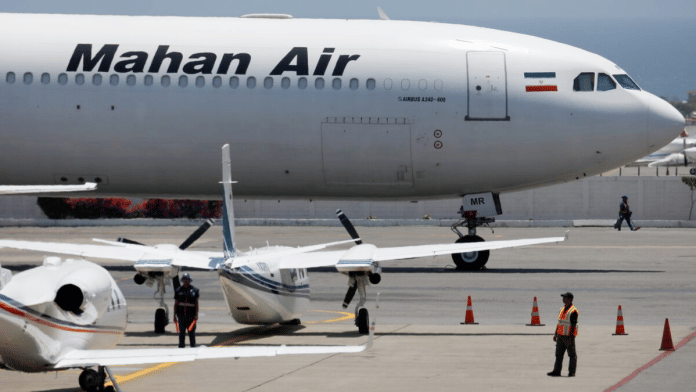



New Delhi: A plane owned by Iran’s privately owned Mahan Air scheduled to depart Mashhad for New Delhi Tuesday has been damaged Sunday in US airstrikes.
The Iranian aircraft was scheduled to reach New Delhi Wednesday morning to carry humanitarian aid back to the West Asian nation.
Diplomatic sources confirmed to ThePrint that the plane was scheduled to depart Mashhad Tuesday and was headed to pick up medicines from New Delhi. The medicines had been bought in India using funds donated by Indians throughout the month-long conflict, one of the sources told ThePrint.
The Iranian embassy in New Delhi has since the start of the war, received donations from Indians through bank accounts shared widely on social media. Last week, the embassy shared a quick response (QR) code, allowing donations to be wired directly to its bank accounts.
The source added that the flight was coordinated by the Iranian authorities. Iran is planning another flight in a few days to carry the medicines from New Delhi.
The war involving Israel, the US and Iran is now in its fifth week. The war has escalated in the last couple of weeks, with tit-for-tat strikes on energy and critical infrastructure by both sides. Iran Sunday struck a power and desalination water plant in Kuwait, which led to the death of one Indian national.
The region is home to almost 10 million Indians. Their safety, security and welfare remains the Government of India’s “utmost priority”, Aseem Mahajan, Joint Secretary (Gulf) in the Ministry of External Affairs (MEA), said at an inter-ministerial press briefing Monday.
“Yesterday an Indian national unfortunately lost his life in an attack in Kuwait. We express our deepest condolences to the family of the deceased…Eight Indian nationals have unfortunately lost their lives, and one Indian national remains missing,” he added.
The conflict has killed around 2,000 Iranians, including Supreme Leader Ayatollah Ali Khamenei on 28 February, so far. Iran, in retaliation, has struck targets around the region, with the six member-states of the Gulf Cooperation Council (GCC) facing the brunt of Tehran’s retaliation.
As of 25 March, over 4,300 missiles and unmanned aerial vehicles (drones) had been launched by Iran at Saudi Arabia, Oman, Qatar, Kuwait, Bahrain and the UAE. The war has led to the effective closure of the Strait of Hormuz, the international waterway that accounts for the supply of a fifth of the world’s total oil needs.
The effective closure has led to a spike in global oil prices, with the Brent futures benchmark touching $112 a barrel Monday. The price spike has seen the US waive sanctions on the sale of Russian and Iranian crude for 30 days, in an attempt to stabilise global oil markets. Crude already in transit from Russia and Iran can be bought by any country, according to the US sanctions waiver.
US President Donald Trump Sunday announced that Iran is set to allow 20 ships to exit the global choke point. No further details were given.
Trump has claimed for the last week that there are ongoing negotiations between the US and Iran through third parties. Pakistan has asserted that it has been conveying messages from the Trump administration to Tehran. However, Iran has rejected Trump’s 15-point proposal and outlined its own vision for peace.
The foreign ministers of Saudi Arabia, Egypt and Türkiye travelled to Islamabad over the weekend for further discussions to end the war. Pakistani Deputy Prime Minister and Foreign Minister Ishaq Dar is set to travel to China Tuesday to support Islamabad’s efforts to end the war.
As the conflict rages across West Asia, the US, which threatened to strike Iranian energy infrastructure, has given Tehran time till 6 April to strike a peace deal. This is the second extension issued by Trump.
Apart from striking at Iranian targets, Israel has also expanded its military operations in Southern Lebanon, in an effort to capture more land, leading to fears of a long-term occupation of the region by Tel Aviv. One United Nations Peacekeeper from Indonesia was killed in an Israeli strike in South Lebanon.
(Edited by Tony Rai)