





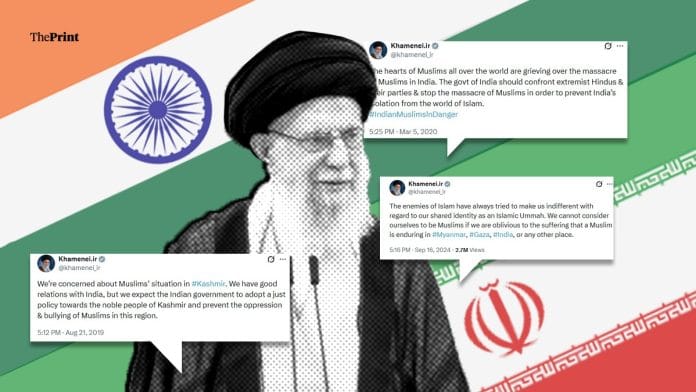



New Delhi: Even as India and Iran maintained strategic bilateral ties across sectors including energy cooperation, connectivity projects and regional diplomacy, the country’s Supreme Leader Ayatollah Ali Khamenei, who was killed in US and Israel airstrikes Saturday, was openly critical of the Indian government.
In August 2019, when India abrogated Article 370, Ali Khamenei posted on X, saying he was “concerned about Muslims’ situation in Kashmir”.
“We have good relations with India, but we expect the Indian government to adopt a just policy towards the noble people of Kashmir and prevent the oppression & bullying of Muslims in this region,” he added in his post.
His remarks drew a sharp reaction from the Ministry of External Affairs (MEA) which summoned then Iranian ambassador Iraj Elahi on 22 August 2019, and lodged a strong protest against the Supreme Leader’s remarks.
Then MEA spokesperson Raveesh Kumar, in a press statement, also said the comments were “completely unacceptable”, and emphasised that Kashmir is an internal matter for India.
Before that, in a 2017 Ramadan address, Ali Khamenei likened the situation in Jammu & Kashmir to conflicts in Yemen and Bahrain, drawing parallels with Muslim populations resisting what he described as “tyrants” and “external aggressors”.
He compared Kashmir to the Houthis’ fight against the Saudi-backed government in Yemen and to Bahrain’s Shia-led protests, which were suppressed by Sunni rulers with support from the Gulf Cooperation Council.
In March 2020, Ali Khamenei also made posts on X about the communal violence in northeast Delhi over the Citizenship (Amendment) Act. “The hearts of Muslims all over the world are grieving over the massacre of Muslims in India,” he posted on X.
“The govt of India should confront extremist Hindus & their parties & stop the massacre of Muslims in order to prevent India’s isolation from the world of Islam,” he added.
In response to the comments made by Tehran’s Supreme Leader, MEA summoned then Iranian Ambassador Ali Chegeni on 5 March 2020, and lodged a strong protest.
On 16 September 2024, on the occasion of the birth anniversary of the Prophet Muhammad (Eid-e-Milad-un-Nabi), Ali Khamenei posted expressed concern about the “suffering” of Muslims in various parts of the world, including India, Gaza and Myanmar.
The enemies of Islam have always tried to make us indifferent with regard to our shared identity as an Islamic Ummah. We cannot consider ourselves to be Muslims if we are oblivious to the suffering that a Muslim is enduring in #Myanmar, #Gaza, #India, or any other place.
— Khamenei.ir (@khamenei_ir) September 16, 2024
In an X post, he wrote, “The enemies of Islam have always tried to make us indifferent with regard to our shared identity as an Islamic Ummah.”
“We cannot consider ourselves to be Muslims if we are oblivious to the suffering that a Muslim is enduring in #Myanmar, #Gaza, #India, or any other place,” he added.
MEA spokesperson Randhir Jaiswal sharply responded to the statement by calling it “misinformed and unacceptable.”
He also said that Tehran should “look at their own record before making any observations about others,” referencing to the domestic protests in Iran following the death of Mahsa Amini.
(Edited by Ajeet Tiwari)