





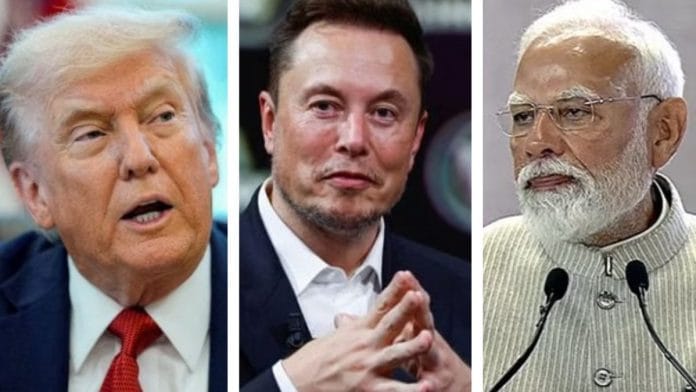



New Delhi: India Saturday said Prime Minister Narendra Modi “only” spoke with US President Donald Trump during their 24 March call—but stopped short of denying that billionaire Elon Musk was physically present while the two heads of state were conversing.
The statement from the Ministry of External Affairs came in response to a New York Times report published Friday that Musk had participated in the call.
“We have seen the [NYT] story. The telephone conversation on 24 March was between Prime Minister Narendra Modi and President Donald Trump only. As has been stated earlier, it provided the opportunity for exchange of views on the situation in West Asia,” MEA spokesperson Randhir Jaiswal said.
The statement rules out any role for Musk—founder of SpaceX—in the conversation itself, but leaves unaddressed whether he was in the room while the US President was talking to PM Modi. The White House has not made any clarification on the report.
Neither side’s public readout of the call made any mention of Musk’s presence. The NYT report described Musk’s supposed participation as an “unusual appearance by a private citizen on a call between two heads of state during a wartime crisis”. It noted that Musk’s presence suggested the SpaceX founder, who had a falling out with Trump last year, has been able to repair ties with the American President.
The 24 March call—which Trump dialled—was the first between the two leaders since the US and Israel jointly struck Iran at the end of February. The month-long conflict has sent shockwaves through global energy and fertiliser markets, with Brent crude climbing to $112 a barrel, nearly 50 percent above its level a month ago, and Iran’s effective closure of the Strait of Hormuz tightening supply further.
PM Modi has called for “de-escalation and restoration of peace” in the region. Trump, who has been publicly asserting that negotiations with Iran are under way to end the war, used the call to keep Modi abreast of developments. But Tehran insists there are no direct talks with Washington.
Third countries have, however, been relaying messages between the two sides. Pakistan publicly acknowledged it has conveyed American positions to Iran; Prime Minister Shehbaz Sharif held an hour-long call with Iranian President Masoud Pezeshkian earlier Saturday.
The conflict has hit India’s energy supply lines at a particularly sensitive spot. Qatar—India’s largest source of liquefied natural gas (LNG)—has seen Iranian retaliatory strikes damage output at its Ras Laffan production facilities, disrupting roughly 17 percent of its LNG exports.
Six member-states of the Gulf Cooperation Council (GCC)—Saudi Arabia, the United Arab Emirates, Kuwait, Qatar, Oman and Bahrain—have borne the worst of Tehran’s retaliation, with over 80 percent of Iran’s missiles and drones targeting them.
To temper the price shock, Trump has eased sanctions on both Iran and Russia, freeing both countries to sell crude oil already at sea to buyers worldwide.
India, which imports a majority of its oil and gas supplies, is expected to be among the worst affected countries if the West Asian conflict continues for long.
Modi has now spoken to both the US and Iranian presidents, but New Delhi has given no indication it intends to position itself as a mediator. Washington, meanwhile, is weighing deploying additional ground troops to the region, adding another layer of uncertainty to how long the war will last.
Also Read: Gulf war exposed India’s fragilities. It’s time for navel-gazing, in the national interest