





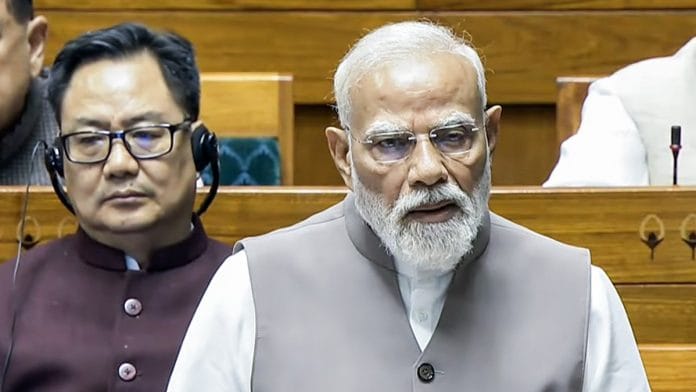



New Delhi: Prime Minister Narendra Modi Monday said in the Lok Sabha that India “must be prepared to face the long-term impact” of the war in West Asia.
“Due to this war, the conditions of the world are set to remain difficult for a long time. Therefore, we must be prepared to face the long-term impact, we must stand united. We have faced such challenges even during the (COVID-19) pandemic. We now have to be ready once again. We have to face each challenge with patience,” Modi said in his address on the West Asia conflict to the Indian Parliament.
The Prime Minister added: “When such problems arise, some elements try to take advantage of it. All our law enforcement agencies are on alert. Be it coastal security, border security, cyber security, or strategic installations—for all, security is being strengthened.”
Modi added that obstructing international waterways such as the Strait of Hormuz is “unacceptable”, while announcing that India “opposes any attacks” on civilian, energy and transport infrastructure.
Prime Minister Modi called for “dialogue and diplomacy” to end the current conflict, highlighting that every effort by New Delhi in the West Asian war will be focused on reducing “tensions and to end this conflict”.
This is Modi’s clearest statement yet on the war. For over three weeks, the US, Israel and Iran have been locked in a conflict that has been escalating in the last few days. A result of the war has been the disruption of the flow of energy to the global markets due to the situation in the Strait of Hormuz. While Iran has said that the strait is open for vessels of non-combatant nations, very few ships have been allowed to travel through the international waterway.
Two ships carrying liquefied petroleum gas (LPG) reached India’s western shores last week after negotiations between New Delhi and Tehran. Two more ships are currently on their way to India carrying LPG.
“India is continuously striving for the safe passage of Indian ships in this environment of war through diplomacy. India has always raised its voice for the benefit of humanity and for peace. I would like to reiterate that dialogue and diplomacy are the solution to this problem,” said Modi.
‘Challenges for India’
The PM added: “Even for India, this war has created a number of challenges. These challenges are economic, national security, and human rights… India has trade relations with the West Asian nations. The area in which the war is taking place is an important link between India and other countries of the world. This area supplies a large part of our needs for crude oil and gas.”
A fifth of global oil supplies emanates from West Asia and passes through the Strait of Hormuz. For India, the region is an important source for liquefied natural gas (LNG). Qatar alone supplies almost 40 per cent of India’s LNG imports. Last week, attacks on the Ras Laffan industrial city in Qatar by Iranian missiles and unmanned aerial vehicles destroyed refineries that were producing roughly $20 billion worth of LNG exports per annum.
The impact of the war has increased fears of energy shortages across India. The Prime Minister announced that there are roughly 53 lakh metric tonnes of strategic petroleum reserves, while pointing out that the petroleum companies have their own reserves.
“The government is also in constant contact with suppliers from different countries. We are trying to ensure the safety of our ships, including oil, gas, and fertilisers. We are continuously communicating with our international partners to ensure the safety (of our maritime corridors.) Due to such efforts, many of our ships, which were almost stuck in the strait in the past few days, have arrived in India,” said Modi.
The Prime Minister announced that the government has diversified its energy basket in the last decade, with energy imports emanating from 41 countries flowing into India today, from about 27 previously.
This diversification is a part of the government’s strategy to ensure minimal disruption during periods of challenge, the Prime Minister indicated. Modi is clear that the government will focus on ensuring little disruption for domestic consumers, especially with regards to the production of LPG.
“Due to uncertainty in its supply, the government has prioritised the domestic use of LPG. In addition, LPG production is also being increased in the country. The supply of petrol and diesel has been continuous throughout the country,” said Modi.
The Indian government has not so far raised the prices of petrol and diesel in the country. The Brent futures benchmark for crude oil has seen a 40 per cent increase in the last three weeks, crossing $108 a barrel Monday.
Fears remain over an increase in crude oil prices, as US President Donald J. Trump has promised to “obliterate” Iranian power plants if Tehran does not open the Strait of Hormuz. Iran has promised to hit energy and critical infrastructure around the region, if the US carries through with its threats.
Around 10 million Indians also live in West Asia, Modi said. Around 3,75,000 Indians have returned to the country. So far, six Indians have died during the conflict. Three Indians perished in an attack on a vessel early on during the war, while two more passed away in Oman and most recently an Indian was killed in the Saudi capital of Riyadh.
(Edited by Viny Mishra)
Also Read: Iran says Hormuz open, but vessels linked to US & Israel ‘don’t qualify for non-hostile passage’
India’s West Asia policy needs to be better aligned with our enduring, very substantial , widely dispersed, economic equities. I2U2 does not reflect them.