








New Delhi: India has not “lost” Bangladesh yet, given the role New Delhi played in its creation, Congress Member of Parliament Manish Tewari has said Monday.
The former Union minister highlighted that the Bangladesh interim government’s grouse with former Prime Minister Sheikh Hasina should not impact New Delhi-Dhaka ties.
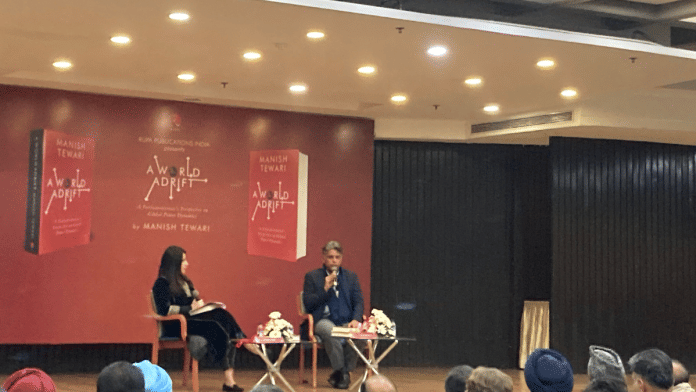
“Have we lost Bangladesh? My answer is no. We invested blood and treasure in creating the country called Bangladesh. Our former Prime Minister Indira Gandhi, 25 years after partition, redrew the map of South Asia and created a new country,” Tewari said at the launch of his latest book, ‘A World Adrift’.
“I don’t think that reality is lost to the people of Bangladesh…You have an interim government that is belligerent to India. For the life of me, I am unable to understand why. They may have a grouse with the previous government [led by Hasina], but to extrapolate that to the rest of India, it makes no sense,” he told India Today managing editor Marya Shakil.
The conversation and book launch happened at New Delhi’s India International Centre (IIC). Former Union Minister for External Affairs Yashwant Sinha launched the book.
Tewari, a three-term parliamentarian from Punjab and the union territory of Chandigarh, described a gap he’s found during his tenure—the lack of “literature” on what constitutes India’s neighbourhood first policy.
An unstarred parliamentary response almost six years ago by V. Muraleedharan, former Minister of State in the Ministry of External Affairs, highlighted that the policy would ensure India would “walk an extra mile” for its neighbours, Tewari said.
“What really are the contours of India’s neighbourhood first policy, I could not find any real literature on it,” he pointed out, urging the Indian government to go back to the “drawing board” especially if the neighbourhood is considered as New Delhi’s “eminent domain.”
However, the neighbourhood has seen a sea of change in the last seven years. In 2022, Sri Lanka witnessed a change in regime after it declared bankruptcy, Hasina was ousted from power in Dhaka in 2024, while a regime change took place in Kathmandu last year.
All of these changes were partly due to protests, be it due to the failing Sri Lankan economy in 2022, or the student-led demonstrations against Bangladesh’s quota in public sector jobs for veterans from the 1971 Liberation War, or Prime Minister K.P. Oli’s attempted imposition of a law on social media restrictions in Nepal.
Tewari pondered whether any understanding of what truly led to these protests exist, highlighting that the “weaponisation” of social media helped spread the protests and led to the ouster of various leadership in the region.
“Sri Lanka, Bangladesh and Nepal you saw regime change taking place due to weaponisation of social media that tapped into grievances that could be real…The footprint of the government on the ground is a light footprint…You’ve seen three regime changes in South Asia over the past four years now….Nobody has gone into the fact into these grievances,” he explained.
Referring to former US Secretary of State Hillary Clinton’s memoir ‘Hard Choices’, the Congress MP pointed out that a number of individuals were better educated in how to use social media as a part of their campaigns, indicating that the reasons for such changes in the neighbourhood could be more than currently understood.
At the same time, Tewari made it clear that he is not inferring a US hand in any of the protests.
The vast changes in the neighbourhood have led changes in India’s approach to each of the countries. For instance, Maldives elected President Mohamed Muizzu, who campaigned extensively against India, in 2023. However India’s concerted efforts in 2024 and 2025 have resulted in normalisation of the ties.
Similarly with Sri Lanka, New Delhi has stepped in with emergency loans to help Colombo tide over the financial crisis and, most recently, was a first responder following Cyclone Ditwah.
However, ties with Dhaka remain tense. Bangladesh has taken exception to India sheltering Hasina following her ouster. Dhaka has sought the former Prime Minister’s extradition, a request India has confirmed that it has received.
Also Read: In Dhaka for Khaleda Zia’s funeral, Jaishankar meets Tarique Rahman and Pakistan Assembly speaker
‘Unprecedented’ times
On the challenges facing the global order, Tewari highlighted that the last year was “unprecedented”, especially due to the actions of the US President. Donald Trump’s return to the White House last January has seen a churn in international relations.
“After what happened on 6 January (the US Capitol attack), there was a feeling that the current president would not come back to become president again.What you see in the last year is unprecedented,” he said.
“There is a flux and a vacuum that opened up. Who is going to fill it up…The real challenge is going to be Greenland and whether NATO survives…We survived Covid, I think we will survive the next three years.”
Comparing Trump’s approach to his predecessor Joseph Biden, Tewari highlighted that the 46th President of the US was an “internationalist” who tried to strengthen the global order through NATO as well as his strong support for Ukraine. Trump has taken differing positions on the Russia-Ukraine war, pushing for a negotiated end, while applying pressure on Kyiv to accept Moscow’s demands.
The situation in Ukraine is a “travesty,” Tewari said, but described the challenge as one for Europe to step up and handle. “How much will the Europeans stand up to the peace plan? How much would Ukraine be forced to give?”
(Edited by Tony Rai)
Also Read: Trump’s ‘Donroe Doctrine’, the Western Hemisphere, and unravelling of the global order