





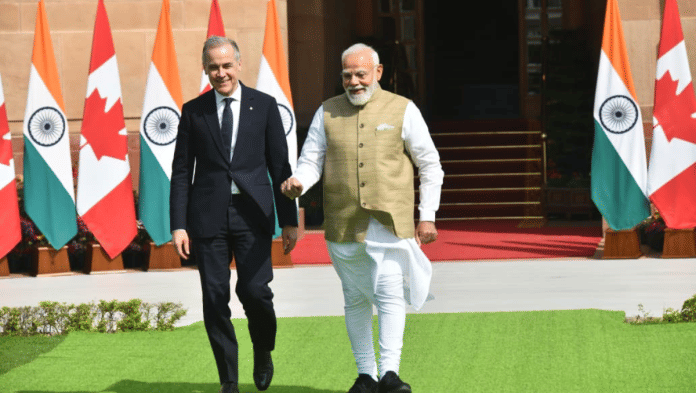



New Delhi: India and Canada agreed Monday to cooperate in their fight against “terrorism, extremism and radicalisation” as Prime Ministers Narendra Modi and his Canadian counterpart, Mark Carney, sought to reset ties amidst increasing geopolitical turmoil.
“We agree that terrorism, extremism and radicalization are shared and serious challenges not only for both countries, but for all humanity. Our close cooperation against them is crucial for global peace and stability,” Modi said in a press statement in the national capital.
Carney is the first Canadian prime minister to have a bilateral visit to India in eight years. Ties nosedived almost three years ago after over allegations by Ottawa of “interference” in its affairs by New Delhi.
India has consistently raised what it calls the space given to Sikh separatists by the Canadian administration, an irritant in ties that was raised publicly at the highest levels by then prime minister Justin Trudeau in September 2023.
Trudeau accused Indian agents of being linked to the killing of Hardeep Singh Nijjar in Surrey, British Columbia. Nijjar, an Indian-designated terrorist, was killed outside a gurdwara in June 2023. India rejected the allegations, calling them absurd and motivated.
“It is more than renewal of the partnership, it is the expansion of ties between two confident countries charting our future together…We both know that nostalgia is not a strategy. Those who succeed in this new area will be those with confidence to create a more inclusive and sustainable future for all our citizens,” Carney said in his statement Monday.
The Canadian prime minister made no mention of foreign interference or transnational repression by Indian authorities during his four-day visit to Mumbai and New Delhi.
Addressing the joint press meet with PM Mark Carney of Canada.@MarkJCarney https://t.co/p0PVHPlw0k
— Narendra Modi (@narendramodi) March 2, 2026
The two leaders agreed to set ambitious goals, including concluding negotiations for a comprehensive economic agreement (CEPA) by the end of this year, and signing memorandums of understanding in areas such as critical minerals and renewable energy cooperation.
Modi and Carney agreed to double trade between the two countries to $50 billion by 2030. Total trade in goods and services between India and Canada currently stands at $30.8 billion.
The visit comes as Ottawa continues to grapple with the US strategy of imposing trade tariffs. Canadian exporters are extremely dependent on the US markets for their merchandise exports. Almost two-thirds of Ottawa’s exports are to US markets.
Carney has sought to reduce Canada’s economic dependence on the US by finding new markets. The Canadian prime minister travelled to China earlier this year to seek a fairer trading relationship with strong guardrails.
In India, Canada has sought a strategic partnership, with the two sides establishing a defence dialogue Monday. The two countries also announced a long-term supply agreement of uranium concentrate worth $2.6 billion.
“In Civil Nuclear Energy, we have made a landmark deal for long-term uranium supply. We will also work together on small modular reactors and advanced reactors. Value addition in agriculture, agri-technology and food security are our shared priorities. In this direction, India-Canada Pulse Protein Centre of Excellence will be established in India,” said Modi.
PM Modi labelled the growing defence ties as a “symbol of the maturity of our deep mutual trust and relations.”
Just a little over a year ago, India expelled six Canadian diplomats and withdrew six of its own from the North American nation.
Questions surrounding the killing of Nijjar remain. On the eve of Carney’s visit to India, senior Canadian officials had highlighted that New Delhi’s “interference” in its affairs had ceased.
Recent media reports from Canada, however, suggest that interference continues, indicating the delicate balance Carney faces domestically as he opens diplomatic relations with India.
However, the Canadian prime minister struck a positive tone in New Delhi, commending Prime Minister Modi’s stewardship of the Indian economy and even quoting Swami Vivekananda in his statement to the press.
The two leaders also agreed to deepen the partnership in space between India and Canada. Another major agreement signed during the visit is the trilateral Australia-Canada-India Technology and Innovation Partnership (ACITI).
The ACITI, first launched by the three prime ministers Modi, Carney and Anthony Albanese of Australia – on the margins of the G20 last year, has identified areas for further engagement, including the development and deployment of artificial intelligence and industry cooperation.
(Edited by Sugita Katyal)