








New Delhi: India Thursday called for a stop to attacks on civilian and energy infrastructure even as Israel and Iran continued to strike energy sites in West Asia.
The statement marks a significant shift as India hasn’t explicitly called out Israel over the almost three-week war in West Asia. The latest statement, however, does not directly name either Tehran or Tel Aviv.
“India had previously called for the avoidance of targeting civilian infrastructure, including energy infrastructure, across the region. Recent attacks against energy installations in different locations across this region are therefore deeply disturbing and only serve to further destabilise an already uncertain energy scenario for the whole world,” Randhir Jaiswal, the official spokesperson for the Ministry of External Affairs, said in response to media queries.
He added: “Such attacks are unacceptable and need to cease. India had previously called for the avoidance of targeting civilian infrastructure, including energy infrastructure, across the region. Recent attacks against energy installations in different locations across this region are therefore deeply disturbing and only serve to further destabilise an already uncertain energy scenario for the whole world. Such attacks are unacceptable and need to cease.”
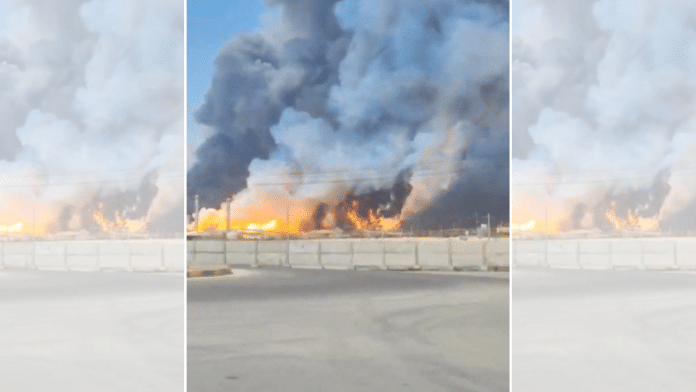
On Wednesday, Israel struck the largest natural gas field in Iran—South Pars—which led to Iran targeting energy infrastructure in Qatar, Saudi Arabia and the United Arab Emirates.
US President Donald Trump distanced his government from the Israeli strike in a statement late Wednesday, declaring that Tel Aviv did not inform America of the strike. Trump further urged Iran to stop targeting energy infrastructure in the region, else a large-scale US retaliation would be likely.
QatarEnergy late Wednesday announced that its Ras Laffan liquified natural gas manufacturing centre was struck by Iranian missiles, damaging the site, leading to further curtailment of the production of energy.
Qatar is a key source of Liquefied Natural Gas (LNG) imports for the Indian market. Estimates indicate that roughly 40 percent of India’s LNG imports emanate from Qatar.
The UAE also shut down the Habshan gas field as a result of the Iranian strikes. The strikes on regional energy infrastructure has led to an oil price spike. The Brent futures benchmark for crude oil jumped to $112 a barrel Thursday morning, but has since fallen a little.
Oil prices have surged roughly 50 percent globally since the US-Israel-Iran war began on 28 February. A joint Israeli-US attack killed the Supreme Leader of Iran, Ayatollah Ali Khamenei. Since then a number of senior Iranian leaders have been targeted and killed including Ali Larijani, Iran’s security chief, who was killed earlier this week.
Tel Aviv’s strikes on Iranian energy infrastructure have faced some pushback within the US. Israel had struck oil fields surrounding Tehran, which was mildly criticised by Senator Lindsay Graham, one of Tel Aviv’s most ardent supporters in the US Congress.
The war has seen the closure of the Strait of Hormuz, which has further impacted global energy supply. Two Indian ships carrying LPG finally reached India earlier this week, following negotiations between New Delhi and Tehran.
A number of Indian ships remain in the Strait, which is considered to be a global choke point, accounting for roughly a quarter of the total flow of global energy supplies.
(Edited by Gitanjali Das)