





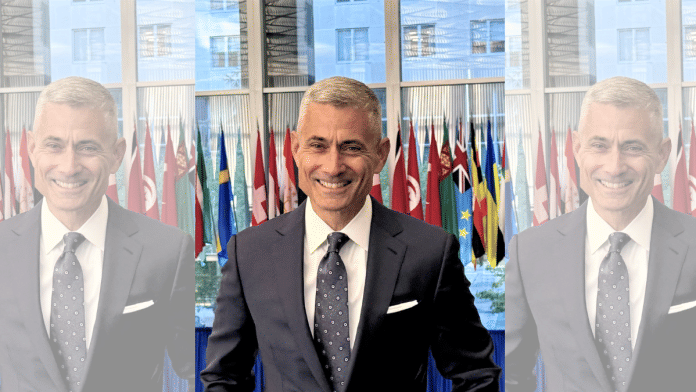



New Delhi: An “independent and strong India” represents a “strategic win” for the United States in its efforts to counter China’s rise in Asia, US official S. Paul Kapur told lawmakers Wednesday.
Kapur, Assistant Secretary in the Bureau of South and Central Asian Affairs (SCA) of the US State Department, appeared before the House Foreign Affairs Committee to outline Washington’s South Asia policy, consistently emphasising India’s centrality to US strategic thinking.
He cited changes to New Delhi’s “civil nuclear legislation” and the recently signed ten-year defence framework as evidence of positive momentum in bilateral ties.
Kapur was referring to SHANTI Bill 2025, which opened India’s nuclear energy industry to private sector investments, and the defence cooperation pact agreed on by New Delhi and Washington last year.
“Well, an India that can be independent and stand up for itself and preserve its freedom of action, works to our strategic advantage and promotes our strategic interests. What we are trying to do fundamentally is to not keep China out of the region, but to prevent China or any single hegemon from taking over or imposing coercive leverage on the region,” Kapur said.
He added: “So, an India that is able to be independent and preserve its freedom of action, takes a huge swathe of the Indo-Pacific off of China’s plate, and almost by definition, prevents it from becoming the dominant power in the region.”
The one-hour hearing painted a picture of robust strategic partnership between India and the US, despite months of diplomatic chill over trade disputes and other issues.
Kapur stressed that even as trade uncertainties persisted in recent months, cooperation in other areas continued unabated. “Despite some of the uncertainties surrounding the trade relationship in recent months, our other initiatives and efforts with India have continued forward – defence, energy, technology and so on… We also have some potential purchases of weapons systems in the pipeline, that will help India protect itself better, ensure its sovereignty, and also create American jobs,” he said.
When pressed on India’s role in countering China’s Belt and Road Initiative (BRI), Kapur highlighted that when New Delhi “develops its economy and its infrastructure and its military independent of China, and is able to maintain its freedom of action, it prevents the Chinese from using the Belt and Road strategy in a big swathe of the Indo-Pacific”.
The current US focus, he said, is to “strengthen” India’s “wherewithal” to maintain its “independence from China”.
In his opening statement, Kapur also described Pakistan as “another important partner in the region”, highlighting US efforts to help Islamabad realise its potential in critical mineral resources while noting strong counter-terrorism cooperation between the two countries.
Large parts of the hearing focussed on Afghanistan, following the Trump administration’s decision to halt immigration from the nation. After Kabul fell to the Taliban on US withdrawal of forces from the country in 2021, the American previous administration had allowed Afghans who aided the US-backed regime to emigrate to America—a programme now discontinued.
Also Read: Modi government’s trade deal with US resembles an IMF bailout
Trade tensions resolved
Last week, India and the US announced the conclusion of an interim agreement for a trade deal that will see New Delhi eliminate or reduce tariffs on numerous American goods in exchange for an 18 percent reciprocal tariff rate, down from the punishing 50 percent imposed by President Donald Trump.
Congresswoman Sydney Kamlager-Dove, ranking member of the House Foreign Affairs Committee, described Trump’s earlier tariff policy as one that caused a “needless rupture in bilateral ties that sacrificed decades of painstaking trust-building” with India. A ranking member is the senior-most member of the minority party–in this case, Democrats–on a committee.
Kapur quickly turned the conversation to the India-US trade agreement, calling it a “historic framework” while pivoting to Washington’s broader “strategic capacity building” in South Asia, including “defence cooperation, targeted investment and diplomacy”.
“India with its size, location and commitment to a free and open region anchors South Asia and more broadly, the western half of the Indo-Pacific. The United States and India maintain high-level diplomatic touchpoints… and cooperate closely in the defence, technology and energy sectors, bilaterally and also through the Quad…Following the trade framework President Trump reached last week with Prime Minister Modi, we can now focus on other priorities, lowering barriers to trade with one of the largest economies in the world and opening the way to even more fulsome cooperation,” Kapur said.
Recent diplomatic strains
Political ties between India and the US nosedived last year after Trump took credit for mediating the ceasefire that ended the 87-hour conflict between New Delhi and Islamabad in May. India has maintained it arrived at the cessation of hostilities through a bilateral understanding with Pakistan after meeting its objectives for Operation Sindoor, which was launched in the aftermath of the Pahalgam terror attack.
Months later, Trump imposed punitive tariffs of 25 percent on India for its continued purchase of Russian oil. Last week, he removed those tariffs after asserting that New Delhi had committed to purchasing zero Russian oil in future, a claim that the Indian government is yet to officially respond to.
Kapur said the two sides are still working out a “mechanism” to measure India’s continued curtailment of Russian oil purchases. “The Indians have been reducing their purchases of Russian oil and diversifying away, which is what we wanted them to do. They have been buying more US energy and I think a promising possibility is to substitute US energy for Russian energy, and buying from other places in the world as well,” he said.
(Edited by Prerna Madan)
Also Read: Indians expecting equal benefits from India-US trade deal are missing power realities