








New Delhi: President Donald Trump and the US for the last couple of weeks had been pushing Pakistan to broker a ceasefire with Iran, despite the American leader’s public rhetoric of grave escalation, according to the Financial Times.
The Trump administration “pushed the idea of a temporary ceasefire with Iran even as Donald Trump escalated threats against the Islamic republic and claimed it (Iran) was ‘begging’ for a deal,” people familiar with the development told the British newspaper.
“For weeks, the Trump administration was leaning on Islamabad to convince the Iranians to agree to a pause in fighting where it would reopen the Strait of Hormuz, the people said. Pakistan’s crucial role, as a Muslim-majority neighbour and intermediary, was to sell it to Tehran,” the British newspaper reported.
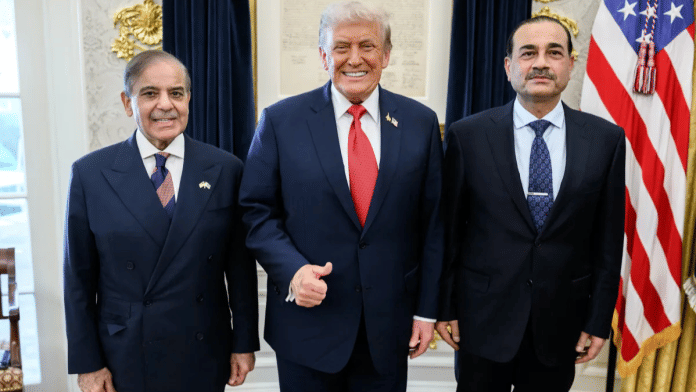
Pakistan’s chief of armed forces Field Marshal Asim Munir led the back-channel efforts which culminated in the announcement of a ceasefire Tuesday between the US, Iran and Israel. Both the US and Iran are set to send delegations to Islamabad over the weekend to open direct negotiations to find a long-term solution to the war before the end of the ceasefire.
The ceasefire has lasted roughly longer than a day, but the US, Israel and Iran all have vastly divergent views on the terms and conditions negotiated by Pakistan. The Iranian leadership has said that its 10-point plan is the “agreed framework”, while White House Press Secretary Karoline Leavitt told reporters that the proposal from Tehran is a “workable basis” from which the two sides can begin negotiations.
Iran and Pakistan both announced that Lebanon is a part of the ceasefire, a position rejected by both the US and Israel. Tel Aviv has continued its strikes on Lebanon, with Wednesday becoming one of the deadliest days of clashes with Hezbollah, leaving over 150 Lebanese dead.
“Trump, worried about surging oil prices and surprised by a resilient Iranian regime, was eager for a ceasefire since at least his first threat on March 21 to ‘obliterate’ Iran’s power plants, according to five people familiar with the Pakistan-led back channel,” said the Financial Times report.
The Iranian regime, despite facing a number of losses in leadership over the course of the five-week war, was able to maintain a chokehold on the Strait of Hormuz, the global waterway chokepoint that accounts for roughly a fifth of the world’s energy supplies.
Tehran was able to continue launching missiles and drones across the region, hitting US allies and major oil producing countries, which further led to spikes in the price of oil, worrying the Trump administration, as the US is months away from a mid-term election, which is expected to be closely fought between the Republicans and the Democrats.
“Shortly after Trump issued his first ultimatum to open the strait, Munir and other senior Pakistani officials began passing messages between Iranian political and military figures and the White House. They pitched Islamabad as a venue for a peace summit, shared a US-drafted 15-point proposal and then Iran’s five- and 10-point responses, and raised options for ceasefires ranging from 45 days to two weeks,” reported the British newspaper.
The report added: “The two sides remained far apart in their demands, but Iran, over time, became more amenable to diluting and accepting limits on its stockpile of uranium, two regional diplomats said. After weeks of heavy US and Israeli bombardment, Seyed Abbas Araghchi, Iran’s Foreign Minister, and other political leaders in Tehran had agreed to a temporary ceasefire-for-Hormuz deal in principle days ago.”
However, the delay was due to the political leadership waiting on the Islamic Revolutionary Guard Corps (IRGC) to give its assent to the deal. Some elements of the IRGC were against any ceasefire, indicating fractures within the all-powerful political and military force which remains a key pillar to decision-making in Tehran.
Despite the ceasefire being in effect, reports suggest that little has been done by Iran to fully open the Strait of Hormuz. In fact, as a part of its 10-point proposal, Iran is seeking American recognition of Tehran’s right to charge tolls to ships passing through the global chokepoint.
The contentious proposal has found little support across the board. Iran has used its ability to control the navigation across the Strait to allow only ships from countries it considers “friendly” to pass through international waterway over the last five-weeks.
All eyes are now on the negotiations scheduled to be held at Islamabad over the weekend. The US team will be led by Vice President J.D. Vance, along with Special Envoy Steve Witkoff and Jared Kushner, Trump’s son-in-law.
(Edited by Ajeet Tiwari)
Also Read: US-Iran ceasefire LIVE UPDATES: Israel says it has killed nephew of Hezbollah chief Naim Qassem