





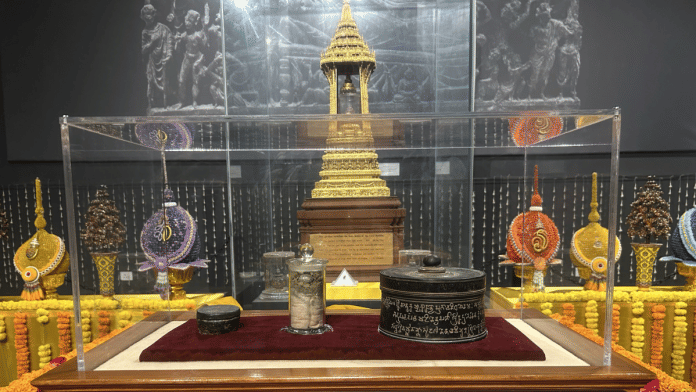



New Delhi: As Sri Lanka received the Devnimori relics of Lord Buddha Wednesday, it became the first country to host them.
The relics, among India’s most sacred Buddhist treasures, reached Colombo with full state honours aboard a special Indian Air Force (IAF) flight, accompanied by a high-level delegation led by Gujarat Governor Acharya Devvrat and Deputy Chief Minister Harsh Sanghavi.
The relics were enshrined for public veneration at the Gangaramaya Temple, one of Sri Lanka’s most important Buddhist institutions.
“This is a rare blessing for Sri Lanka,” Mahishini Colonne, Sri Lanka’s ambassador to India, wrote on X, calling the exposition the first international display of the Devnimori relics.
A rare blessing for Sri Lanka. 🪷
The sacred Devinmori Relics of Lord Buddha on exposition at Gangaramaya Temple in #SriLanka – the first ever international exposition of the relics.
Grateful to the Government of India and all those who made this possible. https://t.co/v5QOfUPfNY
— Mahishini Colonné (@Mahishini) February 1, 2026
For a country where Buddhism shapes national identity, political culture and daily life, the exposition marks a deliberate move of Indian diplomacy.
As Theravada Buddhist tradition traces its roots to Sri Lanka, the exposition reinforces a civilisational bond that predates modern nation-states. Buddhism remains central to Sri Lankan public life, influencing education, politics and national symbolism, and India has increasingly foregrounded this shared heritage in its engagement with Colombo.
The Devnimori relics originate from an archaeological site near Shamlaji in Gujarat’s Aravalli district, where excavations in the late 1950s uncovered a Buddhist stupa dating to the early centuries of the Common Era. Inscribed caskets and ritual objects found at the site are believed to contain bodily remains of the Buddha, lending the relics religious significance.
Also Read: The story of the Piprahwa relics, sacred Buddhist artefacts discovered by the British in 1898
Buddhist diplomacy & China
Moreover, the timing is unmistakable, as the relics’ journey comes just days after India hosted a Global Buddhist Summit in New Delhi. India also announced plans, in its national budget, for a comprehensive development programme for Buddhist sites across six northeastern states of Arunachal Pradesh, Sikkim, Assam, Manipur, Mizoram and Tripura, where Theravada, Mahayana, and Vajrayana traditions are dominant.
Assam, Mizoram, Tripura have dominantly Theravada tradition, while Arunachal Pradesh and Sikkim follow Vajrayana. The tradition of Mahayana is present in Manipur.
“The exposition acts as a powerful instrument of soft power, fostering deeper people-to-people connections, enhancing mutual trust, and complementing formal diplomatic engagements with a profound cultural and emotional resonance,” a Press Information Bureau (PIB) statement on the exposition noted.
“It reaffirms India’s role as a responsible custodian of global Buddhist heritage and strengthens regional harmony in the Indian Ocean neighbourhood, while reinforcing Sri Lanka’s place as a valued partner in India’s vision of peace, stability and cooperative coexistence in South Asia.”
It is important to note that the Second Global Buddhist Summit, which was held 24-25 January, was an expansion from its inaugural edition in 2023. Organised by the International Buddhist Confederation and the Ministry of Culture, the summit was a clear move to position Buddhism as a pillar of India’s regional diplomacy.
Addressing the gathering, Culture Minister Gajendra Singh Shekhawat described India as a custodian of Buddhist wisdom, bridging ancient traditions with contemporary global challenges. The message reflected a decade-long strategy to rebuild civilisational links across Asia and to deploy Buddhist diplomacy as a source of soft power.
Prime Minister Narendra Modi has frequently emphasised a personal and spiritual connection with the Buddha, rooted in his birthplace Vadnagar, an ancient center of Buddhist learning, and Sarnath, where the Buddha delivered his first sermon.
However, the strategy also has a clear external dimension, i.e., China.
Beijing has invested heavily in projecting its own Buddhist heritage, weaving temples, academic institutions and religious exchanges into its Belt and Road Initiative (BRI). Despite its officially atheist political system and a history of repression during the Cultural Revolution, it has sought to position itself as a cultural center of Buddhism, particularly in East and Southeast Asia.
India’s response has been quiet but no less calculated. It has done the same by sharing relics that carry unparalleled religious authority.
In a major diplomatic and spiritual gesture, India sent the sacred Piprahwa Buddha relics to Bhutan for a 17-day exposition in November last year. The relics, discovered in Uttar Pradesh, were enshrined at the Tashichhodzong in Thimphu to celebrate the 70th birth anniversary of the Fourth King of Bhutan.
In 2024, India sent the relics for a 26 day exposition to Thailand. The next year, it repatriated the Piprahwa Buddhist relics found in the Nepal border from Hong Kong, marking homecoming after 127 years.
Add to that, India’s hosting of the Dalai Lama. The Tibetan spiritual head has repeatedly attended Buddhist events which have been called out by China.
In November 2011 when India hosted the Global Buddhist Congregation to mark the 2,600th anniversary of the Buddha’s enlightenment, it was the first major Buddhist conference held in the country in over 50 years. The Dalai Lama’s participation in the event was objected to strongly by the Chinese, who cancelled border talks that were scheduled for the same month.
Similarly, in March 2017, the Dalai Lama was invited to inaugurate a seminar on ‘Buddhism in the 21st Century’ in Rajgir, Bihar. Beijing had then urged New Delhi to “respect its core concerns and avoid China-India relations from being further disrupted and undermined”.
When the Dalai Lama visited Tawang, a town revered by Buddhists as the birthplace of the Sixth Dalai Lama, in April 2017, the trip again drew a sharp reaction from Beijing.
Chinese officials viewed the visit as politically sensitive given its implications for the question of the Dalai Lama’s eventual reincarnation. Under regulations issued in 2007, China’s State Administration for Religious Affairs asserts the authority to approve the next Dalai Lama.
(Edited by Tony Rai)
Also Read: Battle over Dalai Lama’s reincarnation is a geopolitical contest with global implications