





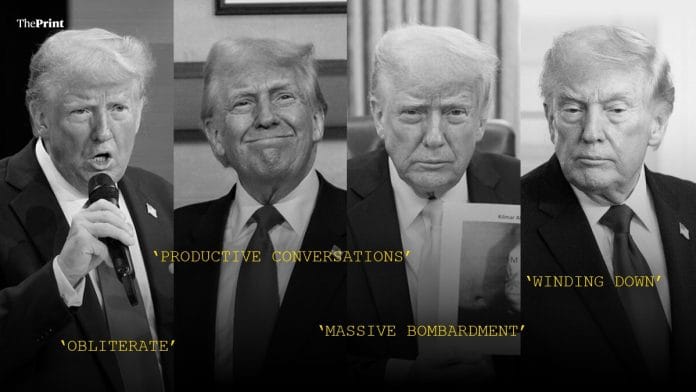



New Delhi: Nearly a month into the West Asia conflict, US President Donald Trump’s approach to Iran has been anything but consistent: declaring that operations were “winding down” last week, threatening “massive bombardment” of energy infrastructure this week, and then claiming “productive” talks towards a “total resolution” were underway.
On Wednesday, Tehran offered a sharp reaction to that oscillation. Washington, Iran said, was “negotiating with itself”. The assessment came from Lt. Col. Ebrahim Zolfaghari, spokesperson for Iran’s military, who said on state television, “Have your internal conflicts reached the point where you are negotiating with yourselves?”
“People like us can never get along with people like you. As we have always said… no one like us will make a deal with you. Not now. Not ever,” he added.
The war itself began with a diplomatic reversal.
Oman officials, who were mediating talks between the US and Iran in Geneva, had said just days before the current conflict began that “peace was within reach”. International media reported Oman officials as saying that Iran had agreed to making several concessions to reach a nuclear deal with the US.
Nonetheless, on 28 February, the US and Israel launched strikes on Iran—in a shift that the Trump administration and Tel Aviv described as an act to neutralise Tehran’s missile capabilities and nuclear ambitions.
Negotiations, thereby, ended before they could take shape.
In the weeks that followed, Trump’s tone was confrontational. The US President warned publicly that Iran’s closure of the Strait of Hormuz—central to shipping and a driver of escalating oil prices—would trigger further strikes by the US.
He threatened “massive bombardment” of Iranian energy infrastructure if access was not restored, and pushed for an international coalition to maintain the Strait’s security. No European allies came aboard.
Then the posture shifted briefly.
As oil prices shot up, markets around the world tanked and most of West Asia felt Iran’s wrath, Trump indicated that the US may soon be “winding down” the operation.
It hasn’t, and the Pentagon has deployed additional forces to the region.
The last weekend saw the President issue a 48-hour ultimatum to Iran to reopen the Strait of Hormuz to all vessels, failing which the US would “obliterate” Tehran’s power plants.
Just as the deadline was looming, Trump announced on Truth Social this Monday that the US and Iran had held “very good and productive conversations regarding a complete and total resolution” of hostilities, and he’d ordered the American military to postpone strikes against Iranian energy infrastructure for five days.
Washington, according to a New York Times report, has since transmitted a 15-point proposal to Tehran on its nuclear programme, ballistic missile capabilities, regional activities and reopening of maritime routes.
Publicly, Iran has taken a defiant stand.
Iranian officials quoted by state broadcaster Press TV dismissed the US’s proposal as unrealistic and excessive—“inconsistent with the reality of its defeat on the battlefield”.
They also accused the US of using diplomacy as cover for escalation, pointing to two previous occasions—the 12-day conflict in June 2025 and the current one—when talks were followed by military action against Iran.
A senior political-security official, speaking through state media, said Tehran would end the war only on its own terms.
“We will continue to defend ourselves until these conditions are fulfilled. Iran will end the war when it decides to do so—not when Trump intends it to end,” the official was quoted as saying.
Iranian Parliament speaker Mohammad Ghalibaf offered a more sceptical reading of the diplomatic signals. Trump’s talk of negotiations, he suggested, was aimed at calming volatile oil markets. He added that Iran was closely monitoring American troop movements.
Zolfaghari, in his state television appearance, said: “The strategic power you used to talk about has turned into a strategic failure. Don’t dress up your defeat as an agreement. Your era of empty promises has come to an end.”
Complicating the conflict is the question of Israel. Prime Minister Benjamin Netanyahu has indicated that Israel is prepared to continue its military campaign regardless of any US-Iran agreement, saying that the country would “safeguard their vital interests under all circumstances”.
(Edited by Prerna Madan)
Also Read: India should be worried. The Iran crisis gives Pakistan the validity it craves