





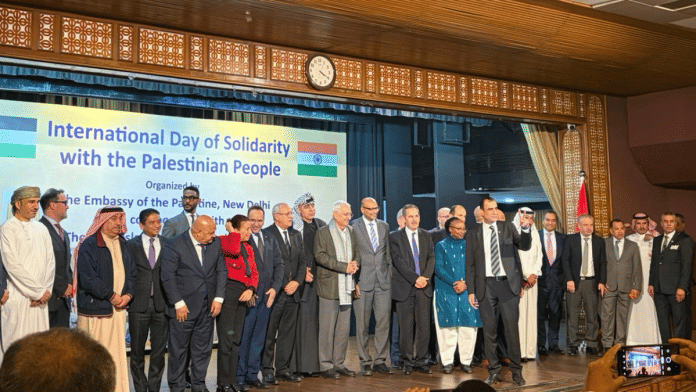



New Delhi: India’s “principal position” on issues concerning the Palestinian people has manifested in consistent actions over decades and remains unchanged, Prime Minister Narendra Modi highlighted on the International Day of Solidarity with the Palestinian People.
“Terrorism must be condemned and development must be prioritised. It is important that the Palestinian people are able to lead a normal life,” said the message released Wednesday.
The Prime Minister’s message was read by Indian envoy Acquino Vimal, who is also Joint Secretary of UN Economic and Social Division-India, at an event in New Delhi that featured senior diplomats, Arab ambassadors as well as United Nations officials.
The International Day of Solidarity with the Palestinian People is observed 29 November to commemorate the anniversary of Resolution 181, which called for the partition of Palestine into separate Arab and Jewish states.
Stressing that New Delhi sees development partnership as the “central pillar” of its engagement, Modi’s message added that India’s implementation of “people-centric projects, in accordance with the needs and the demands of the Palestine people,” reflects its “enduring vision to be a reliable partner in fulfilling their developmental aspirations.”
India, the message noted, has “joined hands with the UN and its agencies” to advance these efforts. It reiterated India’s long-standing view that “dialogue and diplomacy are the best options to find lasting and sustainable solutions to conflicts,” adding that “a window of opportunity has now opened up” for renewed international engagement.
The Palestinian ambassador to India, Abdullah Abu Shawesh, in his remarks, noted that India and Palestine’s relations began more than eight centuries ago with the arrival of an Indian Sufi (read, Hazrat Farid ud-Din Ganj Shakar also known as Baba Farid) in Jerusalem and the establishment of India Hospice.
“India supported the Palestinians during the 1936 revolution, opposed the 1947 partition plan or 181 resolution, recognized the PLO (Palestine Liberation Organisation) in mid-1970, and the State of Palestine in 1988. It has since invested in development, state building, and today we are in discussion in the recovery and reconstruction of Gaza,” he said.
“This is a relation rooted not only in diplomacy but in presence, culture, and shared struggle.”
Re-development amid a shaky peace plan
Speakers at the event drew on religious, historical and political references to situate the present crisis within a broader narrative of identity, displacement and global responsibility. Opening remarks recalled the ancient journey of Abraham from Ur of the Chaldeans—modern-day Iraq—described in the Old Testament as a long sojourn “in the land of the Philistines.”
The United Nations Resident Coordinator in India, Angela Lusigi, delivered the U.N. Secretary-General António Guterres’ statement, describing the past two years in Gaza as a period of “horrific suffering.”
The statement warned that the crisis in the West Bank and East Jerusalem—marked by settlement expansion, demolitions and intensified military operations—remains acute. It also highlighted the deaths of hundreds of humanitarian workers, mostly Palestinian UN staff, the largest loss of personnel in UN history.
“In so many ways, this tragedy has tested the norms and laws that have guided the international community for generations…The recent ceasefire offers a glimmer of hope. It is now vital that all parties, respected fully, and work in good faith towards solutions that restore and uphold international law. This includes returning the remains of hostages from the 7th October attack, promptly, and in a dignified manner, to grieving families in Israel,” she added.
Arab diplomats, led by the Ambassador of Morocco, Mohamed Maliki, who is also the Dean of the Arab Diplomatic Corps in India, situated the crisis within decades of stalled political efforts.
Citing the 1974 Arab Summit in Morocco, which recognised the PLO as the sole legitimate representative of the Palestinians, he argued that the international community now faces a moral obligation to confront settlement expansion, forced displacement and attacks that risk turning the conflict into a religious one.
“Recently, we have witnessed unacceptable attacks on targets involving our brotherly countries also. Such acts do not contribute to ease intentions, nor stabilising the region, but, instead, increase conflicts. To establish peace in the region, we must all continue to support and enable the Palestinian people to realise their legitimate rights and aspirations and for the states to enjoy their total rights on their land,” he said.
Israel and Hamas in October signed a US brokered peace plan which led to an uneasy ceasefire. Hamas Wednesday said it would hand over another set of hostage remains, as Israel announced it will begin allowing Palestinians to leave Gaza through the Rafah crossing—signs the American-backed ceasefire is largely holding despite disputes over earlier returns.
Under the US-brokered plan, a 20-point roadmap is expected to follow the exchanges, including an international stabilisation force, a technocratic Palestinian government, and the disarmament of Hamas.
The ceasefire agreement requires the long-closed Rafah crossing to reopen for medical evacuations and limited travel. The World Health Organisation (WHO) says more than 16,500 wounded or ill people need to leave Gaza for treatment. Israel says only exits will be permitted; Egypt insists movement must be two-way.
Twenty living hostages and the remains of 26 others have been returned since October. Israel and Hamas have repeatedly accused each other of violating terms. Israel says some remains were partial or misidentified; Hamas says recovery is difficult amid Gaza’s destruction.
The war began with Hamas’ 7 October attack that killed about 1,200 people and led to 251 hostages being taken. Gaza’s Health Ministry reports over 70,100 Palestinians killed, about half of them women and children.
(Edited by Tony Rai)
Also Read: As Gaza peace plan takes shape, does India have a role?