





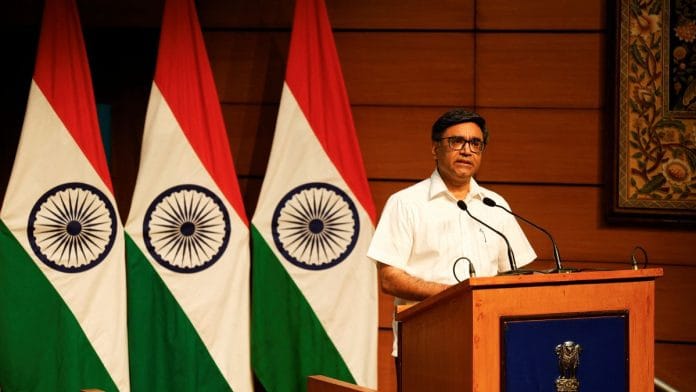



New Delhi: Foreign Secretary Vikram Misri is representing India at the summit convened by the United Kingdom Thursday to look at political and diplomatic measures to reopen the Strait of Hormuz. The UK is also looking at marshalling its defence forces to ensure the security of the global waterway once the current conflict in the Gulf ends.
“In the talks hosted by the United Kingdom, we have been invited. The Foreign Secretary is representing India at the meeting…With regards to the other initiatives, we are following all the developments, particularly with regards to this conflict,” Randhir Jaiswal, the official spokesperson for the Ministry of External Affairs said at a regular press briefing Thursday.
Around 35 countries were invited to the virtual meeting by the United Kingdom. The talks were billed as the opening efforts towards building a coalition to ensure security in the Strait of Hormuz, once the current conflict ends.
British Prime Minister Keir Starmer in an address to the nation the previous day had highlighted the talks as a part of the UK’s efforts to ensure the future security of the international waterway.
“And today I can announce that later this week, the Foreign Secretary will host a meeting that brings those nations together for the first time, where we will assess all viable diplomatic and political measures that we can take to restore freedom of navigation, guarantee the safety of trapped ships and seafarers, and resume the movement of vital commodities,” Starmer said in the address Wednesday, adding that the UK will “convene” its military planners to ensure the security of the Strait once the “fighting has stopped”.
The Strait of Hormuz has been effectively closed since the conflict between the US, Israel and Iran began on the last day of February. Iran has maintained the effective closure as a part of its larger strategy of raising the costs of war for the US and Israel.
Helmed by the British Foreign Secretary Yvette Cooper, London has made clear that the focus of the coalition is diplomatic measures rather than military action to resume trade through the global choke point.
Cooper, at the start of the talks Thursday had said that Iran has hijacked an “international shipping route to hold the global economy hostage,” as reported by the BBC.
The Strait of Hormuz accounts for roughly 20 percent of the global supply of oil. The US-Israel joint strikes on Iran kickstarted the conflict that has continued for almost five weeks, and has led to price spikes in crude oil.
Liquefied natural gas and liquefied petroleum gas supplies have also been hit during the course of the war. US President Donald J. Trump in an address to the nation late Wednesday evening called on other countries to secure the Strait, as America does not “use” the international waterway.
A number of countries including Japan, Australia, France and Germany had signed a joint statement in mid-March calling on Iranian authorities to allow the free navigation of ships through the choke point. They are all expected to take part in the UK-convened virtual discussions apart from India’s Foreign Secretary.
The price of Brent crude has jumped from around $70 a barrel before the conflict to over $100 Thursday. The spike led to the US easing sanctions on both Russian and Iranian crude already at sea, in an attempt to ensure global supply.
However, the continuation of war has led to further fears of shortages. For India, six ships have been allowed safe transit through the Strait of Hormuz so far, following negotiations between New Delhi and Tehran.
Prime Minister Narendra Modi has held conversations with Iranian President Masoud Pezeshkian. Modi also spoke to President Trump towards the end of March over the current situation in West Asia.
The region accounts for a large share of India’s energy needs, especially for LNG. Qatar accounted for roughly 40 percent of all of India’s LNG imports. QatarEnergy has issued a force majeure on its contracts due to the ongoing conflict.
(Edited by Amrtansh Arora)
Also Read: How Iran choked Strait of Hormuz & why it’s not easy to break the blockade