





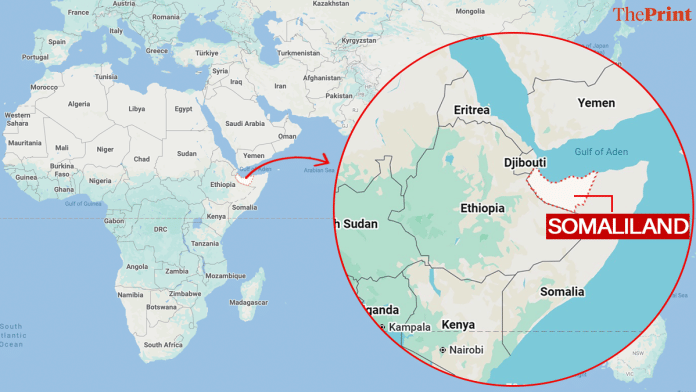



New Delhi: Israel’s recognition of Somaliland—its first formal international recognition as a sovereign and independent state—has triggered far-reaching diplomatic ripples, especially in Africa and the Middle East.
Israeli PM Benjamin Netanyahu announced the decision Friday, a day before Somalia was set to assume the rotating presidency of the United Nations (UN) Security Council. Somalia has reacted angrily to the development, with the foreign ministry statement remarking that this was a “deliberate attack” on its sovereignty that would undermine peace in the region.
Significantly, the US is also at odds with ally Israel on the matter. President Donald Trump, in an interview to the New York Post, said he does not support the recognition of Somaliland, adding: “Does anyone know what Somaliland is, really?”
A number of other countries have condemned the move with regards to Somalia’s breakaway region. A joint statement by more than 20, mostly Middle Eastern or African countries, and the Organization of Islamic Cooperation (OIC), flagged “serious repercussions of such unprecedented measure on peace and security in the Horn of Africa, the Red Sea and its serious effects on international peace and security as a whole”.
Syria also opposed it separately, as has Palestine.
The European Union (EU) has also backed Somalia. The bloc reaffirmed “the importance of respecting the unity, the sovereignty and the territorial integrity of the Federal Republic of Somalia,” which is “key for the peace and stability of the entire Horn of Africa region,” EU foreign affairs spokesperson Anouar El Anouni said in a statement.
The EU also pushed for “meaningful dialogue between Somaliland and the Federal Government of Somalia to resolve long standing differences”.
The UN Security Council plans to call an emergency session Monday to discuss Israel’s move. Somaliland President Abdirahman Mohamed Abdullahi has said the development, which comes after “more than three decades of peaceful self-governance, constitutional order and democratic practice,” affirms “an objective reality that has long existed”.
So where exactly is Somaliland? What is its significance and what is its current status? ThePrint explains.
‘Republic of Somaliland’
Somaliland is a self-governing region located in the Horn of Africa, on the southern coast of the Gulf of Aden. Djibouti lies to its northwest, and Ethiopia to its west and south.
It runs along the southern coast of the Gulf of Aden, perched at the approach to Bab el-Mandeb strait which links Red Sea to the Indian Ocean. Though Somalia recognises it as part of its territory, the region has its own flag, government and currency.
In the 19th century the ‘Scramble for Africa’ left the Somali people under five different imperial administrations.
With the British mainly focused on port access and trade, administering the North via indirect rule, the South was developed as a plantation economy under Italian rule.
British Somaliland gained independence as the state of Somaliland in June 1960; it was recognised by 35 countries, including the US and the UK. In July, the Italian-administered South followed suit. The state of Somaliland voluntarily united with the South to form the Somali Republic. Development aid and trade were thereafter centralised in Mogadishu.
A Constitutional Referendum was held in 1961 on a new constitution drafted in the South, overwhelmingly rejected by the North.
The deepening divide peaked under President Siad Barre.
Under the Barre regime, the Somali state waged a brutal war against the northern Isaaq clan in 1988. The Somali Air Force carpet-bombed Hargeisa, erstwhile capital of the North, reducing almost 90 percent of the city to dust.
At the first opportunity following Barre’s collapse, the Somali National Movement (SNM) in the North declared the “dissolution of the union” in May 1991 at the “Grand Conference of the Northern Clans”, reverting to the 1960 borders of British Somaliland.
It has since operated as ‘Republic of Somaliland’, a self-declared independent state without any international recognition, until now.
Although a lack of international recognition cuts Somaliland off from global financial systems, meaning it cannot access loans from the World Bank or IMF, and restricts international aid, it relies instead on diaspora remittances and private investment. Its economy is largely import dependent. The diplomatic isolation forces its citizens to travel on unrecognised passports, limits foreign direct investment and leaves the government without sovereign immunity or recourse in international courts.
What’s in it for Tel Aviv
With the Houthi movement in Yemen threatening Israeli shipping passing through the Red Sea, recognition of Somaliland could offer a vital surveillance and logistical counterweight directly across the Aden.
Further, Somaliland’s administration could provide Israel a rare partner in a critical Muslim-majority region to project power and secure intelligence assets.
By backing a breakaway state with which it shares enemies and allies, Israel could also deepen its interests in the emerging Red Sea security structure.
This move may also create leverage against Egypt and Turkey, potentially opening markets for Israeli defence technology, agriculture, and desalination expertise in a region already in desperate need for development.
Why African Union & Arab Nations are worried
Somaliland argues that it is not ‘seceding’ but dissolving a failed union it entered into voluntarily. It claims its borders are the frontiers of British Somaliland which it inherited at the time of its independence.
Somalia speaks for territorial integrity, arguing that Somaliland is part of its territory and unilateral secession is illegal without Mogadishu’s consent.
What Somalia and the African Union (AU) fear is the ‘Balkanisation’ of its territory and how it could trigger a domino effect across the continent.
With regions of Puntland and Jubaland suspending ties with the federal government in Mogadishu, and an insurgency by Al-Qaeda affiliate ‘Al-Shabaab’, Somalia remains deeply fragmented. Leaders argue that recognition of Somaliland could legitimise separatist movements like Nigeria’s Biafra or Cameroon’s Ambazonia, threatening the stability of Africa’s fragile post-colonial state system.
A 2024 Memorandum of Understanding (MoU) between Ethiopia and Somaliland where Ethiopia offered recognition in exchange for naval access pushed Somalia to expel Ethiopian diplomats and forge defensive pacts with Egypt and Turkey, effectively militarising the Red Sea.
(Edited by Amrtansh Arora)
Also Read: Dismantling Iran proxies is a legacy issue for Netanyahu. And Iraq is his last battleground