





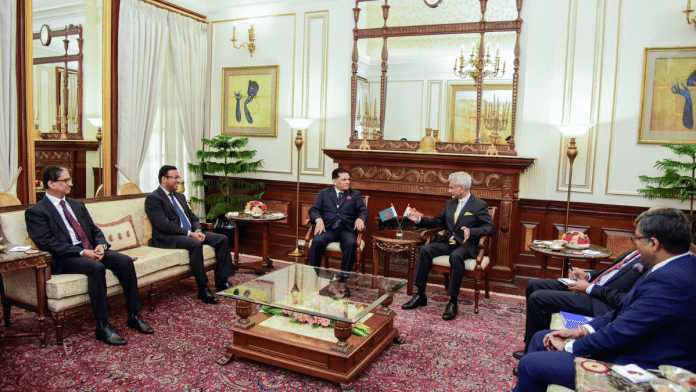



New Delhi: India Wednesday signalled its intention of “deepening” its partnership with Bangladesh, announcing further “follow-on” meetings after the bilateral discussions held between External Affairs Minister S. Jaishankar and his Bangladeshi counterpart Khalilur Rahman in the national capital.
Rahman raised the issue of the extradition of former Prime Minister Sheikh Hasina, and former Home Minister Asaduzzaman Khan Kamal, both of whom are facing a death sentence for crimes against humanity in Bangladesh. Bangladesh also appreciated India’s role in apprehending the alleged killers of Bangladeshi political aspirant Sharif Osman Hadi, a statement by the country’s foreign ministry said Wednesday.
The focus of the visit for both sides is to mend the relationship that cratered during the previous 19 months following the ouster of former Bangladeshi Prime Minister Sheikh Hasina in August 2024. For Dhaka, the message to New Delhi is one of “keeping irritants” aside (the issue of Hasina’s extradition) and to work on the current realities of the relationship, a diplomatic source told ThePrint.
Rahman’s maiden visit to India in his current role comes as the newly elected Bangladeshi Prime Minister Tarique Rahman is slowly recalibrating ties with India. Under the previous interim government led by Chief Adviser Muhammad Yunus, Dhaka rarely interacted with New Delhi at the political level. This is the first visit of a Bangladeshi foreign minister to India since 2024. Rahman was also accompanied by Humayun Kabir, the foreign affairs adviser to the Prime Minister of Bangladesh.
Kabir’s addition to the high-level meetings further shows Dhaka’s inclination of building deeper political ties, further allowing both countries to go beyond a partnership that revolves around specific regimes in power.
“External Affairs Minister reiterated India’s desire to engage constructively with the new government and further strengthen bilateral ties. The two sides agreed to explore proposals for deepening the partnership through the relevant bilateral mechanisms. Follow-on official meetings are expected to take place at an early date. Further, both sides exchanged views on regional and global issues of mutual interest,” the Ministry of External Affairs said in a statement.
Apart from Jaishankar, Rahman also met National Security Adviser Ajit Doval Tuesday evening for about an hour followed by dinner. The Bangladeshi foreign minister also held meetings with Commerce and Industry Minister Piyush Goyal and Hardeep Singh Puri, India’s Minister for Petroleum and Natural Gas Wednesday.
The meeting with Goyal indicates Dhaka’s intention to undo the trade restrictions imposed by New Delhi last year, following steps taken by the interim government to curb trade ties with India. New Delhi had cancelled transshipment rights for Bangladeshi exporters via its airports, while also ensuring that all trade emanating from Dhaka would be allowed to berth at the Nava Sheva port in Navi Mumbai all the way on the western coast of India.
The steps increased the per-kilometre cost of transporting Bangladeshi goods, impacting its trade with the world. Rahman’s visit to New Delhi in a sense is to explore new ways for India-Bangladesh ties to focus on trade and economic linkages, carving out the irritants from the larger relationship.
Foreign Minister Rahman also met Puri, as India had stepped in to send additional diesel to Bangladesh since the start of the war in West Asia. Around 5,000 tonnes of additional diesel was sent last month to Bangladesh, while New Delhi has shown willingness to send up to 40,000 tonnes before April-end, as per Dhaka’s needs and India’s own domestic requirements.
India is also looking to stabilise ties with its eastern neighbour. A number of infrastructure projects in Bangladesh funded by India have remained in limbo over the tenure of the interim government. Under Prime Minister Rahman there is a move to relook at the development partnership, while keeping Bangladeshi’s domestic sentiments in mind.
Dhaka is also pushing India to issue visas of all types for Bangladeshi nationals, which had slowed down since the chill in ties.
On the issue of the major irritant in ties (Hasina’s stay in India), the message delivered by Rahman to New Delhi is to carve out the issue, thereby allowing the larger relationship to stabilise.
Another major issue between India and Bangladesh is the renewal of the Ganges Water Treaty. The treaty signed in 1996 will expire in December 2026 and the follow-on meetings will likely explore a variety of methods to continue the stable sharing of water between the two countries.
(Edited by Viny Mishra)
Also read: From water to visas to security—India-Bangladesh ties moved beyond Hasina