





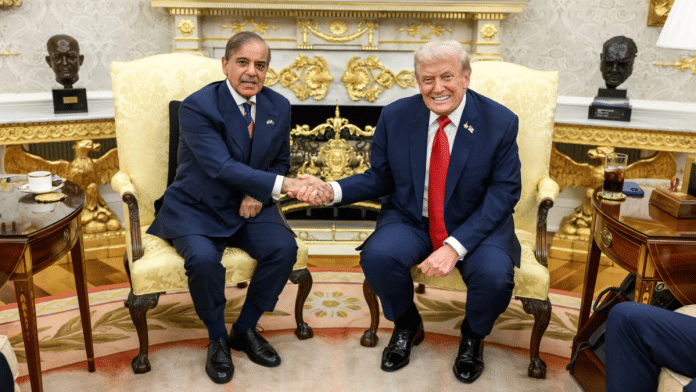



New Delhi: Under President Donald Trump, the United States and Pakistan have expanded cooperation across defence, trade and energy and technology, a shift so rapid few would have predicted it some years earlier.
Relations between Washington and Islamabad had remained deeply strained since Trump’s first term, when he accused Pakistan of offering the United States “nothing but lies and deceit”.
Yet within months, that strain appeared to lift. The first thaw was after Operation Sindoor in May 2025. Trump publicly claimed credit for mediating a ceasefire, New Delhi sharply rejected the assertion, claiming it was done bilaterally without external intervention. But Pakistan, on the other hand, amplified Trump’s mediation claims and went so far as to nominate him for a Nobel Peace Prize. The response from Washington was swift: A rapid expansion of military, economic and technological cooperation.
A mix of geopolitical opportunities and economic deals, from a post-conflict diplomatic opening to multi-billion-dollar agreements, repositioned Pakistan as a key US partner. And then came the deals.
The crypto deal
Between 2025 and 2026, Pakistan regulated its digital assets and cryptocurrencies in a sweeping manner. It established new institutions, lifted restrictions and even introduced centralised banking for crypto.
Islamabad simultaneously engaged with global firms like Binance and entities linked to Trump’s business network, including World Liberty Financial (WLF).
Proposals under discussion include integrating a dollar-pegged stablecoin into Pakistan’s payment systems, modernising remittances and building blockchain-based financial infrastructure.
In April 2025, Pakistan entered into a partnership with WLF, a firm reportedly connected to members of Trump’s family. WLF has pledged to support Pakistan develop blockchain infrastructure, tokenise assets, and navigate the broader crypto industry. However, the specifics of the agreement remain unclear.
In September 2025, the State Bank of Pakistan (SBP) agreed in principle to legalise digital currencies and signalled the formal legalisation of virtual assets like crypto. It also announced its plans to launch a central bank-backed digital currency (CBDC).
With its economy in crisis and heavily reliant on repeated IMF bailouts, Pakistan is looking at a potential lifeline in cryptocurrency, and in a partnership with a company linked to US President Donald Trump’s family.
Pakistan-US trade deal
Two months after Pakistan’s validation of Trump’s ceasefire claims, the two countries in July 2025 finalised a trade deal, after months of negotiations. US duties on Pakistani textiles, leather goods and IT services were lowered, while Pakistan removed tariffs on more than 4,000 American products and rolled back a digital services tax.
Pakistan sought relief from the 29 per cent tariffs. In return, Islamabad offered to expand imports of American crude oil and technology, and open new sectors, especially mining, to US investment.
Officials on both sides described the agreement as the beginning of a long-term economic partnership, shifting the relationship away from aid dependency toward trade-driven interdependence.
Energy & oil
Soon after, in August 2025, Pakistan made its first purchase of US crude oil, importing one million barrels of West Texas Intermediate, a grade mix crude oil.
The same month, Trump announced an agreement on joint development of oil reserves in Pakistan. Currently, oil is Pakistan’s largest import item, accounting for nearly 20 per cent of Pakistan’s total import bill, according to the State Bank of Pakistan. Most of that oil comes from West Asia. Trump called the deal “a significant beginning” to a potential long-term energy partnership.
In announcing the oil deal, Trump took a jab at New Delhi, quipping that India could one day buy Pakistani oil. “Who knows, maybe they’ll be selling oil to India someday!”
The proposal claimed further US involvement in offshore and onshore reserves, especially in Pakistan’s restive Balochistan region, the site of China’s CPEC project and Pakistan’s own $7 billion Reko Diq copper-gold project.
Rare earth
Then in October came a rare-earth deal. Pakistan shipped its first batch of rare earth materials to the US as part of a $500 million agreement to strengthen supply chains.
It was largely a symbolic move to show Pakistan could deliver. The two countries have since then added a 3-phase plan to deepen mining cooperation by 2028.
However, while Pakistan claims vast mineral reserves—estimated by officials to be worth as much as $6 trillion and spread across roughly 2,30,000 square miles—extracting value from these resources requires far more than their mere existence.
Defence: A $686 million signal
In December 2025, the United States approved a $686 million package to upgrade Pakistan’s fleet of F-16 fighter jets. The deal was confirmed by the Defence Security Cooperation Agency and included advanced avionics, navigation systems and the Link-16 tactical data network.
Pakistan’s fleet, estimated at 70 to 80 aircraft across multiple variants, will receive enhancements designed to extend operational life and improve combat capability. The package also includes identification systems to distinguish friendly aircraft from hostile, spare parts and inert Mk-82 bomb casings used for training.
Alongside $649 million allocated for sustaining and upgrading Pakistan’s F-16 fleet, the US package includes $37 million in major defence equipment, a category reserved for significant items listed on the American munitions register. Among these are 92 Link-16 systems, a secure tactical data network that enables real-time communication between aircraft, naval vessels and ground forces, transmitting both text and imagery across the battlefield.
The sale also authorises six inert Mk-82 general-purpose bomb bodies, each weighing 500 pounds, according to reports. These are non-explosive casings used primarily for training and testing. Rather than being filled with tritonal—a common explosive blend of TNT and aluminium powder—the inert versions are packed with dense materials such as sand or concrete. Originally designed as unguided bombs, Mk-82s can also serve as warheads in precision-guided munitions.
(Edited by Viny Mishra)
Also read: US voices support for Pakistan, backs ‘efforts to hold Balochistan attackers accountable’