





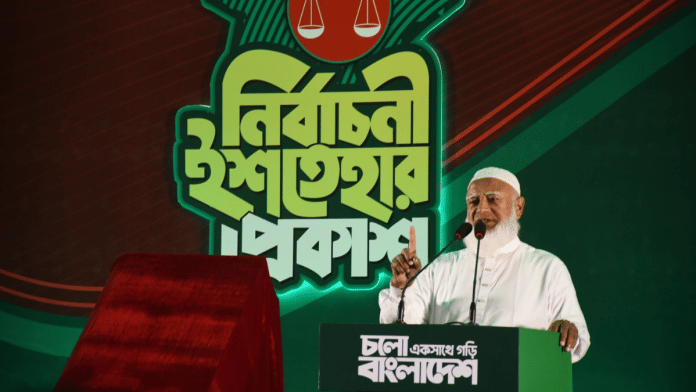



New Delhi: Bangladesh’s largest Islamist political party Jamaat-e-Islami has released its election manifesto ahead of the 12 February national polls, pledging greater inclusion of women in governance, ambitious economic targets, and an expanded foreign policy agenda with no specific mention of Pakistan.
Jamaat president Shafiqur Rahman unveiled the ‘People’s Manifesto’ with the slogan ‘A Safe and Humane Bangladesh’ before an audience that included diplomats, political leaders, journalists, business figures and members of civil society in Dhaka on Wednesday.
The 88-page manifesto outlines 26 priority areas, described by party leaders as part of a broader 41-point plan that Jamaat says will guide governance over the next five years if it comes to power.
Among its core themes are women’s participation in public life, reforms in the justice and economic sectors, and a recalibration of Bangladesh’s foreign relations.
On women’s empowerment, Jamaat pledged to include a “significant number of women” in the Cabinet, even though it has not fielded any female candidate yet. It also says that women will be appointed to key positions within the Cabinet, adding that “special initiatives will be undertaken to increase women’s participation and leadership within the local government system.”
Corruption survives when power is never questioned.
Our #manifesto makes asset disclosure mandatory, digitises government and confiscates illegal wealth with time-bound justice.
This election is about power finally answering to the people.#Jamaat2026 #VoteForDaripalla… pic.twitter.com/RVLqzcDp9L
— Bangladesh Jamaat-e-Islami (@BJI_Official) February 5, 2026
The manifesto also promises representation for religious and ethnic minorities and other historically underrepresented groups.
“The Cabinet will reflect the diversity of the nation by ensuring representation of religious and ethnic communities and other historically underrepresented sections of society,” it reads.
The manifesto focuses on the need for a safe and dignified working environment for women. While Rahman previously floated the idea of a five-hour workday for women with the government to compensate wages for the remaining hours, the proposal does not appear in the final document. Instead, it states that working hours during maternity may be reduced to five per day, subject to the mother’s consent.
The renewed focus on women seems to follow after the recent controversy surrounding a post about women that briefly appeared on Rahman’s X account before being deleted. The Jamaat later claimed the account had been hacked.
It also mentions that initiatives will be undertaken to enact a distinct Muslim Personal Law for Muslims in conformity with Islamic Shari‘ah. In addition, a special bench on personal law matters will be established in the High Court Division of the Supreme Court of Bangladesh and measures will be taken to ensure that women receive their rightful share of inheritance in accordance with the law.
Also Read: Bangladesh court sentences ousted PM Hasina to 10 years in jail in two corruption cases
Foreign policy
In foreign policy, the manifesto calls for peaceful and cooperative relations with neighbouring countries, including India, Bhutan, Nepal, Myanmar, Sri Lanka, the Maldives and Thailand, based on “mutual respect and fairness.”
While it does not mention Pakistan, with whom they have been the closest and sided with the Liberation War of 1971, it pledges to prioritise ties with Muslim-majority countries. It talks about developing “constructive relations” with the US, the UK, the EU, Japan, and Canada.
The party said it would seek to broaden Bangladesh’s diplomatic footprint in Eastern Europe, Africa and South America, while maintaining active engagement with the United Nations and regional organisations such as SAARC and ASEAN to address issues ranging from peace and security to human rights and economic development.
Economic prospects & defence
Economically, Jamaat laid out sweeping ambitions. The manifesto promises to elevate Bangladesh’s position in the global economy from 35th to 20th, though it does not specify a timeline. It also pledges to draft a modern trade policy within five years aimed at attracting $15 billion in foreign direct investment and reducing reliance on imported goods by 30 percent.
Looking further ahead, the party said it aims to transform Bangladesh into a $2 trillion economy by 2040 and raise per capita income to $10,000. As of early 2026, Bangladesh’s economy is estimated at about $475 billion in nominal terms, though its size rises to roughly $1.78 trillion when measured by purchasing power parity.
In defense, it mentions formulation of a national defence policy, development of a new military doctrine, establishment of a military research institution, increased defence budget allocation and modernisation, and a voluntary military training for youth which includes the introduction of a voluntary 6-12 month military training programme for young men and women aged 18-22 which “will be given priority consideration.”
Jamaat-e-Islami and its affiliate student wing, Islami Chhatra Shibir, were banned on 1 August, 2024 amid countrywide protests that led to the ouster of former Prime Minister Sheikh Hasina and her ruling Awami League party four days later.
But, the interim government announced the lifting of the ban days later, saying there wasn’t evidence connecting the parties to terrorism or violence. In its manifesto, Jamaat calls itself ‘the most persecuted’ under 15 years of Awami League’s rule.
A member of an 11-party alliance, the party has announced a seat-sharing arrangement under which it plans to contest 179 of the 300 parliamentary constituencies. Jamaat’s parliamentary presence peaked at 17 seats in 2001, before falling to less than 5 seats in 2008. In 2013, the party’s registration was cancelled, barring it from formally contesting elections for 13 years.
(Edited by Tony Rai)
Also Read: India halves aid to Bangladesh, boosts support for Afghanistan and Sri Lanka in Union Budget 2026