








Pakistan has offered to mediate & resolve the war in Iran. While US President Donald Trump has shared Pakistan PM Shehbaz Sharif’s post on his country’s offer to host talks, there has been no official word from Iran. In Episode 1816 of Cut The Clutter, ThePrint Editor-In-Chief Shekhar Gupta looks at the complexities & hypocrisies as Pakistan tries to play mediator in the Gulf war, & why India should keep away. The episode also details what Pakistan stands to gain from these negotiations.
Here’s the full transcript, edited for clarity:
Fighting is still on in the Gulf despite Donald Trump’s promise of holding fire for five days. But remember, as we explained in the earlier episode, that was a qualified promise—a qualified exception that said no more attacks on Iran’s energy infrastructure, power supply, etc. For that, he had said there is a five-day reprieve because negotiations are going on.
However, Iran has been firing, Israel has been firing. This truce, or so-called idea of a truce, does not apply there. It was unilateral, on behalf of the US and only concerning Iran’s electricity and energy infrastructure.
That said, the discussion now and the argument now has moved from war to truce or some kind of talks. Talks are now going on. Now, it’s quite evident—Iranians issue a denial every few hours that there are talks going on. But the Iranian foreign ministry also confirms to various news agencies, particularly in Arab countries in the Middle East, that they are getting messages or ideas of a truce, ideas of a settlement, ideas of peace, ideas of some kind of de-escalation from a number of friendly states.
We had also told you that an idea had emerged—and this was a story broken by the Financial Times with a five-man byline—and Financial Times has now tweeted that this was their most-read story last night. That story said that there’s going to be talks between the Americans and the Iranians at a very high level.
Maybe J.D.Vance, the American Vice-President, will join in, Steve Witkoff, the special envoy, Jared Kushner, Trump’s son-in-law. And from the Iranian side, maybe Ghalibaf himself— that is Mohammad Bagher Ghalibaf, the 64-year-old hardliner, Speaker of the Iranian Majlis or parliament, has been an IRGC commander in the past—in fact has been an IRGC air corps or air force commander in the past. So, he could be coming in if Vance comes in. Or, maybe Syed Abbas Araghchi, the foreign minister of Iran, will come in.
And that meeting, it was said, is likely to take place in Islamabad. As I speak, just at this moment, there is a tweet from Shehbaz Sharif saying that we are very happy to be involved in these peace talks and we look forward to de-escalation and peace—and we will be very happy to host these talks in Pakistan.
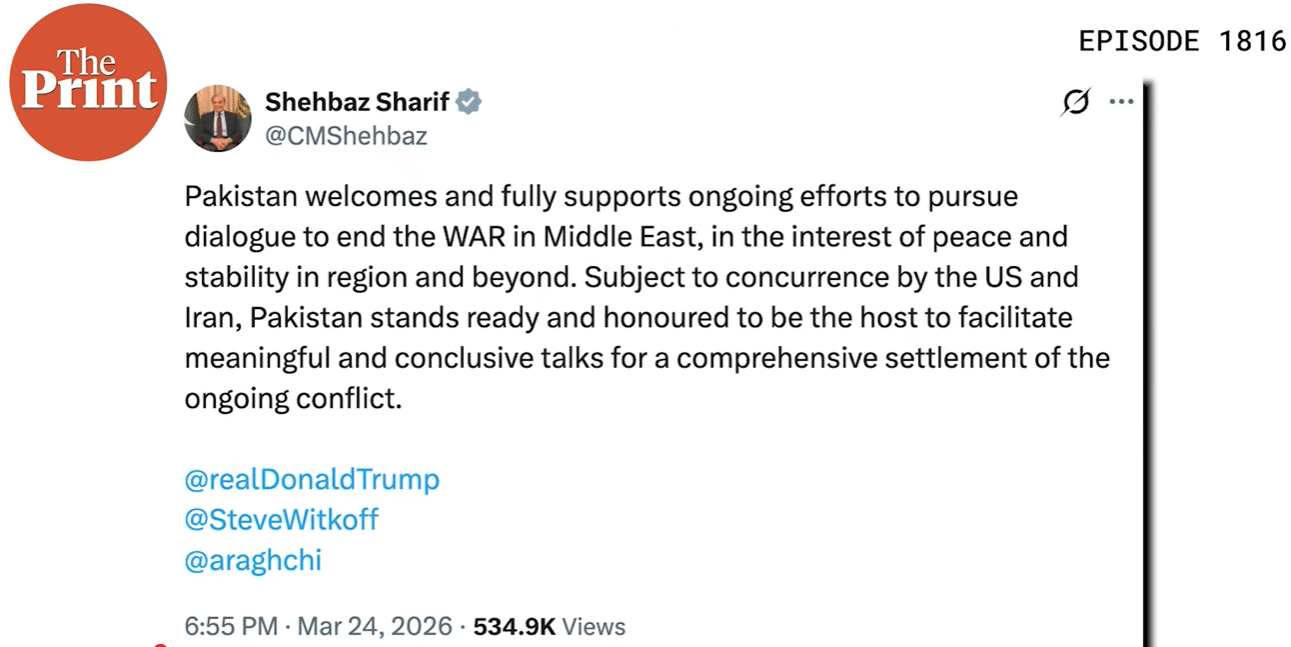
Islamabad has been spoken of as the venue. Until this morning, in the American press, there was some discussion on whether it will be Pakistan or Turkey.
Now, new developments take place every minute in this situation. Now reports have also come out—while efforts to make peace are going on, Pakistan says they are the mediators. But at the same time, Saudi Arabia—the Crown Prince, Mohammed bin Salman—is reported to have been pushing Trump to continue fighting. He does not want the fighting to stop. He wants the Iranian threat to end for good right now. And once again, the contradiction— because Pakistan is a treaty-bound protector for Saudi Arabia as well. So, this is a very messed-up situation.
Looks like now it is zeroing in on Pakistan and Islamabad. I can also understand, why the Iranians would be hesitant to go to Turkey. Turkey, after all, is a NATO country—a full-fledged NATO country with large American bases and military presence there. Pakistan does not have an American base. However, it continues to be a major non-NATO ally. To that extent, it’s also suitable or acceptable to the Americans.
Also, the Pakistanis keep their relationship with the American military—a military-to-military relationship—always very sound, barring some periods of tension. That’s why Pakistan has emerged as a kind of a mediator.
Now, first of all—and I’m warning you—this episode is going to have quite a bit of opinion. So please be prepared for opinion, because some of these things deserve an opinion. And even what I write once a week—that is ‘National Interest’—is still three days away. That’s why it’s important that I get some of these thoughts out today.
Now, there’s been a lot of FOMO in India—fear of missing out. Why this was an opportunity for mediation—how come India is not there? This is the high table where the future of the world will be decided—why is India not on this table?
This is almost like the victors of the Second World War were carving up the world between themselves and making themselves the P5 of the Security Council. No such thing is happening. However, you see the Opposition attacking the government. The Opposition will attack the government—it’s their job.
The government has responded by finally calling an all-party meeting, which Rahul Gandhi has decided not to attend because he wants to campaign in Kerala instead. Those are his choices. However, you can see that there is a buzz in India about these developments.
Now the question is: if these talks are going on—if a process is going on between the US, Israel and Arab countries on one side, and Iran on the other—in this process, three other large Muslim countries with the largest Muslim populations besides Iran, namely Turkey, Egypt and Pakistan, are involved. All three are Muslim countries.
Does India want to have a place on the table? Does India need a place? Look at India’s own interests and alliances. “Alliance” is a very heavy word in India—you can’t use that word. Pakistan takes pride in being a major non-NATO ally—maybe that qualifies them.
Can you imagine India deciding to be a major non-NATO ally? This country will go on fire. The same people asking why India is not on the table, why is India not being consulted, why is India not mediating; if I said maybe India will qualify for it if India was a major non-NATO ally, they would go and climb on Qutub Minar, and not jump from over there but will certainly be waving banners that India has sold out to America. This is a complex situation. You don’t have to be on every table.
Let the people fighting talk. Let those directly affected talk. Let people, who have a piece in the game talk. Countries like India, with deep interests and ties, are better off staying out —because there’s no percentage for India in any outcome here.
I’ll go on and explain it to you, what is that Pakistan is expecting to get. India has no such expectations. India just wants stability. India wants peace, secure energy supplies, it wants the Strait of Hormuz to be open, and India doesn’t want any violence there.
If you look at India’s ties. I earlier mentioned alliances, and I told you how alliance is a very radioactive word in Indian politics. You cannot call anybody an ally. We have only had one ally in our independent history and that was the Soviet Union, starting 1971 onwards when we signed that treaty of peace friendship and cooperation.
Such is our supreme hypocrisy that even after signing that treaty, we continued to be a member of the Non-Aligned Movement and claiming to be the leading light of the NAM, in fact, the leaders of the Non-Aligned Movement while we had a treaty bound relationship with the Soviet Union.
That said, India has strategic partnerships, not alliances. India has strategic partnerships. I told you the other day, India has different levels of strategic partnerships with seven nations in the Middle East. These include almost every nation except Iran and Turkey (for obvious reason). India’s strategic partners in the region are Saudi Arabia, the UAE, Bahrain, Qatar, Israel, Egypt, Kuwait. All are on one side of this conflict—against Iran. All these Gulf countries are the recipients of Iranian missiles and drone attacks.
India also has deep strategic ties with the US. Over decades, leaders from beginning from Narsimha Rao to Vajpayee to Manmohan Singh to Narendra Modi have elevated this strategic partnership to the next level.
So, all of India’s former partners are on one side. They aren’t just one or two but six Arab countries and Israel. In fact, none of these Arab countries is at odds with Israel. Some have formal relationships. Egypt has formal relationship with Israel. The UAE, Bahrain have formal relationship with Israel as does Turkey, whatever the strains right now. It is not as if Israel is some kind of a pariah state in that part of the Middle East. That’s where all of India’s friendships are.
India has had a relationship with Iran and that relationship continues. Indian and Iranian leaders have been talking, but it is quite evident, which side of the equation India belongs. I don’t think it was any different when Manmohan Singh was in power under UPA nor was it any different when Vajpayee was in power. In fact, if anything, over the past 30 years, Indian leaders one after the other have enriched and deepened their relationship with Israel, but more importantly with the Arab countries.
Because there was a past when Arab countries were friendly to Pakistan. A lot of the benefit from them went to Pakistanis. When a lot of Indian terror groups use to operate out of there, especially from the UAE. Dawood Ibrahim use to live in Dubai. We’ve come a long way since then and India’s relationships, once again with the Gulf Arabs, Israel and America have now reached another level. That makes being an “honest broker” difficult—even hypocritical for India.
Pakistan, on the other hand, goes there one as a large Muslim country with a very large army with nuclear weapons. Not that anybody will use nuclear weapons.
It’s, in a way, a guarantor of Saudi Arabia security. At least they’ve signed a mutual defence deal with them. At the same time, Pakistan has a 909 km border with Iran. So it is a next-door neighbour to Iran. Tomorrow if the Americans decided to take ground troops into Iran—it’s most unlikely—but suppose they did, Pakistanis will have something to do with it or Pakistanis will have some say in it and who knows Americans might be using their airspace already or maybe they will use it later. So, Pakistan has a special geographical position here but that doesn’t make Pakistanis life so easy.
Look at the situation right now. The Pakistanis say we are mediating between the Iranians and the Americans and the Arabs. They don’t mention the Israelis on this table, if it’s laid out, say in Islamabad—we don’t know for sure yet—suppose it’s laid out in Islamabad. The Americans will sit, the Iranians will sit, the Pakistanis will sit as hosts. Who knows? Maybe any of the Arabs will sit. Most certainly the Israelis will not sit. Even if there are 5, 7, 10 rounds of these talks, definitely not in Pakistan.
In that situation, why does India want to sit there? Does India want to hold a meeting that that will exclude Israel from these negotiations? Because the Iranians are not coming to a meeting at which the Israelis are present. So, we have to understand these basic facts before getting all head up, before getting hot under the collar and beginning to sound like jilted lovers. No, we are not lovers in this situation.
India has interests in this situation. India also has to handle this situation with a great degree of care. Look at the complexities that exist already. Look at the complexities and hypocrisies that Pakistan is dealing with. Pakistan says it is now mediating between Iran and America, and its Arab Muslim brothers, but not mentioning Israel.
At the same time, Pakistan is bombing the daylights out of Afghanistan. You think that’s funny or that’s a hypocrisy? I’ll take you a step further. Pakistan is offering to mediate between Iran and the US. Iran, on the other hand, one of the few communications that Mojtaba Khamenei put out was to say that his father Ali Khamenei had a special affection for Pakistan. And then he said and how sad he was to see Pakistan and Afghanistan fighting and he offers to mediate between Afghanistan and Pakistan, his two Islamic neighbours who are fighting. Now Pakistan is offering to mediate between their Muslim neighbours that is Iran and the Arab countries and America. Now Iran is offering to mediate between its own Muslim neighbours, Afghanistan and Pakistan. So, what’s going on?
My simple response to that is something like, what young people say, you guys go get yourselves a room. Because you don’t know who has problems with whom, who has arguments with whom, who’s in love with whom, and what do you want to do with that love, or that hate.
That’s the kind of mess this situation is. I use sort of a little bit lightly worded language, that’s because, I find this situation so ridiculous that for anybody in India to think that we should have been on this table, is nuts. The best place around this table is to be away on the most distant steps on the most distant step of the stands. Order some popcorn or chips or maybe khakra, given today’s situation and watch the fun and see how this plays out.
This is a very complex situation. This is not a mess for India to get into. It reminds me of something that economist Montek Singh Ahluwalia often says. He says sometimes that we, Indians, are like people who are not playing the game, but who jump into the field whenever somebody scores a century.
So, why are we jumping into this field? It’s other people’s war. In Hindi and my parents’ western UP Hindi they would say ‘dusre ke phate mein apna pav kyu ada raha hai’. These people are at war. Let them sort it out between themselves. If Pakistan wants to be a go- between and thinks it will get some benefit, good luck to them. Let them do it. It is not a role that India can play.
This is not a role for a country with moral authority, or for a country walking in saying I have moral authority, I am neutral, I will play this role. Because first of all, remember India is not neutral in this situation. India has picked its side and India’s side is the Arabs, the Israelis and the Americans. Pakistan is not neutral either, but Pakistan is a neighbour. Pakistan is fully a Muslim country. Pakistan is also a country that can play the role of a client state much more than India has ever done. That’s why this is not a competition that we in India ought to get into.
Now to buttress my point further, India has a deep relationship with Israel. A strategic relationship partnership going back decades now which has been raised to an even higher level. There is a lot of there is a lot of arms purchases from there and defence technology import from there, and a lot of manufacturing coming up in India. These are deep interests. Pakistan is a country that does not recognize Israel nor does Iran recognize Israel. How can you expect India to walk into this mess?
Americans can deal with these hypocrisies. They live far away. We live in this region. This is a very delicate situation for India, and I think so far the more distant you are from this the better, while you are watching it keeping your relationships and hoping that the violence will stop and that energy pipelines will open again.
So, okay I’m done with the opinion now you might say that I have vented now that I have vented, I will also take you through some of the classical cutter aspects of this situation.
So, first of all what is it? What are the strengths that Pakistan has? If you want to understand your adversary, you must also see their strengths. You can’t always say they are useless or they are this, that. You have to see their strengths, their weaknesses, opportunities and threats.
So, Pakistan, why are they why do they think they are uniquely placed to play a role in this situation?
Firstly, they’re a large Muslim state with the second largest Shia population in the world (India is the third largest). They have a big army, and they have nukes. To that extent that country is safe. It is also not a failed state. I know it’s fashionable in India to say Pakistan is a failed state. It’s a failing state or maybe a flailing state. But it’s not a failed state. A state doesn’t fail if at least one institution functions there and stays robust. In some countries, it can be parliament, it can be democracy, electoral system, it can be the judiciary. In Pakistan, only one institution works, as we know, and that is the army. So, it’s not a failed state that is their strength at least that’s how they see it.
Number two, Pakistan has special relationship with the Arabs and a fairly close relationship with the Iranians with whom they share a long border. I just told you with the Arabs they also have a relationship of military protection. They only recently upgraded their mutual defence pact with the Saudi Arabia. In fact, some Saudi spokesmen have gone so far as to say that Pakistani nukes are available for their protection. That’s not true, but they’ve said it. This is now a formal agreement raised to a higher level.
Important thing is the history. Even in the past, Pakistanis have come to protect the Saudis. They’ve also fought to protect the royal family of Jordan. That is when Zia was a brigadier posted there and they carried out massacres of Palestinians, who were leading a kind of an upsurge against King Hussein of Jordan at that point. Those are events well recorded in history. That was called the Black September operation.
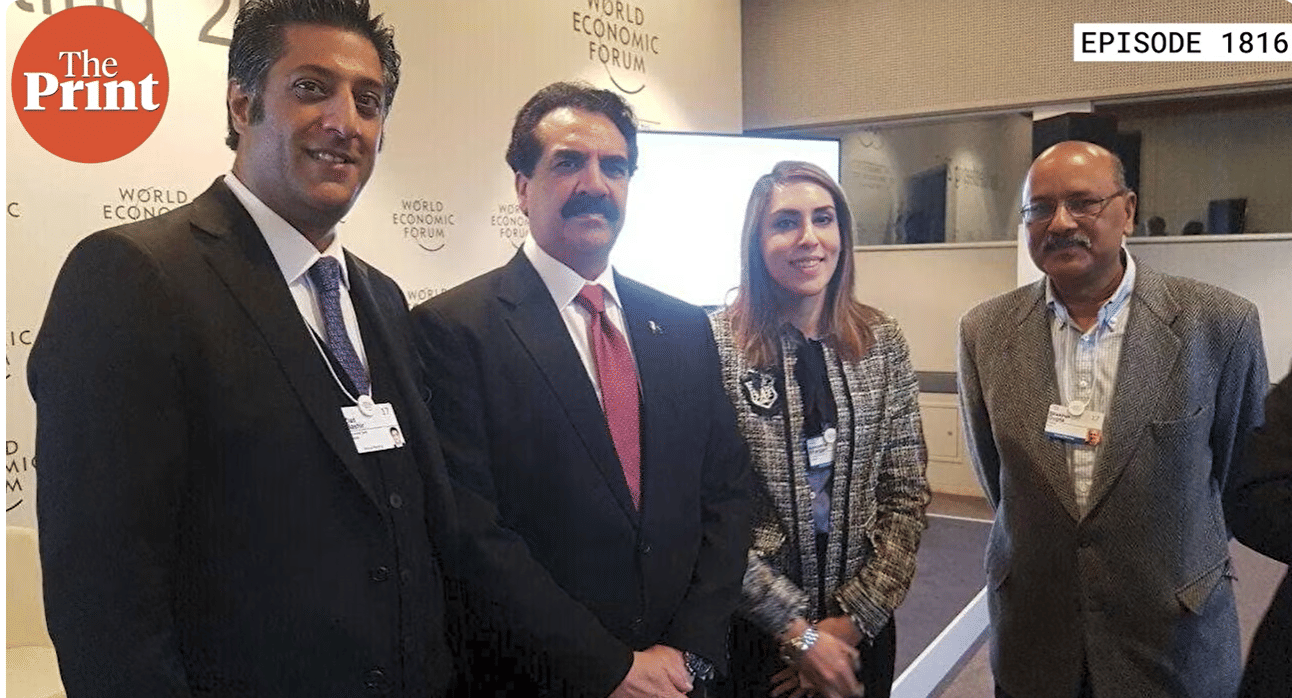
Former Pakistani Army Chief General Raheel Sharif has been serving since 2017. Now, it’s been 9 years. He’s been in Saudi Arabia as first commander of the Islamic military counterterrorism coalition. This involves about 20 members of the 57-member OIC. It has many other countries from Africa.
Since the story is also giving us the opportunity to have a little bit of fun or black humour on the side, this grouping also includes for heaven’s sake, Afghanistan. So, a group which includes Afghanistan against counterterrorism is headed by a former Pakistani army chief.
And you know a journalist’s life takes you to interesting places. So, you can see this picture. This was in Davos after one of the sessions there. I ran into Raheel Sharif there. See this picture there. We lead interesting lives as journalists.
Land border, I mentioned 909 km. Important thing is the economics linked to the land border. Now, one of the reasons Iran or IRGC is able to ride out the sanctions on oil is the very extensive oil smuggling racket that they run. They run a very extensive oil smuggling racket over land and along the coast.
On the coast, they come to Pakistan’s Makran coast—not far from Gwadar—in tiny boats. Also, along this land border, enormous amounts of processed petroleum that is diesel petrol kerosene etc are brought in from Iran by tankers into Pakistan. All of that operation is mostly run by the IRGC. It’s also a source of income for IRGC. It’s a source of cheap fuel for the Pakistanis as well. That’s a long running operation. So, there is a deep vested interest built in there.
Then Pakistani military establishment has deep ties with the US. They are a major non-NATO ally. Field Marshal Asim Munir established a good equation with Trump. But I think Trump established a good equation with Munir. One of the reasons for that was that people think Trump’s stupid, but he’s not stupid.
It’s possible, in fact it’s quite likely, now you can be sure that one reason Trump was patronizing Munir like this was that they knew that they were going to go into Iran one way or the other. That they were going to have a big dust up with Iran and when that happened then, the one country with flat land borders with Iran, they wanted that country in the tent and that country is Pakistan. All the Arab neighbours of Iran usually share mountainous borders with it.
How can I forget among Pakistan’s strengths in this situation is also the business relationship of profit. The relationship that Trump’s son and Steve Witkoff’s son and their firm World Liberty Financial, a crypto firm, they have with Pakistan. So, there is that interest, I would say vested interest as well.
Pakistan also has its limitations. Its limitations are a tiny economy. It has two troubled borders, at least two troubled borders, Afghanistan and India. Very poor and declining social indicators, while India’s and Bangladesh’s are rising. Sri Lanka is already far ahead. And looks like now in the course of time if this goes on like this over the next decade, Nepal will also catch up with Pakistan, because Pakistan will continue to decline and Nepal will also grow. That’s a big that’s a big negative for Pakistan and there is a borrowing dependence and IMF addiction. These are the big weaknesses of Pakistan.
There are internal divisions, which are sectarian and political, and there is terrorism. Just earlier this week on the Global Terrorism Index compiled by the Institute for Economics and Peace, Pakistan has been listed as number one for terrorist incidents. Then besides the addiction to borrowing, Pakistan also has an addiction for covert operations and use of terror as an instrument of state policy. They’ve used this in India. They’ve been using it in Afghanistan. In both cases now, they are facing the blowback much more from India, much more effectively. In Afghanistan, we don’t know what will happen in the course of time.
And what does Pakistan expect? Pakistan expects its status to go up in the Islamic world, with the US, in the Subcontinent, and it’s hoping that it can then impress other neighbours in the Subcontinent, particularly India’s neighbours, like Bangladesh and Nepal; Bangladesh even more so.
Number two, it expects obviously rollovers on oil because Saudis have been giving oil on loan or debt to Pakistan. Some of that more than $5 billion is now due for payment. They expect a rollover of that, and I think they will get a roll over rollover of that.
Then more economic handouts from other rich Arab countries, which Pakistanis think will come to them like protection money and also reopening of their military relationship with America, and in the best of their words, this will be their idea of isolating India.
I know that a lot of this is fantasy and it can unravel very soon unless Pakistan addresses their basic governance issues. Otherwise, the restless population which is getting poorer by the day will come back and give them trouble because those days of 201-11 will not come back. That is when after the 9/11, in those 10 years, the Americans transferred about $22 billion to Pakistan in military and civil aid. That is not going to happen now, not under Trump, not under the under the next one, nor will the Arabs see any need to give Pakistan that kind of money. That will not come in with all these assets and liabilities.
Pakistan has some strengths. What are these strengths? And these strengths are not necessarily military or strategic strengths. Some of these are strengths of clarity. They have great clarity about who they are, what they want to be, and what they want to achieve. We are more than a bit cluttered. That also is given to our size and our ambitions. Our ambitions are not limited to Pakistan.
For Pakistan, they have great clarity about itself. One, they are an Islamic nation. Two, army is the only institution that matters. Thereby they are not a failed state as I explained to you just a while back. Three, Pakistan knows they have great clarity on what it wants to be a fortress and protector of Islam that will enable them to use their army as a rentier army. That’s a central ambition of the country.
Number four, and this is the most ambitious of all, destroy India and will make any compromise. Pakistan will make any compromise with any country in the process if it can strengthen them and move them in the direction of their ultimate ambition of destroying India.
India, on the other hand, has to deal with a lot of clutter in its policymaking as it’s a big nation. It has a lot of diversity, which India loves. It has both regional and global ambitions. It has a large population, and that population is not immediately satisfied by the idea of going and destroying another country, or carrying out some kind of a holy war in another country.
India, for all of those reasons, cannot bat on this pitch like the Pakistanis. This is a pitch that is tailor made for the Pakistanis. Let them play on this bat, bowl, field, be umpires, third umpires, TV umpires, let them do what they want to do. It’s best for India to stay out of this and be a very interested spectator.
(Edited by Tony Rai)