





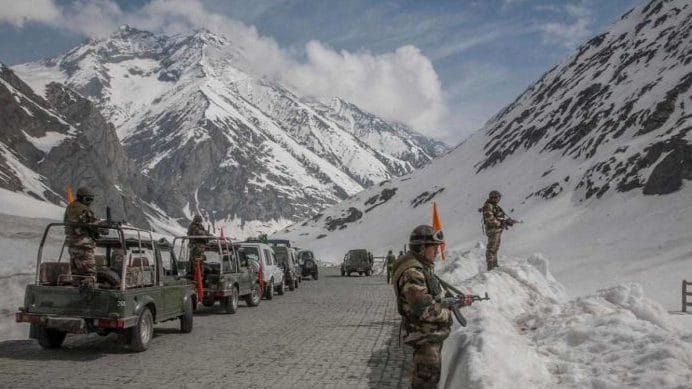



New Delhi: China reduced its forward troop presence in eastern Ladakh by half over the last one year, reports The Economist.
It also added that China is building infrastructure at four times the pace of India.
Satellite imagery reviewed by Indian officials shows a tenfold increase in permanent Chinese structures since 2020, the report also said.
Indian and Western officials report a quiet de-escalation by China post 2024, since a diplomatic breakthrough between New Delhi and Beijing.
As ThePrint reported then, India and China, back in 2024, entered an agreement on the “agreed perceived Line of Actual Control”, including in Depsang and Demchok, even as there was unlikely to be any immediate thinning of troops other than those pulled back in the winter under norms.
According to the latest Economist report, a fragile calm now prevails, with patrols resumed across the LAC, commanders of both sides speaking regularly, and even soldiers exchanging “waves”. So much so that even during Operation Sindoor, India felt “confident enough to divert two brigades from the LAC to the border with Pakistan”, according to a Western official quoted in the report.
Indian Army sources, however, denied that there has been any kind of de-induction of troops, other than regular re-deployment of troops, according to climate centric tactics.
They also denied that Chinese have cut down forward deployed troops by half over the last one year but admitted that the situation remains better than what it used to be.
As ThePrint reported earlier, India has been doing mirror deployment of Chinese presence in the area—matching tanks to tanks and men to men, among others.
Also Read: This is how China is reading US-Saudi Arabia ties
An infra blitz
Yet the “thaw” saw more recalibration than retreat. Beijing has simultaneously accelerated the construction of roads, bridges, villages, and military facilities, building infrastructure at a pace Indian officers estimate is at least four times faster than India’s.
A bridge across Pangong Lake, completed in mid-2024, now allows Chinese forces to redeploy rapidly along the frontier. Their roads run closer to disputed points. Besides, Chinese authorities have relocated civilians closer to the border, establishing villages equipped with housing, electricity, and communication facilities. The goal, Indian officials believe, is logistical as much as political—civilian infrastructure makes it easier to sustain military deployments year-round, the report adds.
“If he builds a hut, we build a hut,” “one senior Indian officer”, not named, is quoted as saying. “But the budgets are not the same.”
“China doesn’t need to sit in strength at the line anymore,” another senior Indian military officer stationed in the region is quoted as saying. “The infrastructure allows them to surge forces in two nights.”
However, Indian officials say Chinese troops have largely adhered to the agreement. Hotline calls are answered promptly, and face-to-face “parlay” meetings now last hours rather than minutes.
“The atmosphere is not cordial,” one officer says, “but it is no longer inimical.”
India has more than doubled its troop presence since 2020, added an armored brigade, and permanently deployed air-defense systems that were once seasonal. In November, it opened a new airbase at Nyoma, just 25 kilometres from the LAC.
The imbalance is compounded by geography.
China’s plateau terrain enables rapid movement from rear bases to the LAC. India’s forces must navigate narrow mountain roads from lower elevations. Indian officials also acknowledge persistent gaps in satellite surveillance, according to the report.
Still, analysts caution against overstating China’s advantage. High-altitude constraints limit aircraft payloads on the Chinese side, while Indian warplanes take off from plains to the south.
Diplomatic ties between New Delhi and Beijing cratered following the military clashes at Galwan during the summer months of 2020. India maintained that until the two sides could disengage at the borders, there would be no discussions at the highest levels.
Following the agreement to disengage at the friction points across the LAC, announced by Foreign Secretary Vikram Misri on 21 October 2024, Prime Minister Modi met with Chinese President Xi Jinping on the margins of the BRICS summit in the Russian city of Kazan on 23 October 2024.
The broader political context has also seen a shift.
India’s ties with the United States have cooled under President Donald Trump, who has imposed tariffs on Indian exports, criticised New Delhi’s purchases of Russian oil, and openly courted Pakistan’s military leadership. This uncertainty has nudged India towards a cautious thaw with Beijing, including the resumption of direct flights and limited trade flow.
India raised the matter of de-escalation at the LAC, the significance of combating terrorism, and China’s construction of a mega-dam on the Brahmaputra River during a two-day meeting with Chinese Foreign Minister Wang Yi in August last year.
(Edited by Madhurita Goswami)
Also Read: 2025 was a year of many diplomatic gains for Beijing, say Chinese analysts