





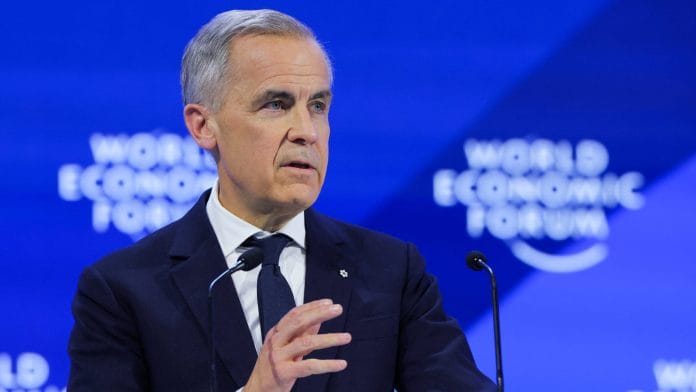



New Delhi: As Canadian Prime Minister Mark Carney is likely to travel to India before the end of March, his key asks from New Delhi remain on trade and economy, as Ottawa seeks to diversify its dependence from the US.
Speaking at the World Economic Forum in Davos Tuesday, Carney outlined Ottawa’s new worldview, which involves reducing reliance on the US and looking east to partners such as India and China, as the global order “ruptures”.
Under Carney, India-Canada ties have seen a reset from the lows of 2024, with Ottawa increasingly looking to New Delhi in areas such as energy security, clean energy, critical minerals, artificial intelligence, and greater access to the Indian market.
During his meeting with Prime Minister Narendra Modi on the margins of the G20 Leaders’ Summit in South Africa in November 2025, Carney urged a focus on the relationship from a “holistic perspective” with serious outcomes and timelines to establish a stronger foundation for ties, a person familiar with the matter told ThePrint.
The last meeting between Carney and Modi on the margins of the G20 Leaders’ Summit in South Africa produced a number of key policy changes that are likely to be finalised and announced during the Canadian leader’s visit to New Delhi this year.
“The meeting between Prime Minister Modi and Prime Minister Carney was laser-focused on outcomes,” the person said, adding that Carney described ties with India as a “tremendous economic opportunity”.
They added: “Carney described the relationship with India as one with a ‘tremendous economic opportunity’ in his meeting with the Prime Minister [Modi]. From supply agreements for uranium to the trade agreement and energy security, the meeting looked at ways to move the ties forward positively.”
The Indian readout after the meeting between the two leaders at the G20 announced that the two sides are looking to begin negotiations on a “high ambition Comprehensive Economic Partnership Agreement (CEPA)” aimed at “doubling bilateral trade” to $50 billion by 2030.
Government sources confirmed last week that India and Canada are currently negotiating the terms of reference for the free trade agreement, with a view to beginning formal negotiations soon. The announcement for negotiations of the CEPA marks a significant shift in Canadian policy, given that it was the first casualty when ties started to cool in 2023.
“Modi and Carney agreed that negotiations for the FTA must be with a strict timeline. Our side has been given the go-ahead to begin talks,” said the person. The person added that Modi also called on Ottawa to increase the financial investments by their pension funds in India. Canadian pension funds have significant investments worth billions of US dollars in India.
The previous Canadian government, led by Prime Minister Justin Trudeau, announced the suspension of negotiations for an almost completed free trade agreement on 1 September 2023. The announcement came days before Trudeau travelled to New Delhi for the G20 Leaders’ Summit and held a bilateral meeting with Modi that ended in acrimony.
Weeks later, Trudeau accused the Indian government of being linked to the killing of Hardeep Singh Nijjar on Canadian soil. Nijjar, an Indian designated terrorist, was killed in Surrey, British Columbia, on 18 June 2023. For India, Trudeau seemed unwilling to understand its own sensitivities regarding the growth of Sikh separatism in Canada, which further negatively impacted ties.
A year later, in October 2024, India withdrew six diplomats from its missions in Canada and expelled six Canadian diplomats, as ties cratered. India maintains till today that not an iota of evidence has been shared with New Delhi regarding links to the killing of Nijjar. Carney’s long-banking history, however, has brought “order” to the ties, with a growing rapport with Modi, a person familiar with the matter said.
From civil nuclear cooperation to advanced manufacturing
The visits by the Canadian National Security and Intelligence Adviser Nathalie G. Drouin in September and Foreign Minister Anita Anand in October indicated a deeper thaw in ties as New Delhi and Ottawa sought to identify potential areas for future cooperation.
Modi, in his discussion with Carney last November, urged the establishment of Canadian universities in India, while also having their financial and technological firms invest in opening operations in areas such as GIFT City in Gujarat, the person said.
“Financial and economic cooperation, including CEO level conversations and potential high-level business delegation visits, were also discussed by the two leaders,” added a person familiar with the matter.
Another area of serious focus is the conclusion of a supply agreement for uranium; negotiations for a long-term deal worth $2.8 billion are ongoing, but considered close to completion, according to media reports. The person stated that Canada is also keen to cooperate with India in civil nuclear cooperation, particularly in research and design for small modular nuclear reactors (SMRs) and other advanced manufacturing sectors.
India and Canada, along with Australia, have also launched the Australia–Canada–India Technology and Innovation Partnership (ACITI), focusing on critical minerals, civil nuclear cooperation, and artificial intelligence.
The other area Carney indicated his keenness to work with India is food security. The Canadian Prime Minister said he wanted Ottawa to become a “reliable partner” for New Delhi in understanding India’s food security needs.
Carney’s call in Davos for Canadian diversification is based on nearly a year of identifying Ottawa’s strengths and weaknesses, and accordingly making its pitch to interested parties. The Canadian Prime Minister travelled to China earlier this month, another country where ties have had their own ebbs and highs, as Ottawa seeks to weaken the economic “leverage” superpowers hold to coerce “middle powers” into deals, as stated in Davos.
(Edited by Varnika Dhawan)
Also Read: ‘Will not take Greenland by force…we will remember if Europe says no,’ Trump says at Davos