





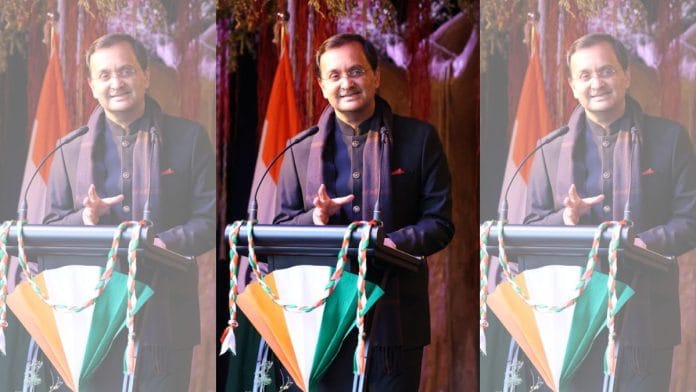



New Delhi: The change in how Canada is viewed under Prime Minister Mark Carney has been such that India no longer considers the country the “younger brother” of the United States, Dinesh Patnaik, Indian High Commissioner to Ottawa, told The Globe and Mail Wednesday.
“For a long time, Canada was seen as the ‘younger brother’ of the US—that if you want Canada to do anything, just get the US to do it and Canadians will follow,” Patnaik told the Canadian newspaper.
Commenting on Carney’s speech to the World Economic Forum (WEF) at Davos last week, Patnaik added that the Canadian prime minister said what “India and the Global South have been saying for a long time: ‘The strong do what they want and the weak suffer'”.
Patnaik further said in the interview that the fact Carney “spoke” shows that the “global world order is actually in a rupture”. Ties between India and Canada have seen a large reset in the year since Carney assumed leadership of the Liberal Party and of the North American nation.
The diplomatic relationship cratered in September 2023 after former Canadian prime minister Justin Trudeau accused New Delhi of links to the killing of Hardeep Singh Nijjar. Nijjar, an India-designated terrorist, was shot dead outside a gurdwara in British Columbia.
Ties remained in a deep freeze until March 2025, when Carney formally took over as prime minister from Trudeau. When questioned by The Globe and Mail on links to the killing of Nijjar, Patnaik reiterated that “no evidence” has yet been shared by Ottawa with New Delhi, and that “action” would be taken should such evidence be shared.
Carney has spent the better part of the last year trying to pivot Ottawa away from the US in a manner that would cut its trade dependence on Washington. Over 70 percent of its exports are to the US.
US President Donald Trump has consistently called the country the “51st state of the US”, and has taken exception to Carney’s remarks at Davos.
As part of the pivot away from the US, Carney visited China earlier this year, has sought to strengthen ties with the European Union (EU), and has been working on fixing the relationship with India. New Delhi and Ottawa are expected to conclude negotiations for the terms of reference for a free trade agreement (FTA) soon, with Commerce and Industry Minister Piyush Goyal expected to travel to Canada.
Carney is expected to visit India at the end of February or the first week of March. Patnaik highlighted that a number of senior ministers are expected to travel to Canada soon, including Goyal, Education Minister Dharmendra Pradhan, Finance Minister Nirmala Sitharaman, National Security Adviser Ajit Doval, and Minister for Petroleum and Natural Gas Hardeep Singh Puri.
“If you can sell it to us, we will buy it: we want to do deals on minerals, on rare earths, on critical minerals and oil and gas, on agri-foods, on fertiliser, on potash—you name it,” Patnaik told the Canadian newspaper, underlining one of the major reasons for the India–Canada reset: New Delhi’s limitless appetite for natural resources as it looks to grow its economy.
India and Canada have also been negotiating a $2.8 billion uranium supply agreement that is expected to be announced soon. Carney’s expected visit to India is also likely to highlight a number of areas of cooperation, including civil nuclear, energy security, education and people-to-people ties, as reported by ThePrint.
(Edited by Shashank Kishan)