





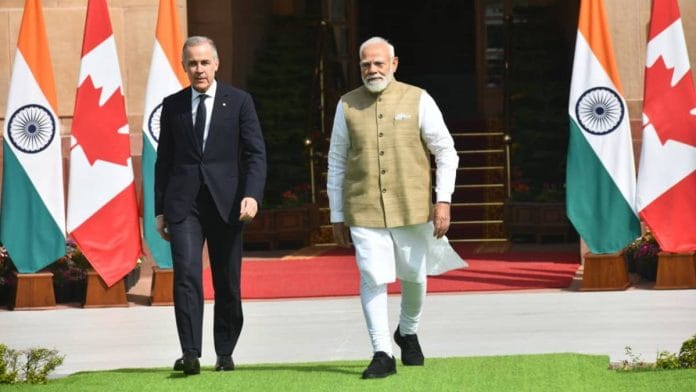



New Delhi: Canadian intelligence is continuing to work with Indian authorities with regard to foreign interference, the Canadian Security Intelligence Service (CSIS) has stated, differing from the position put forth by senior Canadian officials ahead of Prime Minister Mark Carney’s visit to India earlier this month. Senior officials had then indicated that Ottawa no longer believes New Delhi was interfering in the nation.
“The Canadian Security Intelligence Service (CSIS) continues to take all allegations of foreign interference and transnational repression seriously. CSIS remains vigilant against foreign interference and espionage threats from all countries. As noted by Canada’s Minister of Public Safety, Gary Anandasangaree, last week, work is ongoing (with Indian authorities) towards addressing Canada’s concerns and defending Canadian public safety interests,” Magali Hébert, spokesperson for CSIS, told ThePrint in a written statement.
When questioned whether there were concerns about potential interference by Indian agents during the 45th general election in Canada last year, Hébert said the Security and Intelligence Threats to Elections Task Force (SITE-TF) “observed instances of foreign interference such as transnational repression, inauthentic and coordinated amplification of online content and online threats such as scams and disinformation”.
“These activities were observed at small scale and often remain difficult to attribute to a foreign actor,” added the CSIS spokesperson.
A retrospective report on the security threats seen in the elections held last year highlighted that India “had the intent and capability” to interfere in the polls and ahead of the polls, but did not mention any specific instances attributed to New Delhi.
Anandasangaree in statements to the press last month indicated that work was continuing with Indian authorities over allegations of foreign interference by New Delhi. Anandasangaree’s remit includes CSIS and the Royal Canadian Mounted Police–the federal investigative agency looking into transnational crimes.
“The Government of India had been increasingly relying on Canada-based proxies and contacts to conduct foreign interference-related activities. The SITE-TF actively monitored for potential foreign interference related activities by the Government of India during GE45,” the retrospective report said.
The CSIS spokesperson’s comments stopped short of contradicting the views of senior government officials who had informed Canadian media ahead of Carney’s visit to India from 27 February to 2 March that Ottawa is “confident that the activity (foreign interference) is not continuing”.
These statements continue to indicate the challenges India and Canada face as Prime Minister Narendra Modi and Carney look to reset ties. The Canadian PM’s visit was perceived as largely successful, including outcomes such as the launch of a “strategic energy partnership” among other agreements in different sectors.
However, a person familiar with the matter at the time told ThePrint that the issue of transnational repression had not been brought up between the two sides at the meetings they were present in. India and Canada, however, established a new mechanism, including liaison officers, in their respective diplomatic missions to exchange security information when necessary, following National Security Adviser Ajit Doval’s visit to Ottawa last month.
The new mechanism is considered part of the larger security dialogue between India and Canada and their law enforcement agencies, and an attempt to depoliticise the issue of transnational repression. New Delhi has consistently denied it is involved in such activities.
Politicisation of security issues under Trudeau
The issue came to the fore after former Canadian PM Justin Trudeau alleged that Indian agents were linked to the killing of Hardeep Singh Nijjar, an India-designated terrorist, outside a gurdwara in Surrey, British Columbia, in June 2023.
Trudeau made the allegations in the Canadian Parliament three months later, in September that year. The allegations set off a diplomatic meltdown between New Delhi and Ottawa.
Canada was forced to remove 41 diplomats and their dependents from its missions in India by October 2023. A year later, India expelled six Canadian diplomats and withdrew six of its own diplomats from its missions across the North American nation, including then High Commissioner Sanjay Kumar Verma.
Distrust within official levels was widely seen when senior Canadian officials, including former National Security and Intelligence Adviser Nathalie G. Drouin and former Deputy Foreign Minister David Morrison, admitted to sharing sensitive information with American newspaper The Washington Post, in an official judicial inquiry in October 2024 on alleged Indian interference in Canadian affairs.
While Drouin last month took over as Canada’s envoy to France and Monaco, Morrison was moved last week to become the Senior Diplomatic and International Affairs Advisor to Carney. The Canadian PM has sought to recast the irritants in ties with India at a security level, allowing New Delhi and Ottawa to work closer together on economic affairs.
For Ottawa, India has become a key market for its vision to diversify its exports of goods from the US. Ties between Ottawa and Washington have been negatively impacted by the return of Donald Trump to the White House last year. Carney’s efforts to reset ties with New Delhi include concluding of negotiations for a comprehensive economic partnership agreement (CEPA) by the end of this year.
(Edited by Nida Fatima Siddiqui)