





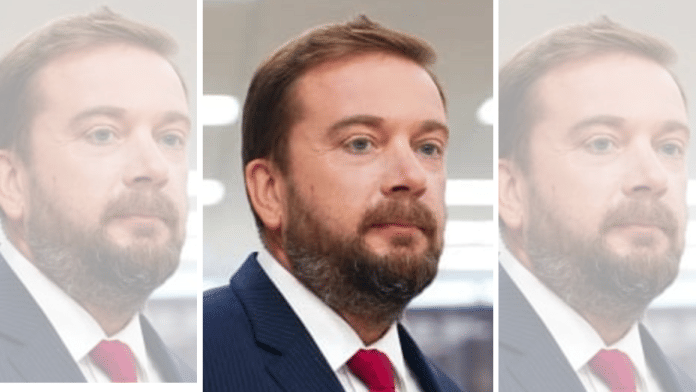



New Delhi: Russia is convinced that the business communities from both countries and the governments will find a way to “work together despite all the limitations imposed by the sanctions”, Roscongress Foundation CEO Alexander Stuglev has said.
At a private briefing Thursday in the backdrop of Russia President Vladimir Putin’s first visit to India in four years, Stuglev told ThePrint that sanctions and limitations are imposed to create “unfair competitive advantage for the Western countries” and “whether or not to follow the sanctions is a matter for independent states (to decide on).”
They (the sanctions) have also created “huge niches and huge potential and opportunities for new players,” he argued, pointing to the rise of Chinese automakers in Russia after Western firms withdrew. “Chinese car manufacturers are absolutely dominant in the Russian market.”
Putin’s visit is part of the annual India–Russia summit. Modi travelled to Moscow in July 2024, and Putin, on his part, arrived in Delhi after rejecting Washington’s latest Ukraine peace plan.
US President Donald Trump has accused India of bankrolling the Russia-Ukraine war and pressured India to cut down Russian imports, imposing a 50 percent punitive tariff on Indian goods. While India insists it will keep buying Russian crude, new US and EU sanctions targeting companies trading with Russia have slowed purchases by Indian private refiners.
India, on its part, has agreed to increase imports of American oil and gas, a move widely seen as an attempt to ease tensions with the US.
“I should say that the scope of cooperation between India and Russia goes far beyond the traditional sanctioned items like mineral resources and energy carriers,” Stuglev, who is also organiser of the India-Russia Business Forum, said.
“In a way we could say that sanctions favour development of cooperation between Russia and India,” he said, noting that countries like Turkey and China had already capitalised on similar openings.
“Most of the countries are being motivated… to search for new partners, to diversify both their political and economic ties. It is not done to oppose the United States or to oppose anyone. It is simply done to ensure long-term interests and create a reliable network of partners.”
Also Read: ‘What game is Putin playing?’ say the Chinese on Russia-India summit
Exports & trade imbalance
The Roscongress Foundation CEO then presented an expansive view of the opportunities Moscow sees for India in its economy.
The current trade turnover, he said, is already estimated at $68–70 billion, with both sides seeking to push that figure past $ 100 billion. Those numbers, he argued, represent more than commercial exchange. “This is definitely in the interests of both our countries, because we know that those are not just numbers —those are new jobs, more taxes, and generally better social well-being.”
On the question of trade imbalance, Stuglev highlighted a wide range of sectors where Russia sees scope for increased Indian exports, from agriculture and food processing to automobiles, energy equipment, medical supplies and digital technologies.
Stuglev acknowledged, however, that the trade imbalance remains a structural concern—not only between India and Russia but also in India’s trade with China.
The central question, he argued, is how India can export more competitively to Russia. “What can be done, what can be changed, what is the potential are questions we are looking at.”
National-currency trade
Stuglev reiterated Moscow’s interest in expanding rupee-ruble trade and, more broadly, in reducing dependence on Western financial infrastructure.
“Both Russian and Indian leaderships have repeatedly been saying that it is very important to stick to this approach and defend the value and importance of one’s national currency as a trade tool,” he said. Such a system, he argued, would “reduce the influence of third countries on our decisions.”
He pointed to ongoing discussions about alternative digital platforms for currency exchange, independent of systems like SWIFT, and noted that these conversations had advanced within BRICS.
India and Russia as well as China are part of the BRICS group of nations.
“We still need to elaborate the rules of currency exchange, establishing the FX (foreign exchange) rate,” he said, adding that BRICS members are exploring “independent digital platforms that are outside the control of third parties.”
On energy, he said Russia’s state nuclear corporation Rosatom remained a “very reliable” partner for India, should New Delhi seek to diversify its energy mix, modernise coal infrastructure or expand generating capacity. “It is entirely up to India… to address those needs with the best available options,” he said. “And I’m sure, the solutions can also be found within the BRICS format.”
As for a possible India-Russia free trade agreement, Stuglev said it was “too soon to tell” and would depend on the outcome of the final meeting of the two leaders.
(Edited by Tony Rai)
Also Read: From nuclear cooperation to defence, trade to oil, what is expected from Putin’s two-day India visit