





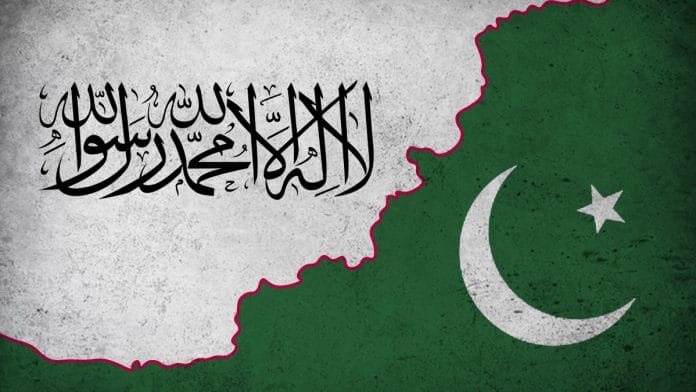



New Delhi: The Taliban’s victory over the US and its allies in Afghanistan and its return to power in Kabul was welcomed by a euphoric Pakistan in 2021. Yet, less than half a decade later, the two nations are in a state of open war as the fundamentals of the relationship between the Taliban and Islamabad continue to crater.
The genesis of the current conflict stems from accusations lobbed by Islamabad that the Taliban continues to support the Tehreek-i-Taliban Pakistan (TTP) and a raft of other militant groups, which allegedly work against Pakistan. Pakistan has witnessed a surge of militant attacks within its own borders in the last year, and Islamabad has laid the blame at the Taliban’s door.
The TTP is an internationally proscribed organisation that had been a powerful terrorist organisation between 2007 and 2014 in Pakistan, before its current resurgence.
The escalation reflects decades of deep mistrust between Afghanistan and Pakistan, particularly between the Taliban and the Pakistani establishment even though Islamabad had hailed the Taliban’s return to power in Kabul as the breaking of Afghanistan’s “shackles of slavery”.
Pakistan’s then intelligence chief Lt. Gen. Faiz Hameed had dashed off to Kabul within weeks of the Taliban’s return, as Islamabad sought to reinforce its ties with the group. However, the outreach unravelled within months, and before the first half of 2022 was over, Islamabad had carried out strikes across the Durand Line.
The Pakistani airstrike on a drug rehabilitation centre in Kabul Monday left at least 408 dead and 265 injured. It is the single deadliest attack in the conflict between Kabul and Islamabad.
Furthermore, the two sides have an undefined boundary, given that Afghanistan does not recognise the Durand Line as an international border, adding further layers to the intertwined histories of Kabul and Islamabad. ThePrint explains the tumultuous relationship between the Taliban and Islamabad.
Also read: ‘Kabul is in pain’—Afghan cricketers condemn deadly Pakistan strike on hospital that killed 400
Pakistan ‘untrustworthy, manipulative, & controlling’
In September 2021, the then chief of the Inter-Services Intelligence (ISI) Lt. Gen. Faiz Hameed had declared “don’t worry, everything will be okay” as he arrived in Kabul to meet the Taliban leadership.
The Taliban’s return to power in Kabul, after two decades of insurgency against the US and its North Atlantic Treaty Organisation (NATO) allies, was a moment of euphoria within the Pakistani establishment. Then Prime Minister Imran Khan had described the return of the Taliban as the breaking of the “shackles of slavery” for the people of Afghanistan. The Taliban’s return was also considered the zenith of Pakistan’s influence in Kabul, after the earlier democratically elected governments were considered to be close to New Delhi.
However, Pakistan’s euphoria was an attempt to paper over the cracks that had long existed between the Taliban and Islamabad, particularly the ISI. In 2012, a report compiled for the NATO-led International Security Assistance Force (ISAF) by special operations interrogators provided a rare insight into how even low-level Taliban fighters viewed the ISI and Pakistan.
“The Taliban themselves do not trust Pakistan, yet there is a widespread acceptance of the status quo in lieu of realistic alternatives… Pakistan continues to monitor, manipulate and direct Taliban interaction with outside entities. Safe havens provided by Pakistan are juxtaposed with their willingness to immediately arrest any Taliban personnel deemed uncooperative,” the report notes.
The report further adds: “Taliban personnel, from low-level fighters to commanders, describe the Government of Pakistan with remarkable consistency as ‘untrustworthy’, ‘manipulative’, ‘controlling’, ‘demeaning’, and fundamentally ‘indifferent to the interests of Afghanistan’. There is widespread belief that, despite their professed support, ISI has no intention of allowing the Taliban to end the war and return to Afghanistan. The Taliban leadership is aware of Pakistan’s historic duplicity.”
Abdul Ghani Baradar, one of the three deputy leaders of the Taliban was in a Pakistani prison for eight years between 2010 and 2018, while the former Taliban ambassador to Pakistan between 2000 and 2001 Abdul Salam Zaeef was arrested by Islamabad and later detained at Guantanamo Bay by US authorities.
The Taliban in 2013 opened its first overseas office in the Qatari capital of Doha, which soon became the place for hectic diplomacy between the then American-backed Islamic Republic of Afghanistan, the Taliban and the US. Qatar, it should be noted, was not one of the three countries that recognised the Taliban regime in Kabul between 1996 and 2001. Pakistan was.
The emergence of TTP within Taliban
Pakistan was also the last to remove diplomatic recognition after the Taliban’s first fall from power. However, despite the intertwined histories, there remains a large distance between the Taliban and the establishment in Islamabad.
This distance is further understood by the existence and activities of the TTP within Pakistan. The founder of the TTP—Baitullah Mehsud—began his career as a jihadist in the Haqqani Network, within the Taliban. In 2007, Mehsud founded the TTP, and was killed in 2009. But not before he had directed his attention to Pakistan.
“Baitullah Mehsud remained in the Haqqani Network until approximately 2007, when he restructured his subordinate personnel and redirected all efforts against Pakistan,” the ISAF report notes.
The TTP was extremely active between 2007 and 2014 in Pakistan, before the Pakistani military launched the Zarb-e-Azb offensive in June 2014 to combat the TTP and other militant groups active in Pakistan.
The Pakistani Taliban responded to the Pakistani military offensive with a number of attacks including the terrorist attack on the Army Public School in Peshawar that left 149 people dead, including 132 school children.
The TTP’s influence waned in the following years, till the Taliban’s return to power in Kabul in August 2021, which led to a resurgence in the strength of the Pakistani Taliban.
Resurgence of the TTP since 2021
Islamabad, in the immediate aftermath of the Taliban’s return to power in Kabul, attempted to differentiate between the two organisations, highlighting that the TTP was independent of the regime in control of Afghanistan.
By September 2021, the TTP began negotiations with Islamabad, mediated by Kabul. By the end of 2021, the negotiations failed, with the TTP carrying out attacks against the Pakistani state. In April 2022, at least 54 attacks within the month were claimed by the Pakistani Taliban, setting a new record.
In retaliation, the Pakistani military carried out cross border strikes within Afghanistan, beginning the cycle of violence between Islamabad and Kabul. The Taliban, however, attempted to mediate an end to the violence between the TTP and the Pakistani government, an outreach which was led by then Prime Minister Imran Khan.
However, Khan was unceremoniously replaced as Prime Minister in April 2022 by Shehbaz Sharif. Khan continues to be in a Pakistani prison, while Islamabad’s leverage over the Taliban—for its historic support for the group and the safe harbour for over two decades—have since vanished.
Pakistan’s cross-border operations
In April 2022, days after Shehbaz Sharif replaced Khan as Prime Minister, the Pakistani military launched cross-border strikes in the Khost and Kunar provinces of Afghanistan that left at least 47 people dead, according to reports.
Islamabad did not officially confirm carrying out the strikes in April 2022, but its Ministry of Foreign Affairs had urged Kabul to not shelter militants, days after the attacks. The surge in violence within Pakistan, led to Islamabad urging Kabul to do more to rein in the various terrorist and militant organisations that were allegedly active within Afghanistan.
By May 2022, the Pakistani Taliban had announced a ceasefire with the Pakistan government, while negotiations with Islamabad began once again. However, it is said to have ended after the US airstrike on Kabul killed Ayman Al-Zawahiri in July 2022, the leader of Al Qaeda. The Taliban in Kabul blamed Pakistan for allowing the US to carry out the strike to kill Al-Zawahiri from its territory, leading to a diplomatic chill.
By September 2022, the TTP had begun attacks against the Pakistani state once again. In December 2024, Pakistan once again carried out airstrikes in Afghanistan, leading to the Taliban retaliating with strikes across the Durand Line. India stepped in and condemned Pakistan’s airstrikes at the time, going so far as to label Islamabad’s actions as a part of its “old practice to blame neighbours” for its own domestic challenges.
In October 2025, Pakistan launched air strikes across the Durand Line, which led to the closure of various border trading posts between Kabul and Islamabad. The Taliban sought to hedge its foreign policy, looking further East to India, with a series of visits to New Delhi by its senior officials.
On 21 February, 2026 Pakistan carried out cross-border airstrikes once again, which eventually led to further escalation by both sides five days later. Since then, both the Taliban and Pakistan have continued attacks against one another, leading eventually to the air strike on the drug rehabilitation facility in Kabul, leaving 408 people dead.
The historical grouse—the Durand Line
Afghanistan does not recognise the Durand Line, the 2,670 kilometre long boundary line that stretches from China to Iran, essentially the border with Pakistan. While the Durand Line is not a major reason for the current clash, it remains an irritant in ties.
Originally created in 1893, the Durand Line was a part of the ‘Great Game’—the 19th century rivalry between the British and Russian Empires and the influence over Central Asia. The British, in their repeated attempts to capture Afghanistan, eventually came to an agreement with the then Afghan Emir Abdur Rahman Khan to identify spheres of influence between British India and Afghanistan.
This resulted in the establishment of the Durand Line in 1893, named after Mortimer Durand, a British civil servant. The single page agreement established Afghanistan as a buffer state between Russia and the United Kingdom in Central Asia. The British Raj gained control of Balochistan and essentially split the Pashtun-dominated region into two.
Eventually in 1919, the line was modified through the Anglo-Afghan Treaty. In 1947, Pakistan inherited the Durand Line, following the partitioning of India. However, a number of Afghan governments have refused to recognise the line as an international boundary, which has further inflamed the relationship between Kabul and Islamabad.
The India detente
In the last year, the Taliban and New Delhi sought to establish a closer working relationship, which eventually culminated in a visit to India by the Acting Foreign Minister of Afghanistan Mawlawi Amir Khan Muttaqi in October 2025.
While Muttaqi was in India, Pakistan launched strikes across the Durand Line. On 11 October 2025, both countries closed their respective border trading posts, further fracturing the relationship between Islamabad and Kabul.
Kabul and New Delhi moved quickly to deepen the diplomatic engagement, announcing the elevation of its missions to the status of an embassy last October. India, throughout the first years of the current Taliban regime, maintained humanitarian support for Kabul. While India does not recognise the Taliban as the official government of Afghanistan, it, however, has announced its intention to restart infrastructure projects that had been suspended since the fall of Kabul in 2021.
From healthcare to the use of the Chabahar port in Iran and humanitarian assistance, India has focused on a multi-sectoral engagement with Kabul, just as its relationship with Islamabad cratered. The two sides also announced the intention to appoint commercial attaches, as Kabul further sought to reduce Pakistan’s leverage over its economy.
(Edited by Viny Mishra)