





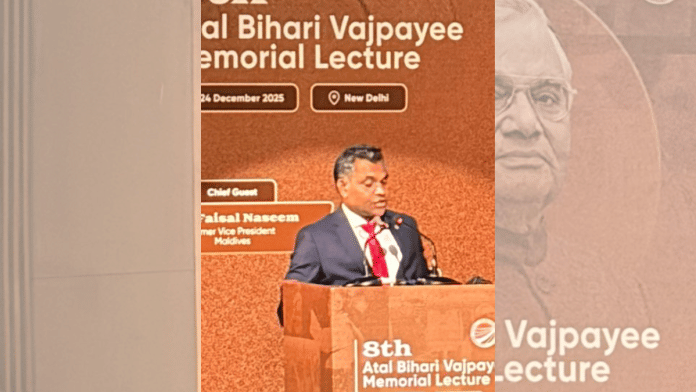



New Delhi: Former Maldives Vice President Faisal Naeem on Wednesday described Atal Bihari Vajpayee as a leader who demonstrated that “firmness and civility can coexist”, saying his politics proved “leadership can be decisive without being divisive, a lesson of enduring relevance in an era marked by polarisation”.
Naeem was delivering the 8th Atal Bihari Vajpayee Memorial Lecture organised by the India Foundation at the India Habitat Centre, ahead of Vajpayee’s birth centenary on 25 December.
The panel included Bharatiya Janata Party leader Ram Madhav and Vijay Goel, former minister of state for parliamentary affairs, and statistics and implementation in the NDA government.
Opening the lecture, Madhav described Vajpayee as a rare leader whose public and private personas were identical. “His life was an open book. One of Vajpayee ji’s greatest strengths was that he was not a split personality. Whatever he was, he was before the entire nation,” he said.
In his address titled ‘Peace, Democracy and Islam: The Maldivian Experience’, Naeem said India and the Maldives are close neighbours bound by history and culture, sharing “the same dream: peace and prosperity in South Asia”.
“In our journey of democracy and development, India has been our closest companion. The story of our partnership is written in deeds,” he said.
He added that the Maldives’ relationship with India is “built not merely on proximity, but on trust earned through actions over time”.
“During Atal Bihari Vajpayee’s tenure, the relationship gained renewed depth and clarity,” Naeem said.
Naeem recalled India’s response during the 1988 coup attempt against the Maldivian government. “When Maldives faced an existential threat to its sovereignty, India responded swiftly and decisively. Such moments are not forgotten. They form the foundation of confidence between a large democracy and a small island state,” he said, referring to New Delhi’s help in thwarting the coup.
Naeem said Vajpayee recognised early that the Indian Ocean would be central to Asia’s stability and prosperity. “He understood that maritime security is not only about naval strength, but about secure sea lanes, cooperative surveillance and trust among neighbours,” he said.
That outlook, he added, laid the foundation for current India-Maldives maritime cooperation, including coast guard capacity building, maritime domain awareness, hydrographic cooperation, search and rescue coordination and joint emergency responses.
“These efforts enhance security without militarising our waters and cooperation without compromising sovereignty,” Naeem said, adding: “This is security built on partnership, not projection.”
He said India’s role had evolved from being a reliable first responder to a comprehensive development partner, citing vaccine support during the Covid-19 pandemic as “timely, practical and life-saving”.
Naeem said Vajpayee understood peace not merely as an outcome but as a sustained political practice. “Peace is cultivated through restraint, dialogue and respect for institutions,” he said, adding that the Maldivian experience showed peace was “sustained not by uniformity but by balance”.
Calling democracy more than a procedural exercise, Naeem said Vajpayee viewed it as “an ethical framework for governing diversity”. Despite years in opposition, Vajpayee never undermined institutions, he said. “He believed Parliament mattered not because it was flawless, but because it embodied the people’s voice.”
That example, he noted, resonated deeply with the Maldives’ democratic transition in 2008 from centralised authority to constitutional governance.
“Like India, our democracy has faced moments of strain, yet it has endured because our people believed in accountability, checks and balances and peaceful political competition,” he said.
He said Vajpayee’s idea of a grand coalition carried lessons beyond India. “It reminds us that compromise is not weakness and inclusion is not inefficiency, an ethic especially vital for small, closely knit societies.”
“India’s rise, grounded in democracy and conscience, therefore carries global meaning. As the voice of the Global South and a whistleblower to the world, India has shown what responsible leadership looks like,” he added.
Also Read: India a ‘first responder’ for Maldives. How ties between the 2 nations have evolved