





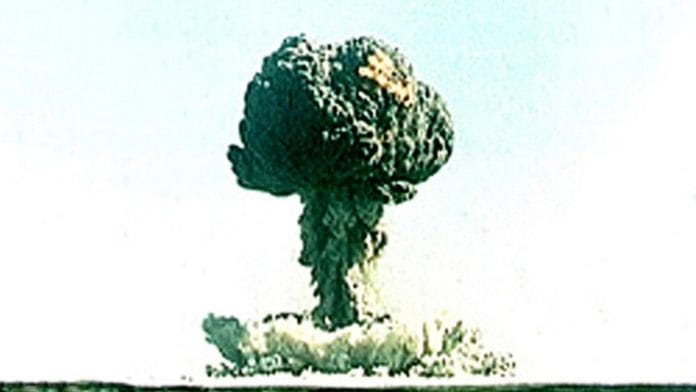



New Delhi: The US has now accused China of conducting a “covert” nuclear test back in 2020—just days after the Galwan Valley clash—setting alarm bells off.
On Friday, Thomas G. DiNanno, the US Under Secretary of State, posted on X that “China has conducted nuclear explosive tests, including preparing for tests with designated yields in the hundreds of tons”.
He further highlighted that the tests used the decoupling method, which clouds the effectiveness of seismic monitoring, with other countries kept in the dark about such activities.
The test allegedly came four days after the 15 June 2020 Galwan skirmish in eastern Ladakh, resulting in the death of 20 Indian soldiers and at least four from the Chinese troops, in what was the deadliest clash between the two nations in over 45 years.
Robert Floyd, the executive secretary of the Comprehensive Nuclear-Test-Ban Treaty Organisation, has said that its monitoring system “did not detect any event consistent with the characteristics of a nuclear weapon test explosion”, Al Jazeera has reported.
In response, Shen Jian, Chinese Ambassador to the Disarmament Affairs of China and Deputy Permanent Representative to Geneva—without even mentioning the Galwan clash—wrote on X that Washington, D.C., is spreading accusations only to shift its “own responsibility” towards achieving nuclear disarmament, with the aim of pursuing “nuclear hegemony”.
He was referring to the US aiming to have sole control over nuclear power after the official expiration of the Strategic Arms Reduction Treaty (New START)—the last remaining nuclear arms control agreement between the US and Russia—just a day ago.
This is the first time in over 50 years that the world’s two largest nuclear powers do not have a legally binding framework limiting their nuclear weapons.
Also Read: China’s Motuo dam is coming. Assam has no buffer and no real-time data
The Galwan clash
The Indian Army has reported that during the Galwan clash, 20 of its soldiers were killed in a brutal hand-to-hand combat, using clubs, stones, and barbed wire, in sub-zero temperatures, along the Line of Actual Control (LAC).
Months later, China officially acknowledged only four PLA deaths. Some reports, however, have estimated Chinese casualties at 38-43 on the premise that many must have drowned in the fast-flowing Galwan River during their retreat.
The fighting between the two sides started when Chinese troops violated disengagement agreements, prompting Indian patrols led by Colonel B. Santosh Babu to confront them at 14,000 feet.
Both sides used lethal improvised weapons—despite a no-firearms pact—resulting in soldiers falling from cliffs and succumbing to hypothermia.
The aftermath
The Galwan incident had triggered a months-long standoff between India and China, with tens of thousands of troops amassed along the LAC.
In response to the attacks, India banned 59 Chinese apps, including TikTok and PUBG, scrutinised foreign direct investment from China, and restricted Huawei from 5-G trials. Additionally, the defence ministry blacklisted Chinese equipment suppliers.
After prolonged discussions, disengagement began in a phased manner from Gogra-Hotsprings in 2022. The final disengagement, at the last two friction points of Depsang and Demchok, was on 30 October 2024.
After a five-year hiatus, New Delhi finally restored direct flight operations between the countries in 2025.
Relations have stabilised through dialogue, but mistrust lingers amid ongoing Line of Actual Control (LAC) build-ups. Chinese President Xi Jinping & Indian Prime Minister have met twice since the Galwan clash, gradually moving towards stabilisation in relations.
(Edited by Madhurita Goswami)
Also Read: Xi’s military shake-up — stripping power from China’s central military command