





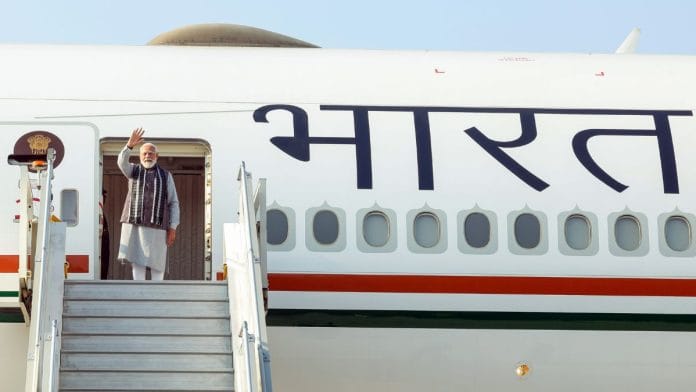



New Delhi: Prime Minister Narendra Modi, who is on a two-day visit to Israel, is looking at deepening India’s already close defence ties with Tel Aviv.
No major defence procurement deal is expected to be signed during the two-day visit, contrary to the media frenzy. However, defence and security cooperation will be a key focus area, ThePrint has learnt.
The two sides will sign a framework agreement on defence cooperation that will allow companies from both sides to collaborate deeper.
Government sources told ThePrint that the idea is to move away from a buyer-seller relationship in defence to actual co-development and co-production.
“India and Israel are moving beyond transactional deals. The story is not whether a contract has been signed but what the new framework agreement is and what it seeks to do. The impact will be seen in the coming months,” a source said.
Another source added, “The sky is the limit,” when asked about the projects the two sides are working on.
Sources said Prime Minister Modi’s visit will take forward the Memorandum of Understanding (MoU), signed in November last year by Defence Secretary Rajesh Kumar Singh to expand the scope of bilateral defence ties between the two nations.
As reported by ThePrint in December, Tel Aviv is increasingly looking at India as a long-term defence manufacturing and strategic partner in its search for alternatives.
Israel is reassessing its defence partnerships, even though its own sale of military equipment to Europe is at an all-time high. Israeli defence companies currently have signed orders from Europe that would sustain them over the next four to five years, even if no new orders are placed.
Israel’s small geographic size and security vulnerabilities have made diversification of defence manufacturing a strategic priority.
A senior source in the Indian establishment has told ThePrint, “Israel has cutting-edge technology, and India has the ability to scale up manufacturing. It is a win-win situation for both sides.”
Sources explained that Israel is looking at not just Indian orders but manufacturing in India for their own and global demand.
However, Israel is seeking changes to Indian law on company share holdings and Intellectual Property Rights.
Talking about projects in the pipeline, including some of which will take a few years to materialise if at all, the sources said Israel has even offered co-production of systems that are still under development.
The systems include the Ice Breaker, a 5th generation long range cruise missile that can be air launched, the Sparrow series of missiles including the much-touted Golden Horizon, an air-launched ballistic missile that has a range of about 2,000 km, and even Arbel technology for small arms.
Arbel is a computerised system that, once integrated, allows a rifle and even a light machine gun to independently fire follow-up shots at a target after the first shot is fired, using the operator’s behaviour to determine the optimal moment to fire each shot and the rate of fire to be used.
The system was initially integrated onto IWI’s Negev light machine gun (LMG) and then subsequently onto the company’s Arad assault rifles.
Though originally meant as an anti-drone system for last-mile defence, the system can be used on any target.
Along with the systems mentioned above, Israel is also offering a slew of air defence systems for procurement, which India will decide on depending on its own need.
(Edited by Viny Mishra)
Also read: Why Modi’s Israel visit has become the stage for a Knesset vs Judiciary battle