








New Delhi: If all goes to plan, by the end of 2026 or early 2027, India and France will finally sign a government deal for the procurement of 114 Rafale fighters through the Make in India route.
While social media is divided on the project, with many slamming it, others see this as a necessary interim arrangement to arrest the falling combat strength of the Indian Air Force (IAF).
In fact, the India-France Rafale deal is actually a story of 25 years of detours, deadlocks, and political hesitation.
In the aftermath of the Kargil conflict, the IAF concluded it urgently needed a modern, precision-capable fighter aircraft.
During the short conflict, the French-origin Mirage 2000 emerged as IAF’s most reliable platform. It offered what India critically lacked at the time—precision strike capability, all-weather operations, beyond-visual-range (BVR) combat, and the foundations of networked warfare.
Such was the Mirage’s performance that it cemented its reputation as the IAF’s most versatile and dependable strike aircraft.
Notably, both the Mirage and Rafale are products of the same manufacturer: Dassault Aviation.
IAF’s Mirage plan
The IAF knew its MiG-21 squadrons would have to be phased out over the coming years. The Su-30MKI, which was beginning to enter service, was a heavyweight air-dominance fighter. Internally, the IAF wanted more Mirages to replace the MiG-21s even as the Light Combat Aircraft project was on. If the IAF had its way, the force would have got more Mirages than the Su-30 MKI.
In September 2000, India ordered 10 additional Mirage 2000s, apart from aircraft procured earlier to replace losses from accidents.
Dassault sensed an opportunity and offered India the upgraded Mirage 2000-5, along with a full transfer of the assembly line from France. Dassault made the offer as it was transitioning to the Mirage’s successor, the Rafale.
The IAF was receptive and took the proposal to the government. But geopolitical realities intervened. Russia and the United States weighed in because they knew the potential of such a deal.
The then NDA government led by Prime Minister Atal Bihari Vajpayee grew wary of possible allegations of corruption and wanted to play safe and asked the IAF to open up the competition to have a wider pool.
Instead of buying more Mirages outright, the requirement was tweaked in favour of a medium-weight, multi-role fighter with Mirage-like performance, but one that was future-proof and procured through competition.
Thus was born the Medium Multi-Role Combat Aircraft (MMRCA) programme.
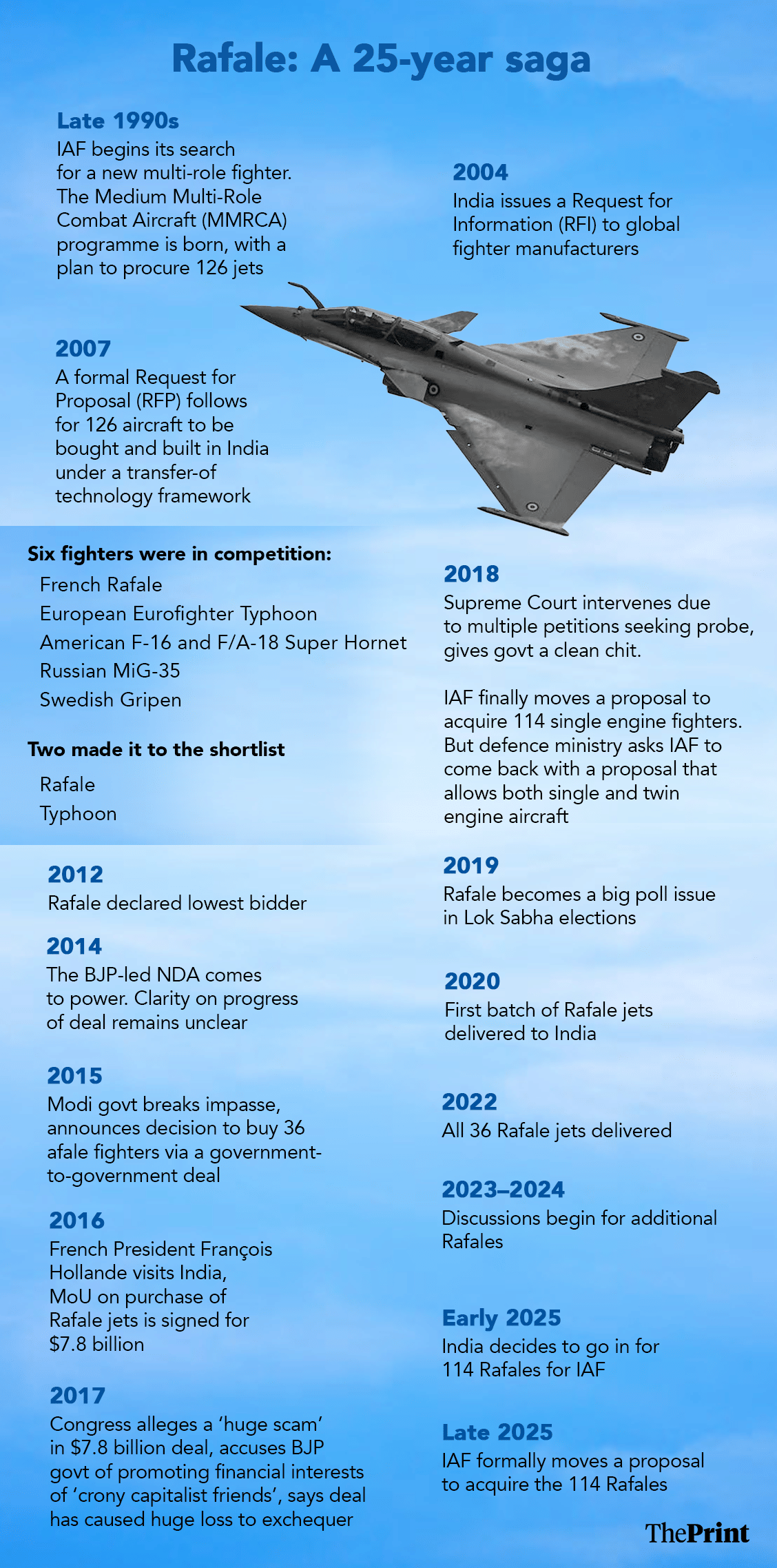
In August 2004, India issued a Request for Information (RFI) to global fighter manufacturers. A formal Request for Proposal (RFP) followed in 2007 for 126 aircraft to be bought and built in India under a transfer-of-technology framework, with an option for 74 more.
The plan was ambitious and the biggest fighter jet procurement programme in the world.
As per the plan, 18 aircraft were to be procured in fly-away condition and 108 to be built by HAL with deep technology transfer. The aircraft was meant to be a multi-role one, meaning it was for air-to-air combat, strike, maritime, and nuclear delivery roles.
Who failed and why
A total of six fighters were in competition—French Rafale, European Eurofighter Typhoon, American F-16 and F/A-18 Super Hornet, Russian MiG-35 and the Swedish Gripen. After exhaustive trials, which included both high altitude and desert, only two survived—Rafale and Typhoon.
The F-16 was rejected largely because the IAF viewed it as insufficiently future-proof. IAF was concerned about the aircraft’s legacy airframe which limited upgrade headroom, its single-engine configuration and the fact that Pakistan already operated F-16s.
The Super Hornet, while an excellent aircraft, struggled in hot-and-high trials and was seen as carrier-optimised, imposing compromises for land-based Indian operations.
The Gripen failed because the promised Gripen NG existed largely on paper at the time.
Russia’s MiG-35 was offered in prototype form, with radar, avionics, and engine issues unresolved.
In 2012, Rafale was declared as the lowest bidder (L1). But what followed was chaos.
The Rafale havoc
Former Defence Minister Late Manohar Parrikar had said in 2015 that during cost negotiations, then defence minister A. K. Antony made a puzzling note on the file. Antony asked negotiators to finalise discussions and then return with proof that Rafale was indeed the lowest bidder.
“He (Antony) said, ‘start discussion, finalise price and after everything is finished, please come back to me with all documentary evidence’ how Dassault, or the Rafale company, was the lowest,” Parrikar had said.
Parrikar pointed out that the Central Vigilance Commission guidelines say the government cannot negotiate with anyone other than the lowest. “If you have identified him (any company) as the lowest, you can negotiate. But how do you negotiate with someone and then prove that he was lowest? So… for two-and-a-half years, the file was going around in circles (under UPA).”
Sources explained the tendering team always looks into costing details provided by the bidding firms to ensure that no one deliberately undercut the actual cost. Finally when the cost negotiations are done, the pricing will in all cases move up based on inflation dynamics and other costing.
Compounding matters in the MMRCA process was a major dispute between Dassault and HAL over man-hours. HAL quoted 2.57 times the manpower cost estimated by Dassault, dramatically inflating the projected price. Dassault also refused to guarantee aircraft manufactured by HAL.
By 2015, the deal was effectively dead.
The Rafale reset
The same year, the Modi government broke the impasse by surprisingly announcing a government-to-government deal for 36 Rafale fighters. The numbers were insufficient, but the move was seen as an interim measure to arrest the IAF’s rapidly declining squadron strength.
The expectation was that this would be followed by another large competition—MMRCA 2.0, later called the MRFA. Initially, the idea was to procure a single-engine fighter alongside Rafale. Manohar Parrikar confirmed this in 2016 in an interview to PTI.
This would have meant that the competition would have been between the F-16 and the Gripen E.
Top IAF officials had then explained to journalists that the process would be much faster and they wouldn’t have to go through full trials like MMRCA because it was the same set of fighters.
The IAF in 2018 finally moved a proposal to acquire 114 fighters. But then the defence ministry headed by Nirmala Sithraman asked the IAF to go back and come up with a proposal that allowed both single and twin engine aircraft.
It was that new plan which finally got the nod from the government in 2025, allowing the IAF to move a proposal after waiting since 2018.
Many experts, within and outside the Air Force had said the government would order more Rafale once the delivery of the initial 36 aircraft started or ended.
It is only now that a process initiated more than two decades ago is finally nearing closure. As reported last week, India and France have agreed on the modalities for the procurement of the 114 Rafale F4 fighters for the IAF, official formalities for which will be completed by the end of 2026 or early 2027.
The proposed project, which will cost about Rs 3.25 lakh crore, would entail procurement of 18 aircraft in fly away condition and the rest manufactured in India with up to 60 per cent indigenous content, achieved in phases, just like the C-295 transport aircraft.
Existing Rafale aircraft with the IAF will also be upgraded to the F4 version as part of the contract.
The F4 standard focuses on improving the connectivity of the Rafale through new satellite and intra-flight links, communications servers, and software radios, improving its effectiveness in net-centric combat and paving the way for the Future Combat Air System (FCAS).
If the deal is signed early 2027, the delivery of the first 18 in fly away condition will start from 2030 onwards.
It is learnt that the final assembly line for the Rafales will come up at the Dassault Reliance Aerospace Limited (DRAL) Nagpur facility, which is now a subsidiary of the French aviation major Dassault Aviation that manufactures the fighter.
In September last year, Dassault Aviation acquired the majority stake in the joint venture. It is learnt that Anil Ambani-led Reliance could sell its minority stake to another Indian company following which DRAL would be renamed if the plans move ahead.
Multiple Indian companies like TATA, Mahindra, Dynamatic Technologies Limited, along with over 3 dozen other firms, are expected to be part of the Rafale project. TATA has already been contracted for manufacturing the fuselage for the Rafale which will go into foreign orders at this time.
It is also learnt that the Final Assembly Line (FAL) will eventually cater to Rafale’s global demand and will act as the second manufacturing hub of the French aviation major.
Sources said, overall Indian numbers could go up with time.
ThePrint was the first to report in April 2025 that the Indian government had decided to go in for 114 Rafale for the IAF and the formal process would start later that year.
In the second half of 2025, the IAF formally moved a proposal to acquire the Rafale, following which discussions took place at the defence ministry level and at government-to-government level.
After 25 years of detours, deadlocks, and political hesitation, the IAF’s Mirage-led journey has finally come full circle—back to Dassault, back to Rafale, and back to a fighter it always wanted.
(Edited by Viny Mishra)
Also read: China ran disinformation campaign against Rafale jets post-Op Sindoor—US govt report
Great reporting, as usual! Snehesh Alex Philip excels in defence-related reporting.