








It has now started aggressively marketing military hardware across Africa, the Middle East and parts of Asia. From fighter jets and trainer aircraft to drones, small arms and ammunition, Islamabad is seeking both revenue and strategic influence through defence diplomacy.
According to available reports, Pakistan has managed to strike export deals worth nearly $10 billion in 2025, the highest it has till date.
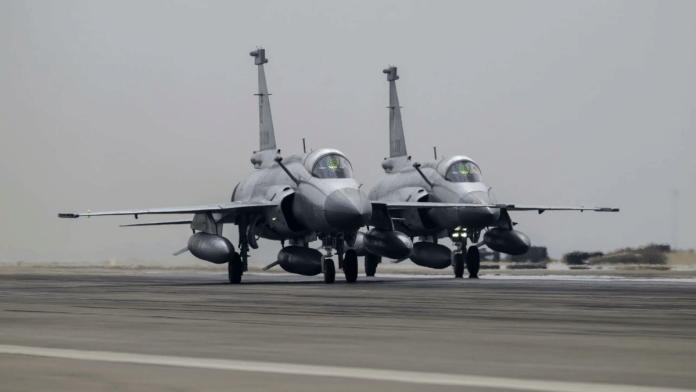
The crown jewels in its export portfolio are the Sino-Pak joint venture JF-17 fighter jet and the Mushshak trainer aircraft. In December, Libya entered into a nearly $4.6 billion deal with Pakistan to procure 16 JF-17 and 12 Super Mushshak.
🇱🇾🇵🇰 Lt Gen Saddam Haftar meets Field Marshal Asim Munir in Benghazi
Deputy Commander-in-Chief of the Libyan Armed Forces for the Eastern and Southern regions, Lt Gen Saddam Haftar, held a meeting with Pakistan’s Army Chief, Field Marshal Asim Munir, at the Libyan National… pic.twitter.com/Wtmeavi2qA
— Global Defense Insight (@Defense_Talks) December 19, 2025
Neither the Libyan National Army nor the Government of National Unity in Tripoli, currently operate a substantial air force, making the acquisition significant for Libya’s military balance.
Interestingly, Libya is now under an arms embargo by the United Nations and it is not yet clear how Pakistan plans to fulfill the contract. While Pakistan has officially not said a word, Reuters and Pakistani media have reported on this deal quoting unnamed military sources.
This deal follows a series of export arrangements that Pakistan has entered with a host of other nations last year, ranging from Azerbaijan to Zimbabwe, highlighting not just the geographic reach but also the growing contours of its defence export composition.
At the 2024 edition of International Defence Exhibition and Seminar (IDEAS) in Karachi, a major biennial defense industry expo, Pakistan signed 82 MoUs with the possibility of earning around $30 billion in the coming years. These MoUs included the possible export of defence products and equipment including advanced drones, fighter jets, commercial and logistic ships, electronic warfare equipment, and radars.
The Iranian pavilion was awarded the best foreign booth at the 12th International Defence Exhibition and Seminar (IDEAS 2024) in Karachi, Pakistan, during Iran’s first participation in the event, which hosted representatives from 53 countries. pic.twitter.com/cRrhY6yUgo
— Iran Military Monitor (@IRIran_Military) November 23, 2024
Between its previous edition in 2022 and the latest one in 2024, Pakistan logged defence exports worth $1.3 billion, showcasing the steady maturity of its defence-industrial ecosystem.
Yousuf Nazar, a former investment manager and regular commentator on Pakistan’s political economy, in a recent article, showers praise on how Pakistan has “maintained one of the developing world’s most resilient defence ecosystems under severe fiscal and geopolitical constraints”.
For instance, the Global Industrial and Defence Solutions (GIDS), which happens to be Pakistan’s largest defence company, has over 200 products and exports to around 15 countries globally.
He also delineates how Pakistan can build a $5 billion defence export base by 2035.
Pakistan’s defence exports, as per public estimates, hover between $ 300 million and $ 500 million annually, he notes.
Ammunition and small arms bring up the bulk, followed by the JF-17 fighter jet, the Super Mushshak trainer, and a growing portfolio of drones and naval vessels. The Pakistan Ordnance Factories (POF), majorly producing conventional arms and ammunition, caters to export demands as well in addition to supplying its own defence forces.
Expanding defence footprint
Pakistan has found a market for its domestically produced military equipment not just in traditional partners, like the monarchies of the Gulf or Turkey, but also steadily expanded its geographic portfolio to incorporate other regions like Africa, Europe as well as the Caucasus.
Islamabad advertises its weaponry based on their supposed success in its military encounters with India.
“Our recent war with India demonstrated our advanced capabilities to the world,” Pakistan’s Chief of Military Staff Field Marshal Asim Munir claimed in remarks broadcast by Arabic news channel Al-Hadath in Tripoli.
Pakistan’s marketing of its equipment being not only a cost-effective alternative to Western equivalents, but also battle-hardened and serviceable, makes them appealing to many African countries like Nigeria, who have emerged as a reliable clientele for Islamabad.
The Libya deal follows an August $1.5 billion export agreement that Islamabad signed with the Sudanese Armed Forces, showcases Pakistan’s strategy of positioning itself as an export partner to states that are embroiled in internal crisis and face structural bottlenecks in acquiring arms.
Pakistan’s track record of selling weaponry to active conflict zones hogged global headlines when the BBC reported in 2023 that the economically ventilated country allegedly earned $ 364 million in arms sales to Ukraine the previous year.
Even the 2023 International Monetary Fund (IMF) bailout was secured by Islamabad by virtue of what many termed as the “bombs for bailout” deal, involving arms sales to Ukraine.
Also Read: Stake in PIA to UAE deal, Fauji Foundation—the money machine that keeps Pakistan Army running
Aeronautical edge?
Aeronautical exports like the JF-17 fighters and Super Mushshak trainers comprise a significant proportion of the export basket for Pakistan. It signals Islamabad’s deeper penetration into the global military aviation market.
The JF-17, co-produced by Pakistan and China, perceptively remains the most advanced military export. Islamabad has selectively exported the multi-role fighter jet to a small coterie of nations, in congruence with its strategic interests.
In November 2025, on the sidelines of the Dubai Airshow, an MoU for the export of the JF-17 Thunder to a “friendly nation” was announced by the Pakistan military’s media wing. Azerbaijan, a longstanding partner of Türkiye, has emerged as the largest export customer of the warplane with a $4.6 billion deal for 40 JF-17s, the first of which was delivered to Baku in September 2024.
In addition to Azerbaijan, the JF-17 finds itself in the fleets of Nigeria and Myanmar by virtue of Pakistani exports, with Libya being the latest entrant.
The Super Mushshak trainer aircraft is another marquee aeronautical export that has consistently garnered a lot of attention from various quarters of the globe.
Pakistan successfully completed the delivery of all 52 MFI-395 Super Mushshak basic trainer aircraft to the Turkish Air Force in December 2025.
The careful scouting of export markets enabled Islamabad to secure a deal to export 12 Super Mushshak trainer aircraft to sanctions-hit Zimbabwe. With this development, Zimbabwe will join an expanding list of countries operating the Super Mushshak as part of their training aircraft fleet.
Pakistan Aeronautical Complex (PAC) in Kamra having produced over 300 Mushshak-series aircraft and exported more than 100 units worldwide, including to Saudi Arabia, Iraq, Qatar and Azerbaijan, helps bolster its credibility in the military aviation market.
Co-production the secret mantra?
Pakistan’s defence-industrial ecosystem has benefitted immensely from co-production arrangements and technology-transfer programmes, particularly with its “iron-clad” partner China.
Buttressing the positive impact of such arrangements for indigenous defence ecosystem, Pakistan Navy chief Admiral Naveed Ashraf, in an interview with Global Times, highlighted how it leads to “self-reliance through transfer of technology and skill development.”
Tûrkiye’s deepening defence partnership with Pakistan is not a matter of secret either.
According to a Bloomberg report on 5 December, 2025, citing Turkish defence sources, Tûrkiye is preparing to establish a combat drone assembly facility in Pakistan. Such a project would provide Pakistan access to high-end technology and aid in its asymmetric warfare strategy against India.
Pakistan’s indigenous defence ecosystem is also actively assisting the armed forces with induction of new and advanced weaponry in its arsenal
(Edited by Tony Rai)
Also Read: US says Pakistan is acquiring 36 J-10s from China—as many as Rafale jets bought by India
Even the dawn newspaper of Pakistan won’t paint such a rosy picture. Written by a commie bong