





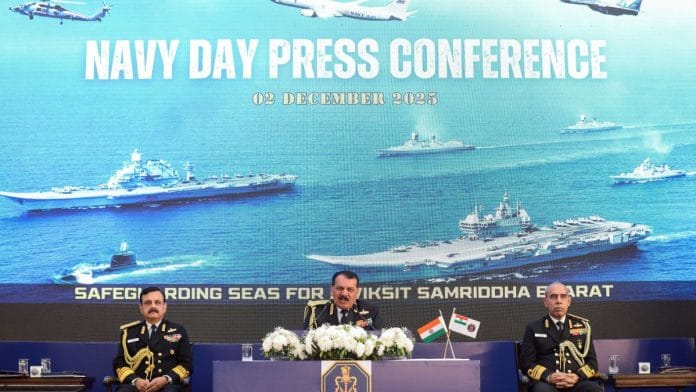



New Delhi: The Indian Navy’s “aggressive posturing” during Operation Sindoor forced the Pakistani Navy to remain in its ports, airports or near the Makran coast, Naval chief Admiral Dinesh K. Tripathi explained Tuesday.
“We reaffirm our commitment and capabilities of our Navy including during those four days (Operation Sindoor) and the days after. Suffice to say that the aggressive posturing and the immediate actions that we took including the deployment of a carrier battle group in the Arabian Sea forced the Pakistan Navy to be either in their ports or airports or near the Makran coast,” Tripathi said at the annual Navy Day press conference in the national capital.
India’s Navy chief added: “We also noticed during those four to five days (of action) noticeable effect on the Pakistani economy. Many of the major shipping companies of the world started avoiding the Pakistani ports. There was an increase in insurance premiums (on ships) going to Pakistani ports minimising merchants going to their ports.”
Admiral Tripathi maintained that the Indian Navy continues to “maintain a high tempo” in the Arabian Sea, especially in the North Arabian Sea, to be able to respond to any eventuality as quickly as possible.
The Indian Navy chief pointed out that while the 87-hour conflict was “too short” for a large impact on the Pakistani economy, he had no doubt that at least 10 percent of their trade took a hit during the four days in May that the two militaries were engaged in “kinetic action”.
India launched Op Sindoor on 7 May striking at 10 terrorist complexes across Pakistan and Pakistan-occupied Jammu and Kashmir. India’s strikes were in retaliation to the terrorist attack in Jammu and Kashmir’s Pahalgam on 22 April that left 26 people dead.
Islamabad escalated by striking at Indian military positions leading to an 87-hour conflict that ended after the two sides agreed to a pause in hostilities. The Navy deployed a Carrier Battle Group (CBG) for any escalation on the high seas.
“Our aggressive posturing and maritime domain awareness as to what is happening ensured that the Pakistani Navy never came out. We are maintaining that operation tempo. We exactly know where the Pakistani naval units are deployed… We are also ensuring that their units have not been doing anything inimical to our interests,” said Tripathi.
The Navy chief further added that they did not “notice” any Chinese support during Op Sindoor, but pointed out Islamabad’s heavy-use of Chinese arms and ammunition during the conflict.
For India, Op Sindoor is ongoing and therefore Admiral Tripathi did not disclose a number of details. The Navy has established a task force to look into learnings from Operation Sindoor and how to apply them to naval operations going forward.
Tripathi’s interaction with the media comes ahead of Navy Day celebrations. This year an operational demonstration will be carried out at the Shanghumugham beach in Kerala’s capital Thiruvananthapuram Wednesday. Indian President Droupadi Murmu will be the chief guest at the demonstration. The demonstration is expected to showcase a number of indigenously built defence platforms.
In the last year alone, India has inducted 52 new defence platforms in the Navy, including one submarine.
(Edited by Viny Mishra)
Also read: After Op Sindoor, India goes in for more Heron Mk IIs; Israel frontrunner for mega MALE drones deal