





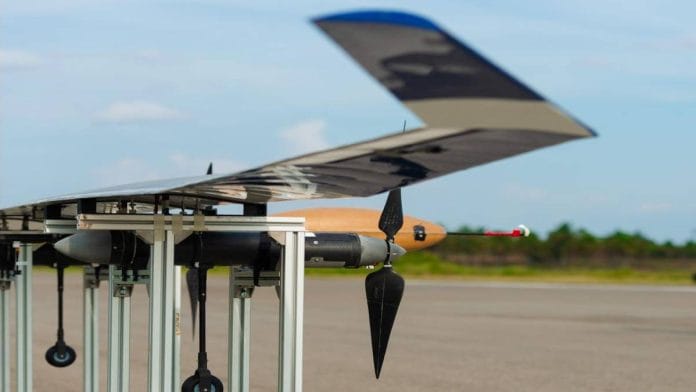



New Delhi: Pursuing persistent surveillance of India’s vast borders, Indian Army has placed a Rs 168 crore order with Bengaluru-based startup NewSpace Research & Technologies (NRT) for its Medium Altitude Persistent Surveillance System (MAPSS), a fully electric, solar-powered unmanned aerial vehicle (UAV).
This is the first time when the Indian armed forces would be deploying solar-powered surveillance UAVs than the battery powered and tethered drones currently in use.
The contract, which has its origin in the Defence Ministry’s Innovations for Defence Excellence (iDEX) programme, underscores the growing role of Indian startups in meeting the armed forces’ next gen operational needs purely on local research and development.
The latest order is part of the series of several bagged by NRT, founded by Indian Air Force veteran Sameer Joshi along with co-founders Julius Amrit and Dilip Chabria.
“This validates years of focused R&D at NRT, building cutting-edge capabilities that rival global standards for next generation warfare applications,” Joshi, NRT’s CEO, told ThePrint.
The MAPSS represents an evolution from NRT’s ongoing solar-powered High Altitude Pseudo Satellite (HAPS) programme, which has seen impressive milestones as part of a spiral development, as reported by ThePrint earlier.
Supported by iDEX grants, NRT’s solar UAV prototypes have delivered national endurance records, including flights exceeding 27 hours at altitudes over 26,000 feet and another over 24 hours during challenging conditions.
These tests, conducted at the Aeronautical Test Range in Chitradurga, demonstrated reliable solar energy harvesting even on low-sunlight days.
Sources in the defence establishment said that MAPSS has been adapted for medium-altitude missions after operational capability demonstrations at high altitude area locations with the Indian Army.
“The drone is designed to provide long-endurance intelligence, surveillance, and reconnaissance (ISR), electronic intelligence (ELINT), and communications relay support,” a source said, adding that it offers a vantage point over diverse terrains—from the high Himalayas to the deserts of Rajasthan—while minimising detection risks through quiet electric propulsion and low thermal signatures.
The MAPSS will feature a lightweight construction, solar recharging for long endurance flights, and modular payloads with advanced mission autonomy for operations in GNSS-denied zones—while prioritising persistence without frequent refuelling or landings.
This reduces logistical demands in remote areas, allowing continuous overwatch for border patrols, artillery spotting, or network extension in communication-denied environments, the sources said, explaining the reason why the Indian Army was going in for a solar-powered drone.
They added that MAPSS will complement existing medium-altitude long-endurance (MALE) platforms, providing networked ISR at forward level formations.
The procurement is a major success for the iDEX that was launched in 2018 to bridge the gap between innovators and the armed forces.
Incubated under iDEX since its early days, NRT has previously secured contracts for swarm drones, tethered surveillance systems and high-altitude platform development.
These include delivery of 100 heterogeneous swarm drones to the Indian Army in 2023 under fast-track procurement, making India one of the first nations to operationalise high-density swarms.
More recently, NRT has delivered tethered drone solutions for the Army and is developing advanced platforms like the Abhimanyu collaborative combat aircraft (CCA) for the Indian Navy.
With over 200 startups incubated and procurement orders worth thousands of crores placed for indigenous solutions, iDEX has so far facilitated transitions from design and prototype development to fielded systems.
The MAPSS delivers a first-of-its-kind sovereign hardware delivery via the iDEX’s UAV development vector for India. Similarly, NRT’s journey—from initial swarm contracts to advanced HAPS platforms—exemplifies this ecosystem’s maturity.
Also Read: India-made loitering munitions to swarm drones, Army showcases new hi-tech offensive capability
HAPS, more drones pursued by armed forces
The full-scale iDEX HAPS, contracted for the Indian Navy with delivery expected around 2027, aims for stratospheric operations with multi-day endurance in optimal conditions.
Parallel indigenous efforts in the HAPS domain involve the Council of Scientific and Industrial Research’s National Aerospace Laboratories (CSIR-NAL), which has also demonstrated solar-powered HAPS flights with prototypes at Chitradurga.
Veda Aeronautics, a Noida-based company, is taking a transfer of technology (ToT) for the HAPS system from UAE-based Mira Aerospace to compete for the Indian Air Force’s HAPS requirements.
There has been a strong push by the Indian armed forces for use of more drones. Incidentally, the IAF was among the first to induct drones way back in 2001 from Israel even before drones became the buzzword since the Azerbaijan-Armenia conflict.
The Army has inducted loitering munitions, kamikaze and surveillance drones for over Rs 5,000 crore post Operation Sindoor from domestic firms like NRT, ideaForge, SMPP, Raphe Mphibr, Adani Defence, Bharat Forge, JSW, A-Vision and Munitions India.
Additional drone procurements with a budget of Rs 3,000 crore were approved by the Defence Acquisition Council (DAC) in end 2025, which facilitate further inductions, including the MAPSS from NRT for the Indian Army.
A larger Rs 20,000 crore Fast Track Procurement (FTP) for drones is likely in 2026.
Looking ahead, the global UAV market is projected to exceed $45 billion by 2030, with persistent platforms gaining prominence.
(Edited by Nida Fatima Siddiqui)
Also Read: CSIR-NAL’s new solar-powered UAV can help border surveillance, improve communications