





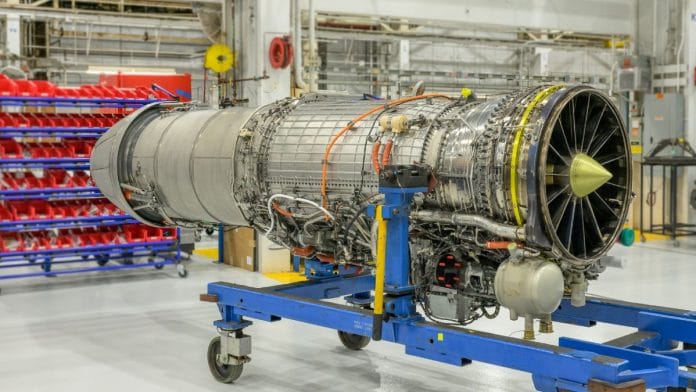



New Delhi: American aviation major GE has delivered the sixth F404-IN20 engine to Hindustan Aeronautics Limited (HAL) to power the Tejas Mk1A fighters.
Only six engines have been delivered to HAL in the last fiscal which ended Tuesday, short of the 11 promised as per the revised timeline.
Confirmation on the sixth engine came as ThePrint reached GE to inquire about the delay. “GE Aerospace has handed over the sixth F404-IN20 engine against the order from 2021. GE Aerospace and HAL continue to work closely to ensure clear line of sight of production schedules for the F404 engines,” read a statement by a spokesperson for GE Aerospace.
HAL sources said they have yet to receive the sixth engine in India, adding that the handover could have taken place in the US.
Sources in the defence establishment said GE has informed HAL that the delay in deliveries is due to the ongoing US-Israel and Iran war.
The first of 99 F404-IN20 engines, contracted in 2021, was delivered in March last year, and the fifth in December.
Earlier this year, ThePrint had reported that despite what the HAL claims, the first lot of the Tejas Mk1A, which was to be delivered to the Indian Air Force (IAF) in March 2024, is likely to be inducted latest only by June-July this year—after a delay of over two years.
On 3 February 2021, when the deal for 83 Tejas Mk1A was signed, ThePrint had reported that the IAF’s biggest worry was the delivery schedule. Since then, HAL has gone on the record multiple times to give various revised timelines which have not been met.
HAL has maintained that the main issue has been the delay by GE in supplying the F404-IN20 engine that powers the fighters. However, ThePrint had in July 2024 reported quoting sources that the “engine is the larger problem behind which all other issues are hidden”.
Incidentally, the IAF and the Ministry of Defence (MoD) have agreed to grant HAL certain exemptions from contractual obligations, so that the long-pending delivery of the Tejas Mk1A can start early this fiscal year. Under the new understanding, IAF will accept the aircraft if the Aeronautical Development Agency (ADA) and HAL complete the missile-firing tests, integration of radar to the electronic warfare systems, and the weapons package.
It is learnt that firing trials are complete and the certification process is underway. The three tasks were described as “completely essential” under the new arrangement.
HAL has argued before the defence ministry and IAF that much of the pending work is being overseen by ADA, and is not a manufacturing delay. Major capabilities incorporated are undergoing the certification process and should be completed by the end of April. Following this, the IAF will undertake acceptance trials, which could last a few weeks.
(Edited by Amrtansh Arora)