





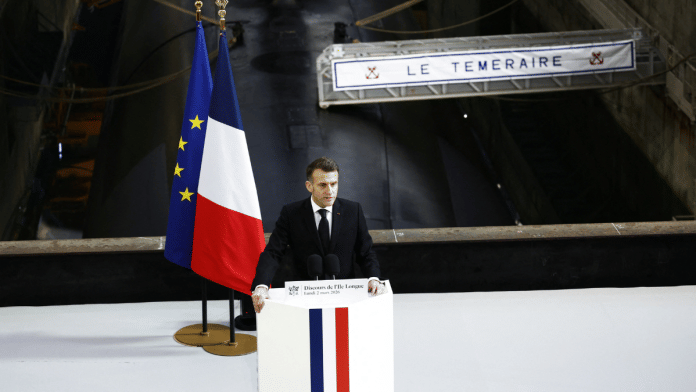



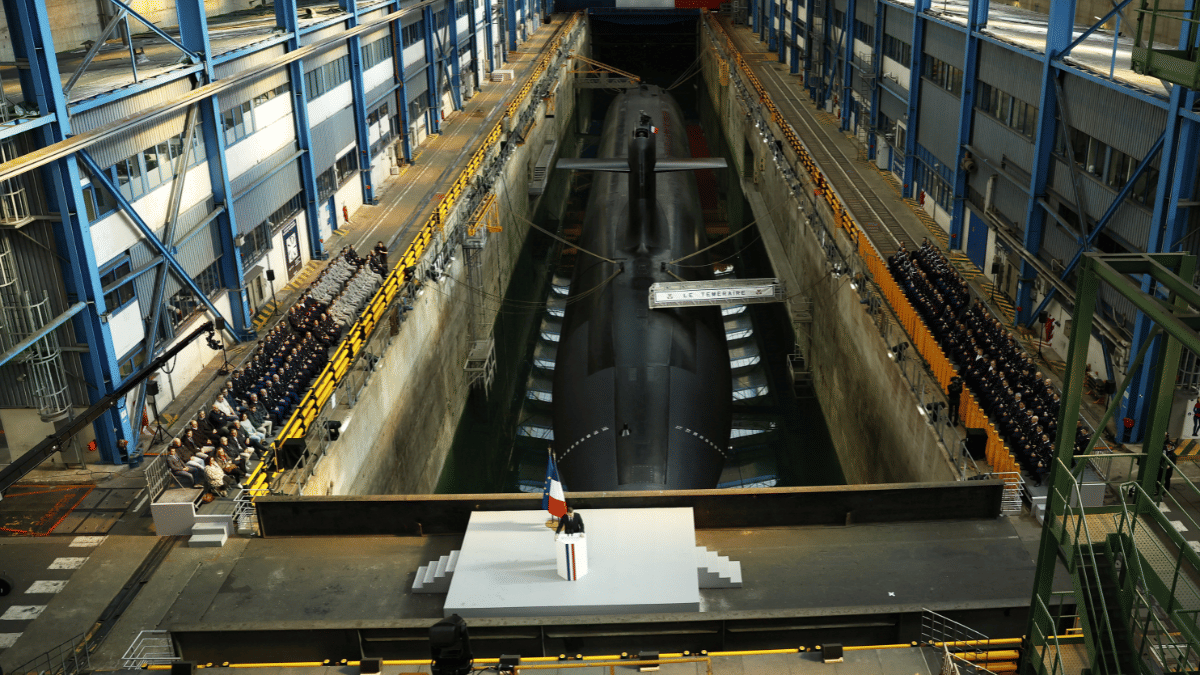
New Delhi: Reversing three decades of policy, French President Emmanuel Macron Monday announced that Paris will expand its nuclear arsenal and declared that the next 50 years will be an “era of nuclear weapons”. The announcement, made as he stood in front of a nuclear submarine at the highly secretive Ile Longue military base near the port of Brest— upends the country’s long-standing commitment to disarmament transparency.
France, in 2008, capped its nuclear arsenal at 300 warheads and committed to publicly reporting that figure. Both policies were reversed Monday, with Macron declaring that Paris would “no longer disclose” the figures.
The President unveiled what he called a new “advanced deterrence” doctrine designed to extend Paris’s nuclear umbrella over seven European allies.
“We must strengthen our nuclear deterrent in the face of a combination of threats. And we must conceive our deterrence strategy in the depth of the European continent, in full respect of our sovereignty, with the gradual establishment of what I shall call an ‘advanced deterrence’,” Macron declared.
The announcement comes amid sustained strain on the trans-atlantic alliance, with Macron reviving a near-Gaullist impulse—principles of General Charles de Gaulle, long dormant in Paris — to forge an independent European security architecture.
Poland, the Netherlands, Belgium, Greece, Sweden, Denmark and Germany will partner France under the new strategy, which envisages joint nuclear drills and the eventual deployment of France’s strategic arsenal across allied nations in Europe.
“At the geopolitical level, we are currently living through a period of rupture, fraught with risks, and our fellow citizens are fully aware of this. This period justifies a hardening of our model. We are witnessing both an increased risk that conflicts may cross the nuclear threshold and, at the same time, an intensification of conflict below that threshold. This has very direct implications for us,” the French President said.
Also Read: US to resume nuclear testing—what are India’s choices?
Control remains in Paris
Macron was unambiguous that the authority to expand its nuclear arsenal or use the weapons would remain solely with the French head of state.
“There will be no sharing of the ultimate decision–neither in its planning nor in its implementation. Under our Constitution, it belongs solely to the President of the Republic, accountable to the French people. Consequently, there will likewise be no sharing in the definition of vital interests, which will remain a matter of sovereign assessment for our country,” he said.
Macron added: “With advanced deterrence, our doctrine will retain its original foundations: its strictly defensive character, the rejection of nuclear warfighting, and the total and deliberate separation between conventional and nuclear forces. The same applies to the possibility of a single, non-repeatable nuclear warning: it will always be decided at France’s sole discretion…”
Between 1991 and 2008, France reduced its warheads, aircraft and submarines capable of carrying nuclear weapons by a third. It last produced plutonium in 1992 and halted production of highly enriched uranium for warheads in 1996. France currently operates no weapons testing or fissile material production facilities.
Until Monday, it had maintained a doctrine of “strict sufficiency”, keeping its arsenal at the lowest level deemed necessary for its strategic environment—a posture that had been almost entirely unilateral, anchored by a formal pledge of transparency on total warhead numbers.
A wider European shift
The announcement carries implications well beyond France.
European nations have long championed nuclear disarmament while sheltering under the American security umbrella. France and the UK remain the only nuclear-armed states in Europe. Paris has historically stayed outside North Atlantic Treaty Organization’s (NATO) Nuclear Planning Group, maintaining full sovereignty over its nuclear posture while affirming that its security guarantees carry a European dimension.
Macron had first floated the idea of sharing France’s nuclear umbrella with European allies in 2020, to little effect. But Russia’s war in Ukraine in February 2022, combined with incumbent US President Donald Trump’s slow disengagement from European security, appears to have lent the proposal renewed urgency.
“It will strengthen our defence by giving it greater scope: it will provide it with a new strategic depth, consistent with the security challenges facing Europe. It was clear from the outset, for us and for our partners, that this effort would come in addition to NATO’s nuclear mission,” Macron said.
France’s nuclear history
France became the world’s fourth nuclear power on 13 February 1960, when it conducted its first test as part of the Reggane series in then-French Algeria, shortly before the end of the Algerian War of Independence in 1962.
The Atomic Energy Commission had been established in 1945 after the Second World War, with military research continuing over the next 15 years—much of it carried out under the Fourth Republic government before de Gaulle’s return to power in 1958.
In 1964, the Force de Frappe—France’s Strategic Forces or its air-launched nuclear capacity—became operational with the first squadron of Mirage IV bombers entering service, according to Camille Grand in a paper published by the Stimson Center. The Force de Frappe was renamed Force de Dissuasion in 1961.
De Gaulle was focused on ensuring complete independence of the French nuclear arsenal rather than placing it under the broader NATO umbrella, Grand noted. At its peak in 1967, the programme consumed roughly 1.2 per cent of France’s gross domestic product.
The arsenal reached approximately 540 warheads in 1991 before being halved by 2008. In 2015, then president François Hollande confirmed the figure stood at 300.
“That is why I am not afraid to reveal that France has three sets of 16 submarine-borne missiles and 54 ASMPA (nuclear-armed air-launched cruise missile) delivery systems. I would like all nuclear weapon-States to make the same effort of transparency, as I am doing before you, for all the categories of weapons in their nuclear arsenals,” Hollande had said.
With less than 14 months remaining in his term, Macron’s recalibration of nuclear doctrine may not be reversed. Among the popular candidates for the 2027 presidential election is Jordan Bardella, who leads the far-right National Rally, which has traditionally supported nuclear deterrence.
(Edited by Prerna Madan)
Also Read: The third nuclear age is here. With more dangers