





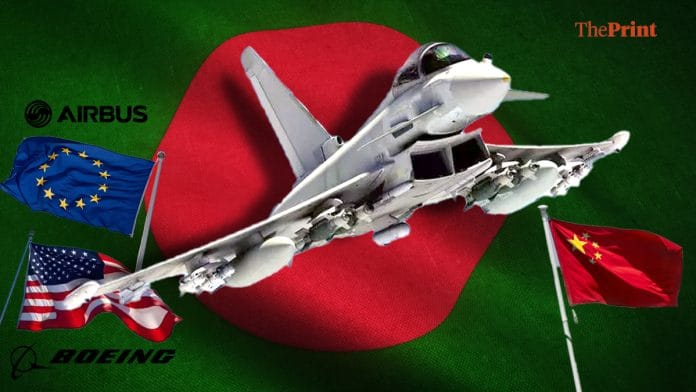



New Delhi: Bangladesh has signed a letter of intent (LoI) with Italy’s Leonardo S.p.A for the procurement of Eurofighter Typhoon multirole fighter aircraft, in what would mark Dhaka’s first major acquisition of a Western-built combat jet if the deal goes through.
Though local media is yet to report on the number of jets, ThePrint has learnt the country is looking to procure 14 Typhoons.
The LoI was signed earlier this month at the Bangladesh Air Force headquarters in Dhaka between Chief of Air Staff-Air Chief Marshal Hasan Mahmood Khan and Italy’s ambassador to Bangladesh, Antonio Alessandro.
Italy is the lead country for the deal, according to reports, though details remain largely under wraps.
The Eurofighter Typhoon is developed by European Airbus, British BAE Systems and Italy’s Leonardo. It remains unclear when the procurement contract will be signed or how Bangladesh plans to finance the purchase.
Earlier this year, a Bangladesh Air Force delegation visited Leonardo’s facility in Turin, Italy, where pilots test-flew the Eurofighter.
Also Read: Stake in PIA to UAE deal, Fauji Foundation—the money machine that keeps Pakistan Army running
Budget constraints raise questions
Bangladesh’s 2025-26 defence budget stands at BDT (Bangladesh Taka) 408.51 billion ($3.34 billion)—the first announced by the country’s interim administration following the ouster of former Prime Minister Sheikh Hasina’s government in July 2024.
The defence allocation, announced on 2 June 2025, represents a 3.6 percent increase compared with the revised 2024-25 defence budget of BDT 394.15 billion, but a 3.4 percent decline against that year’s original defence expenditure of BDT 423.14 billion, Janes, which collects defence intelligence, reported.
Any gains in the new defence budget are offset by inflation, which continues to run high in the country, the Janes report said.
Most of the country’s budget caters for revenue expenditure such as salaries, training and logistics, with barely 2.4 percent earmarked for modernisation.
“The LoI is interesting and the full details are not known yet. One will have to take a look at how Dhaka plans to finance this deal given that the defence budget itself is so small,” a source in the Indian defence establishment said.
The source added, “Another thought that needs to be focussed on is why is Bangladesh buying such expensive fighters and who do they plan to use it against.”
Balancing act
The deal is largely interpreted by experts as a geopolitical trade-off, aiming to balance Bangladesh’s relations between the US and Europe.
Dhaka had in 2023 committed to purchasing 10-14 Airbus commercial aircraft but, under pressure during the Trump administration, was compelled to place an order for 25 Boeing commercial jets instead.
As a counter move, experts believe, Bangladesh is now aiming to procure Typhoons from the European market.
In the past, Bangladesh’s military procurement has been mostly shaped by financial constraints, pushing it towards cost-effective suppliers such as China and Russia.
Defence diversification was officially part of Forces Goal 2030, Dhaka’s long-term military modernisation blueprint, first adopted in 2009 and updated in 2017 to transform the armed forces.
Under this framework, the Bangladesh Air Force has long sought a new fighter aircraft. Following the cancellation of an earlier tender for 8-12 Russian-made multirole combat aircraft, Dhaka set its sights on Western-origin multirole fighters.
Multiple local reports had earlier indicated that the Eurofighter Typhoon and the Dassault Rafale were under consideration. In 2021, the government earmarked around 25,200 crore taka for the acquisition. The same year, Eurofighter World magazine identified Bangladesh as a potential customer for the Typhoon.
Still, China remains a factor. The BAF still prefers the Chinese J-10C in terms of affordability and has agreed, in principle, to procure at least 20 of them.
But the country has also maintained its long-standing interest in acquiring a Western fighter, preferably the Eurofighter.
In 2015, Bangladesh’s then Air Chief Marshal Abu Esrar said that Chinese and Russian platforms no longer provided adequate deterrence against regional competitors. In 2016, he personally inspected the Typhoon at Farnborough Airshow in the UK and soon after, the BAF formally launched its Multi-Role Combat Aircraft (MRCA) programme under Forces Goal 2030.
Europe’s defence bid
The Eurofighter programme is experiencing a commercial and production resurgence driven by increased European defence budgets and exports to the Middle East. Production is being ramped up from 12-14 aircraft per year to 20 by 2028, with potential expansion to 30 annually if additional export contracts materialise, according to reports.
European diplomats and businesses have also encouraged Bangladesh to increase imports from the EU to help reduce the significant trade deficit, creating an economic context in which large defence procurements carry strategic as well as military significance.
Europe remains Bangladesh’s biggest export market. Nearly half of the country’s garment exports are to the EU.
Given the uncertainty around tariffs announced by the US, Dhaka is keen to cater to the Europeans too, experts said.
Regional impact
Defence analysts say Bangladesh’s pivot to Europe reflects less a turn towards military superiority and more a bid for strategic autonomy.
“The reported Eurofighter (Eurojet) Letter of Intent should be seen in this context: one component of a broader diversification portfolio, not a geopolitical statement. Recent developments, particularly since August 5, 2024 (when the Hasina government fell), have reinforced a critical lesson that no single country can serve as Bangladesh’s security guarantor,” Shahab Enam Khan, executive director of think-tank Bangladesh Center for Indo-Pacific Affairs, told ThePrint.
He added that changes in regional politics, unpredictable reactions from neighbours and shifting alliances have shown the risks of excessive dependence.
“Strategic autonomy is therefore not ideological; it is risk management. Bangladesh’s defence modernisation must be understood through a defensive and strategic-autonomy lens, not as an offensive posture,” Khan said.
He added that friends will remain friends, but Bangladesh must have “rainy-day options” when regional dynamics change abruptly.
Moreover, Western platforms such as the Eurofighter appeal not for their origin but for their characteristics: NATO-standard systems, combat-proven performance, mature supply chains and reduced risk of diplomatic entanglement.
Others see a symbolic element.
Group Captain Ajay Ahlawat (retd.), a former Indian Air Force fighter pilot, noted that Bangladesh’s MiG-29s were ageing and its Chinese F-7s nearing retirement, making replacement unavoidable.
But he questioned whether the next government, expected as elections are scheduled for early 2026, would commit to the high costs of acquiring and maintaining Eurofighters.
“This is only a letter of intent. Even if a contract were signed today, the aircraft wouldn’t arrive for seven years. There will be at least one full election cycle before that,” he said.
Ahlawat also predicted that China could re-emerge as a strong contender. “If the new government is willing to spend, Beijing could offer the J-10C at a very attractive price. That will be seriously considered,” he said.
From an Indian perspective, Ahlawat said, Bangladesh’s move was “not something to worry about… It’s something to observe with mild amusement”
Not limited to one ally
According to Khan, one of the key objectives is to minimise the perception that Bangladesh’s defence posture is aligned with any single power bloc.
“For example, Turkey has become an important defence partner, particularly in drones. Similarly, diversification across Europe, Asia, and the US allows Bangladesh to maintain flexibility and neutrality,” he said.
In September earlier this year, a contingent of 120 US military personnel arrived in Bangladesh’s coastal city Chattogram amid speculation of joint exercises. Before that, in August, the two countries conducted Exercise Tiger Shark, which marked growing defence ties with Washington after years of freeze under the Hasina government.
“The country is not preparing for war against any neighbour. Rather, it is adapting to a more unstable regional order, evolving border realities and the decline of the liberal international security framework,” Khan said.
Security pressures have intensified, particularly along the Myanmar border, where some rebel outfits in Rakhine and Chin states have gained ground against the military.
“Security threats today are no longer limited to conventional state actors. Non-state armed groups now control territory along Bangladesh’s borders for the first time in its history. Traditional assumptions about border stability no longer hold. In such an environment, Bangladesh cannot assume that neighbouring states or their allies will be able or willing to respond to crises that directly affect Bangladeshi security,” Khan said.
Signal to China?
An assessment by the Observer Research Foundation indicated that Bangladesh’s diversification push for its military could be driven by dissatisfaction with Chinese-supplied equipment.
China has provided about 72 percent of Bangladesh’s military hardware since the 2002 defence cooperation agreement, including submarines, corvettes, missiles, tanks, jets and radar systems. Beijing also built the BNS Sheikh Hasina submarine base in 2023.
But trust has eroded due to quality concern after crashes involving Chinese-made aircraft, rejected ammunition supplies, unsatisfactory naval radars and poor after-sales support.
On 21 July 2025, a Chengdu FT-7BGI fighter jet operated by the Bangladesh Air Force crashed shortly after takeoff into the Milestone School campus in Dhaka, killing at least 36 there.