





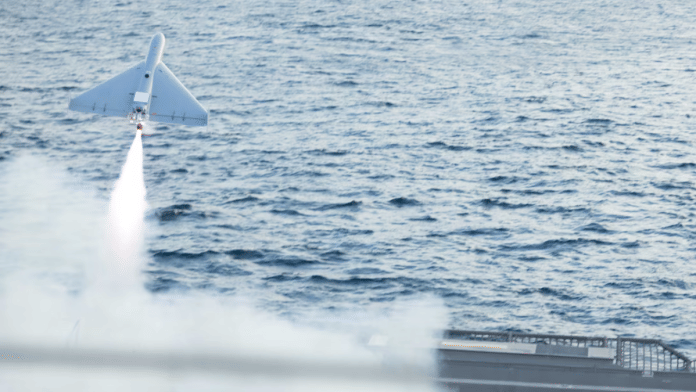



New Delhi: As the US-Israel operation against Tehran enters a new phase, Washington has deployed a weapon engineered after Iran’s own battlefield design—a one-way attack drone called the Low-Cost Unmanned Combat Attack System (LUCAS).
US Central Command (CENTCOM) announced Sunday that American forces had used LUCAS, modelled after Iran’s Shahed drones, for the first time.
“CENTCOM’s Task Force Scorpion Strike—for the first time in history—is using one-way attack drones in combat during Operation Epic Fury. These low-cost drones, modeled after Iran’s Shahed drones, are now delivering American-made retribution,” CENTCOM said in a post on X.
The combat debut came eight months after LUCAS was publicly unveiled at the Pentagon in July 2025—a timeline that US defence officials have cited as deliberate proof that the military can compress its traditionally slow acquisition process when strategic urgency demands it.
Also Read: Israel can afford a long war with Iran—US cannot
What is LUCAS?
LUCAS is a loitering munition, more commonly known as a kamikaze drone. (Kamikaze was a World War II-era practice by Japan when it loaded aircraft with explosives, and deliberately crashed planes on enemy targets)
Unlike surveillance drones that return to base after gathering intelligence, LUCAS is engineered to identify and strike a target, detonating upon impact, with no recovery once launched.
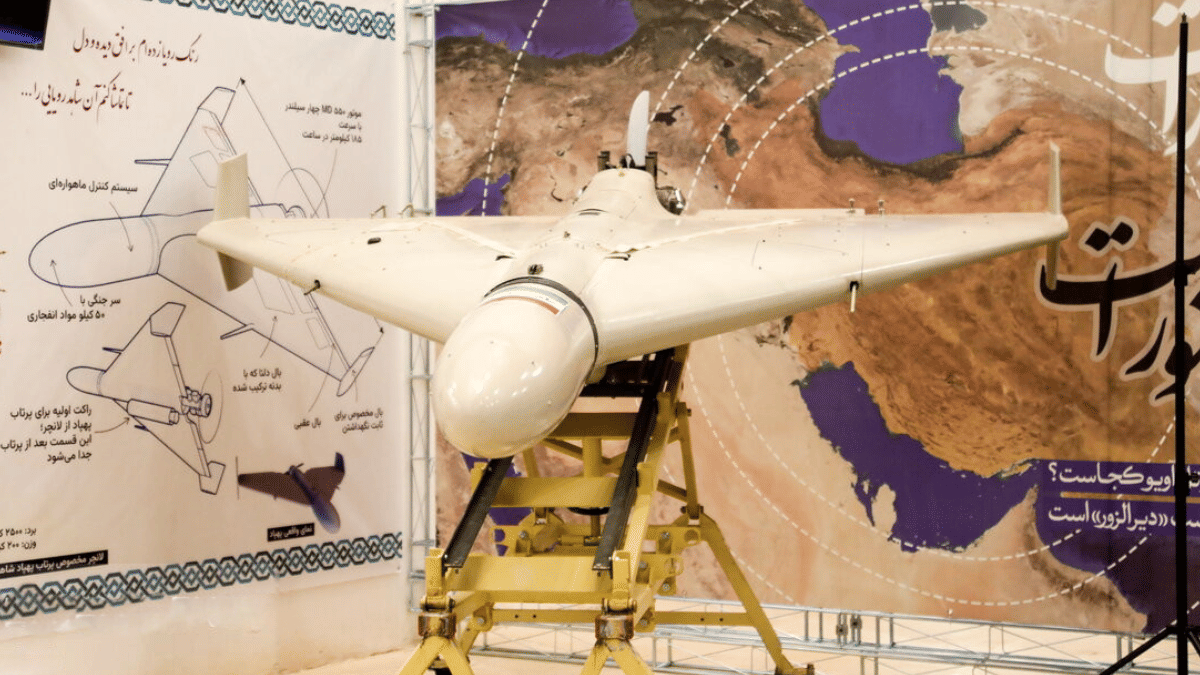
Its V-shaped airframe is directly modelled on Iran’s Shahed-136, an autonomous, pusher-propelled one-way attack drone that experts say were wreaking havoc across the Gulf and have been deployed extensively by Russia in its war against Ukraine.
At an estimated $35,000 per unit, LUCAS costs a fraction of the MQ-9 Reaper—a medium-altitude, long-endurance unmanned aerial vehicle capable of both remotely controlled and autonomous flight operations—which carries a price tag of $30 million per drone.
LUCAS’s open architecture allows it to support a range of payloads and communication systems, including satellite links via SpaceX’s Starlink/Starshield and Viasat’s MUSIC. It can be launched from trucks, ground launchers, or catapults, and can be controlled through software developed by a start-up called Noda, which allows a single operator to manage multiple systems simultaneously.
LUCAS also carries advanced autonomy and anti-jamming features, enabling it to swarm, loiter, and receive updated targets mid-flight.
A fast-tracked process
LUCAS’s development from a prototype to frontline weapon in mere months reflects a deliberate shift in how the Pentagon is approaching weapons development.
US Secretary of Defence Pete Hegseth had identified multiple competing companies to supply the military with new equipment, with SpektreWorks of Arizona selected as the manufacturer for LUCAS.
A key structural element of the programme is that the US government retains intellectual property ownership over the LUCAS design, allowing it to contract multiple manufacturers to produce the system simultaneously—bypassing the single-vendor bottlenecks that slow down procurement.
The effort was also backed by the $1 billion Drone Dominance Programme, established under the Big Beautiful Bill Act of 2025, which was designed to rapidly expand American drone production capacity.
Reuters reported defence officials saying that the compressed timeline was a direct response to the lessons of the Ukraine war, where the mass deployment of low-cost unmanned systems fundamentally reshaped the character of modern warfare.
Also Read: Tracing the story of Iran’s nuclear programme & turning points as Israel-US try to obliterate it
Ask the governments to enable startups deliver emergency medicines on such drones and all across the world there would be a quagmire of regulations to go through and when it comes to weaponry and destruction , the modern day humans are no different from savage Neanderthals. Technology is being used to destroy. Disgusting to the core.