





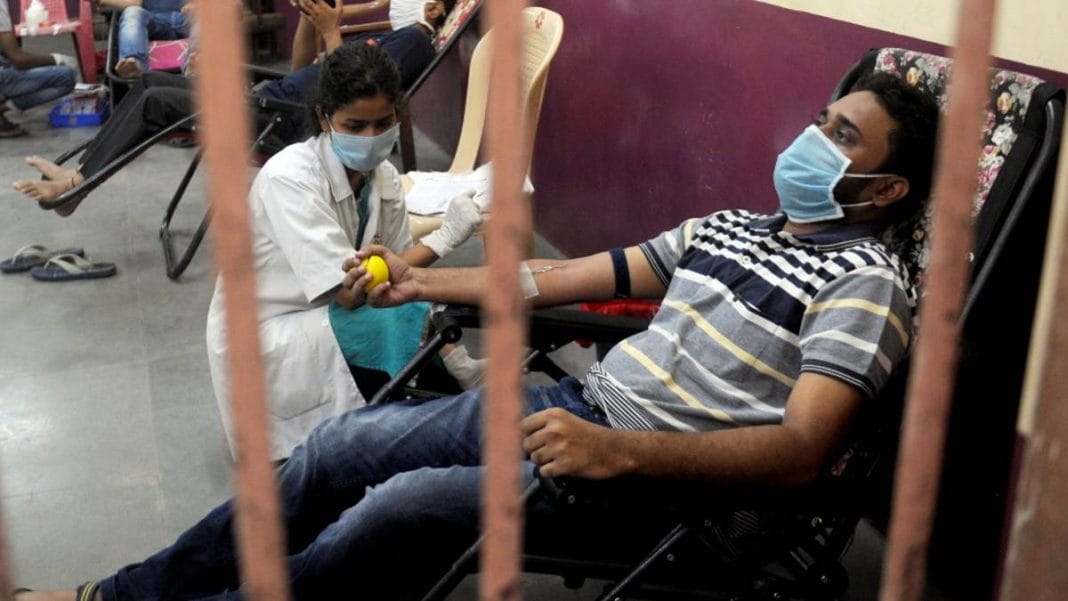



In 2017, the National Blood Transfusion Council (NBTC) and the National AIDS Control Organisation (NACO) published guidelines on blood donor selection and blood donor referral. Clauses 12 and 51 of the guidelines indefinitely ban transgender persons, men having sex with men (MSM) and female sex workers from donating blood.
The major downturn came to light during the Covid crisis, when people from the transgender community were unable to donate blood to their family and friends due to the restrictive guidelines, which turned out to be life threatening for those in need.
As the Supreme Court is yet to decide on the constitutionality of the guidelines in Thangjam Santa Singh @Santa Khurai vs Union of India & Ors, we need to look at the issue from the perspective of equality, dignity and discrimination.
The exclusion of aforementioned people from donating blood due to their sexual orientation and gender identity is prima facie unscientific, arbitrary and unreasonable, and enables passive discrimination.
All blood units are duly tested for infectious diseases which can be transmitted through blood, including hepatitis and HIV/AIDS. Excluding the persons mentioned under the clauses is violative of the right to be treated equally as other donors. Moreover, the negative perception of these people amounts to discrimination under Articles 14 and 15 of the Constitution.
Article 14 ensures equality before the law and equal protection of law. The apex court in NALSA vs Union of India has interpreted “person” mentioned under Article 14 to not be limited only to male and female, and transgender persons shall have full right to be treated as equal citizens with equal respect and non-discrimination.
Treatment as equal citizens would include them as blood donors and not discriminate on the basis of gender identity. There is absolutely no connection between facilitation of good quality blood and exclusion of these categories. Each unit of blood is duly checked and restricting a particular group from donation is a sheer violation of their right to equality.
Article 15 prohibits discrimination on the basis of religion, race, caste, sex, place of birth or any of them. The apex court in NALSA vs Union of India and Navtej Singh Johar & Ors vs Union of India said that discrimination on grounds of sex under Article 15 would include discrimination on the basis of sexual orientation and gender identity. Thus, excluding transgender persons and others from blood donation on the grounds of their orientation, without any imminent or actual harm, amounts to discrimination under Article 15.
These exclusions are made on the false stereotype that transgender persons and MSM are promiscuous, have HIV/AIDS, have unsafe sex, have multiple partners, etc., and are not based on any data or facts.
The apex court in Navtej Singh Johar held that “if any ground of discrimination, whether direct or indirect, is founded on a stereotypical understanding of the role of the sex, it would not be distinguishable from the discrimination which is prohibited by Article 15 on the grounds only of sex”.
The arbitrary exclusion of a particular group from donating blood affects their societal participation, which eventually makes them think that they aren’t worthy. This strikes at the core of the right to dignity enshrined under Article 21 of the Constitution which includes the right to live a dignified life as part of the right to life.
In Kharak Singh vs State of Uttar Pradesh, the apex court held that the term “life” used in Article 21 is something more than mere animal existence. Further, Sunil Batra vs Delhi Administration, emphasised that the right to life includes a healthy life to enjoy all faculties of the human body.
These principles were further strengthened in the landmark judgement of Maneka Gandhi vs Union of India, where it was held that the right to life encompasses the right to live with human dignity and all that goes along with that.
Excluding transgender persons, MSM and sex workers—already vulnerable because of poverty, lack of education, unemployment, inaccessible facilities in public spaces—from blood donation will also deprive the community from healthcare facilities and lead to their further ostracisation.
International norms on blood donation
Many developed and developing countries have revamped blood donation policies and removed such arbitrary bans. In the UK, an advisory committee on blood donation recommended a three-month deferral period for blood and plasma donation after sex between MSM or with a sex worker; however, there is no deferral and explicit ban on transgender persons.
In the US, new FDA regulations have no prohibition on transgender persons from being blood donors, and have a three-month deferral for MSM since their last sexual contact and three-month deferral for commercial sex workers since their last sexual contact. In 2023, the FDA shifted to a gender-neutral, risk-based screening system.
In May 2020, a progressive development emerged from the Brazilian Supreme Court which held that the 12-month deferral period for gay and bisexual men to donate blood is discriminatory in nature and hence, unconstitutional.
Putting a blanket ban on transgender persons, MSM and female sex workers from donating blood, without any scientific and reasonable basis, thus undermines the constitutional principle of equality and dignity. Moreover, these bans are grounded in stigma with no rational and legal backing.
Countries are moving away from such bans, and making such groups feel more included and heard. The constitutional challenge in Thangjam Santa Singh @Santa Khurai vs Union of India & Ors gives the apex court a pathbreaking opportunity to do away with such discriminating clauses and remedy this long-standing injustice. Such a step would reaffirm the constitutional promise of equality and dignity for all.
Varun Pratap Singh is a B.A.L.L.B. (Hons) student at Maharashtra National Law University, Chhatrapati Sambhajinagar. Views are personal.