





Thank you dear subscribers, we are overwhelmed with your response.
Your Turn is a unique section from ThePrint featuring points of view from its subscribers. If you are a subscriber, have a point of view, please send it to us. If not, do subscribe here: https://theprint.in/subscribe/
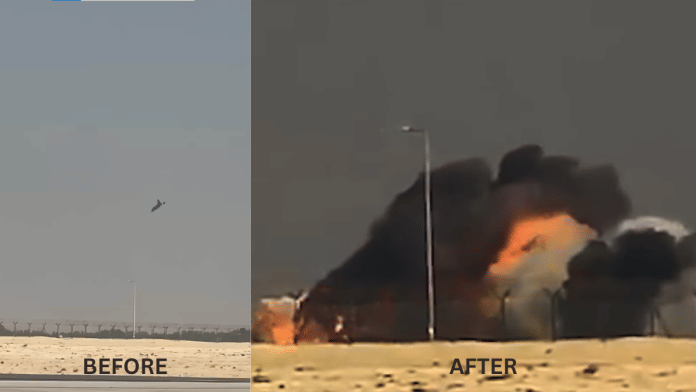
The tragic crash of an Indian Air Force Tejas fighter jet at the Dubai Air Show on November 21, 2025, has cast a long shadow over India’s indigenous defense ambitions. The HAL Tejas, a symbol of self-reliance, plummeted to the ground in a fireball during its aerial display at Al Maktoum International Airport, claiming the life of its pilot, Wing Commander Namansh Syal.
My condolences to his family and friends.
The tragic crash of the Indian Air Force’s Tejas fighter jet at the Dubai Air Show has raised more questions than answers. While the official inquiry is underway and no evidence of foul play has been established, the incident comes at a time when India is facing one of the most aggressive global disinformation and cyberwarfare environments in recent memory. The timing, the optics, and the information battlespace surrounding the crash demand a deeper examination — not of the pilot or the platform, but of the world India now operates in.
We have entered a geopolitical era where military power is challenged not only on the battlefield, but also through digital sabotage, deepfakes, cyber espionage, compromised supply chains, and coordinated global propaganda. Tejas—India’s symbol of self-reliance—has become a prime target for hostile narratives and foreign influence operations.
This is not speculation. It is pattern recognition.
When Disinformation Becomes a Weapon System
India has seen a surge in foreign-origin influence campaigns, many aligned with state-sponsored interests. A recent example: the circulation of a deepfake image claiming that the Rafale jet had crashed, meant to undermine India’s defense acquisition decisions. The image was debunked within minutes, but the damage was done — WhatsApp forwards, political memes, and social media attacks spread faster than the correction.
This is classic fifth-generation warfare. The new WMD: weapons of mass distraction! Yes, distraction!
The Tejas crash now sits in the same volatile information space. Even before recovery teams issued formal statements, thousands of coordinated posts — many from bot clusters — began claiming:
- Tejas is “unsafe”
- Indian defense tech is “inferior”
- Foreign jets should replace indigenous platforms
- India cannot “compete” with China’s aviation ecosystem
This is not a coincidence.
It is the new battlefield.
India’s Indigenous Platforms Face Asymmetric Pressure
Tejas represents more than an aircraft. It symbolizes:
- Supply-chain independence
- Strategic autonomy
- Reduction of Western and Chinese dependency
- Export potential across Asia, Africa, and Latin America
In the global arms market, every sale Tejas wins is a sale someone else loses.
That alone creates geopolitical friction.
Now add that:
- China is promoting its JF-17 aggressively
- Western players want to influence South Asian and ASEAN procurement
- Russia is pushing the Su-75 “Checkmate”
And suddenly, a Tejas crash at an international air show does not just become a technical incident — it becomes a geoeconomic inflection point.
Again:
This is not alleging sabotage.
But it is identifying vested global interests in controlling the narrative.
Understanding the Real Risk: Supply-Chain and Cyber Vulnerability
Regardless of what caused the crash, the broader issue India must confront is this:
Defense platforms are no longer vulnerable only to mechanical failure — they are vulnerable to digital compromise.
Modern fighters include:
- Fly-by-wire systems
- Real-time data buses
- Mission computers
- Telemetry links
- AI-assisted diagnostics
- Middleware for comms, targeting, and sensor fusion
Any one of these can be a vector for:
Malware, firmware manipulation, counterfeit chips, telemetry spoofing, or manipulated sensor data.
As someone who worked in past decades on avionics standards like ARINC 629, ISO 9646 test suites, and global telecom protocols, I can say with certainty:
any system dependent on digital integrity can be compromised if supply-chain trust is broken.
Even a minor weakness in:
- Vendor firmware updates
- Third-party components
- Maintenance software
- Remote monitoring tools
…can create systemic risk.
This is not science fiction.
It is the daily reality of cyber defense labs worldwide.
Geopolitics Meets Cybersecurity
When analyzing the Tejas crash, India must widen its lens:
- Was the platform compromised?
- Was the supply chain targeted?
- Were digital diagnostics manipulated?
- Were external threat actors running disinformation campaigns?
We do not presume any of these happened — but India’s adversaries are known for exploiting gray zones between truth and uncertainty.
China’s known playbook includes:
- Deepfake deployment
- Covert online propaganda
- Cyber reconnaissance
- Compromised hardware exports
Russia’s toolkit includes:
- Narrative warfare
- Misdirection around defense incidents
- Influence operations in South Asia
Western players, too, push hard to preserve their fighter jet export markets.
India must treat information integrity as seriously as hardware integrity.
The Most Dangerous Vector: AI-Amplified Disinformation
The Tejas crash marks one of the first major Indian defense incidents in the era of ubiquitous AI-generated disinformation.
Today:
- Deepfakes can be made in 30 seconds
- Social botnets can amplify a fake claim to 10 million views in an hour
- Foreign adversaries can shape online sentiment in real time
- False technical analyses can be inserted into news cycles
The battlefield has shifted from runways to GPUs.
India must respond accordingly.
India Needs an AI-Based Defense Integrity Model
India should transition to a new defense digital architecture with three pillars:
- Secure Data Mediation
Secure Data Mediation can:
- Validate data integrity
- Authenticate real-time telemetry
- Lock supply-chain changes
- Provide audit trails
- Detect anomalies across aircraft systems
This reduces systemic cyber risk.
- Conversational AI for Defense Audit Trails
Agentic AI systems can act as:
- Real-time defense analysts
- Flight log auditors
- Telemetry interpreters
- Disinformation detection engines
This ensures faster truth discovery and fewer narrative distortions.
- TRiSM: Trust, Risk & Security Management for AI
AI systems must be deployed with:
- Transparent models
- Explainable logic
- Ethical guardrails
- Secure data boundaries
To ensure India’s defense AI is trusted intelligence, not another attack surface.
A New National Priority
India’s enemies are not waiting.
Our response must be swift, coordinated, and technologically superior.
The Tejas crash should not erode confidence in indigenous capability — it should accelerate the modernization of India’s defense digital ecosystem.
Whether the cause was mechanical, human, or environmental, the message remains clear:
India must secure not only its aircraft — but its information, its supply chains, and its narrative.
This is the real lesson of Dubai.
The Tejas program will recover.
The bigger question is whether India will use this moment to transform the very foundation of its defense technology and cyber posture.
Akshay Sharma is a former Gartner analyst and contributor to both the SWIFT protocol for International Banking and ARINC 629 Databus used in Boeing and Airbus aircraft, for fly-by-wire. He served as CTO for firms supporting the World Bank, India’s DRDO, and Air Force. Now Chief Technology Evangelist for an AI/ML company, he is a board member of Somy Ali’s nonprofit No More Tears, and has over 30 published essays in ThePrint.IN. He draws inspiration from Swami Vivekananda’s teachings, and is a descendent of Maharishi Bhardwaj, inventor of the Vimanas.
These pieces are being published as they have been received – they have not been edited/fact-checked by ThePrint.