




In 1953, in the pages of the Loyola College Annual in Madras, my father—then an English Professor at Loyola College—asked a question that now reads like prophecy: Whither Democracy? He warned democracy could decay into spectacle—noise without thought, elections without discernment, liberty without responsibility.
Seventy years later, the question is no longer academic. It is urgent.
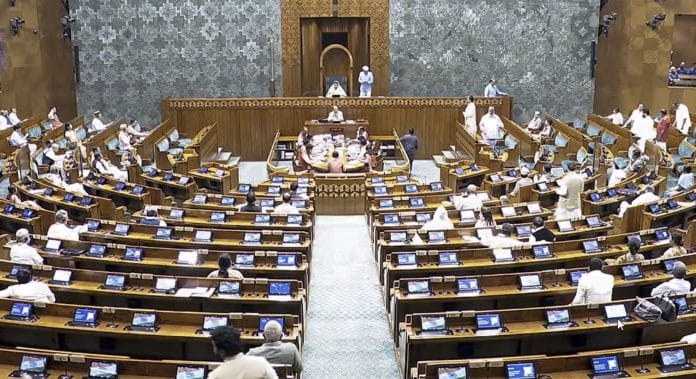
The recent Budget Session was described, politely, as “disrupted.” Let us call it what it was: a washout. Parliament—the Republic’s supreme deliberative body—reduced to a theatre of slogans, walkouts, and televised indignation. The ruling party accuses the Leader of the Opposition of “anarchic and politically uncivilised behaviour.” The Opposition insists it is defending democracy. Meanwhile, the citizen watches—tax-paying, law-abiding, bewildered.
Is this democracy in action? Or democracy in adolescence?
Let us be honest. We are not witnessing ideological combat of high principle. We are watching a collapse of incentives. For the government, brute majority makes debate inconvenient. For the Opposition, arithmetic defeat makes disruption profitable. If you cannot defeat a Bill, defeat the sitting. If you cannot persuade, provoke. If you cannot govern, grandstand.
The tragedy is not that tempers flare. The tragedy is that Parliament no longer fears irrelevance.
The office of Leader of the Opposition was meant to carry gravitas. In mature democracies, the LoP is the Prime Minister in rehearsal—disciplined, policy-ready, measured. In India, it risks becoming the Permanent Protester-in-Chief. But let us not absolve the ruling benches. A confident government should defend debate, not merely survive it. When both sides treat Parliament as a battleground instead of a forum, democracy becomes collateral damage.
And then there is the farce of representation.
How does a national leader contest from Wayanad —or wherever arithmetic demands—often with minimal organic connection to the constituency and call it representation? The law permits it. The Constitution allows mobility. But legality is not legitimacy. Representation without rooted accountability breeds distance, indifference, and eventually contempt.
Democracy is not a circus where candidates parachute in, harvest votes, and disappear into Lutyens’ Delhi.
But the rot is deeper than Parliament.
Federalism—the elegant balance between Centre and States—now resembles trench warfare. In one State, investigative agencies are obstructed. In another, Governors and Chief Ministers conduct public sparring that makes constitutional propriety look optional. Welfare schemes morph into pre-election cash transfers. Five thousand rupees today, applause tomorrow, fiscal headache next year. Competitive populism is not social justice; it is fiscal vandalism dressed as compassion.
Are we a democracy? Yes. Are we a mature democracy? Not yet.
A mature democracy is not defined by the frequency of elections. It is defined by the quality of deliberation between them.
Today, our politics rewards outrage over argument. Television prefers confrontation to comprehension. Social media monetises fury. Parliament reflects the culture outside its walls. When citizens cheer disruption because “our side” is doing it, they mortgage their own future. The penalty for not being interested in politics, Plato warned, is to be governed by those worse than ourselves.
The penalty for tolerating bad politics is worse government.
Do we need Parliament? Absolutely. Without it, we drift toward executive dominance punctuated by electoral rituals. Parliament authorises taxation, scrutinises spending, and questions power. A “washout session” is not harmless drama. It is the evaporation of oversight. Every disrupted Question Hour is a question not asked. Every stalled debate is a clause unexamined. Every adjournment is a citizen unheard.
Democracies rarely die dramatically. They decay gradually. Norms erode. Standards slip. Outrage becomes currency. Accountability becomes optional.
And yet, despair is lazy.
India remains fiercely electoral. Governments fall. Chief Ministers lose. Prime Ministers are challenged. Voters are not fools. But electoral vibrancy cannot substitute for institutional dignity.
We need reforms that sting: automatic financial penalties for disruption; guaranteed Question Hour; mandatory committee scrutiny for major legislation; a fixed parliamentary calendar; Speaker neutrality fortified by transparent rules.
Most of all, we need political adulthood.
The Leader of the Opposition must look like a Prime Minister in waiting. The Prime Minister must look like the custodian of debate, not merely its beneficiary. Chief Ministers must resist converting treasuries into campaign vaults. Governors must remember they are constitutional referees, not political players.
And citizens—yes, citizens—must stop applauding their own side’s excesses.
My father wrote in 1953 that democracy must cultivate the capacity “to distinguish, to understand, and to uphold.” That capacity is not inherited. It is practised.
Whither democracy, India?
The answer is not predetermined. It depends on whether we choose noise or nuance, theatre or thought, slogans or substance.
Democracy is not a self-executing machine. It is a discipline. And discipline, unlike outrage, is unfashionable.
But without it, we may keep the elections—and lose the Republic.
These pieces are being published as they have been received – they have not been edited/fact-checked by ThePrint.