




Thank you dear subscribers, we are overwhelmed with your response.
Your Turn is a unique section from ThePrint featuring points of view from its subscribers. If you are a subscriber, have a point of view, please send it to us. If not, do subscribe here: https://theprint.in/subscribe/
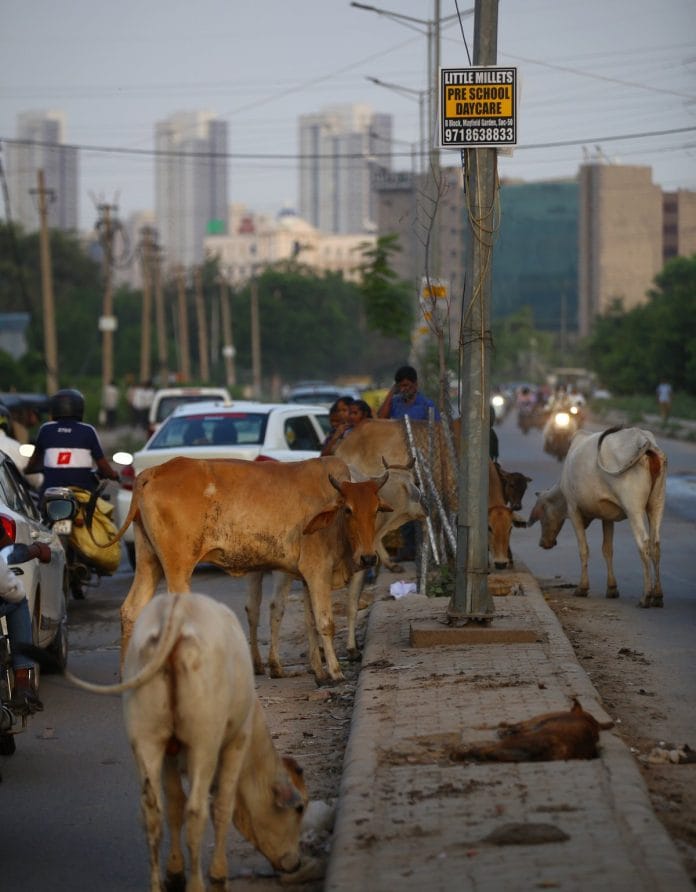
A Delhi School faces closure demands amid unproven allegations of religious discrimination. An image circulating on social media from Delhi shows a troubling scene: a crowd gathered outside a school, shouting slogans demanding that the institution be shut down and converted into a gaushala. Even as facts are still being verified by the mainstream press, the image has already done its work. It has unsettled many not because it may be an isolated act of aggression, but because it mirrors a larger ideological drift that has been unfolding across India for years — one where education itself is increasingly viewed with suspicion.
This is not a story about cows or compassion for animals. It is a story about power and fear, and about a political ecosystem that appears deeply uncomfortable with an educated, questioning population.
Education as a Site of Political Anxiety
Education has always shaped political consciousness, but rarely has it been treated with such overt hostility. In contemporary India, schools and universities are no longer merely institutions of learning; they are being reimagined as ideological battlegrounds. The classroom, once seen as a space for inquiry and debate, is now frequently portrayed as a site of indoctrination, subversion, or cultural betrayal.
This anxiety is not accidental. Education equips people with the ability to compare narratives, interrogate authority, and recognise propaganda. It teaches historical continuity, constitutional values, and the distinction between faith and state power. An educated citizen does not easily accept simplistic slogans or manufactured enemies. For those invested in governing through fear and spectacle, this becomes deeply inconvenient.
The sustained attacks on curricula, the removal of historical material deemed “uncomfortable,” and the branding of universities as anti-national are not isolated policy decisions. They form part of a broader effort to discipline thought itself. When thinking becomes dangerous, schools inevitably come under pressure.
The idea that a school can be surrounded, intimidated, or publicly delegitimised points to a political culture that no longer sees education as a public good but as a liability. The fear is not of what is taught in any single institution, but of what education does collectively: it creates citizens rather than subjects.
The Weaponisation of Cow Politics
The demand to replace a school with a gaushala must be understood not as a spontaneous outburst of religious devotion but as a carefully cultivated political gesture. Over the last decade, the cow has been transformed from a religious symbol into a tool of mobilisation and control, deployed to redraw the boundaries of belonging in public life.
Cow protection, in this context, has little to do with animal welfare. India is replete with underfunded shelters, abandoned cattle, and farmers struggling with stray cows destroying crops. These realities rarely provoke mass mobilisation. What does provoke mobilisation is the cow as a political symbol — one used to assert dominance, intimidate minorities, and police civic spaces.
When a crowd declares that a cow shelter is preferable to a school, it is making a stark ideological claim: that symbolic religiosity outweighs the right of children to education. This is not reverence; it is replacement politics, where constitutional priorities are displaced by performative cultural assertion.
Such demands are especially dangerous because they invert moral reasoning. Education, which expands opportunity and social mobility, is framed as suspect or unnecessary. Meanwhile, symbolic acts are elevated as markers of national and cultural loyalty. This inversion does not strengthen society; it hollows it out.
The cow, in this political usage, becomes less about faith and more about obedience — a test of who aligns with the dominant narrative and who does not. Schools, by their very nature, resist such tests. They teach plurality, disagreement, and complexity. That is precisely why they are unsettling to authoritarian impulses.
What This Moment Reveals
At its core, the hostility toward schools reflects a deeper fear: that an educated mass cannot be easily mobilised through myth alone. Education introduces nuance in a space in which slogans demand certainty. It introduces empathy where polarisation thrives. It encourages historical memory where political projects depend on amnesia.
The real danger is not that a school might be converted into a cow shelter. The real danger is the normalisation of the idea that education is negotiable, that it can be subordinated to ideological pressure, and that intimidation can decide the fate of civic institutions.
A society that begins to rank symbols above schools is not defending culture; it is surrendering its future.
* About the author
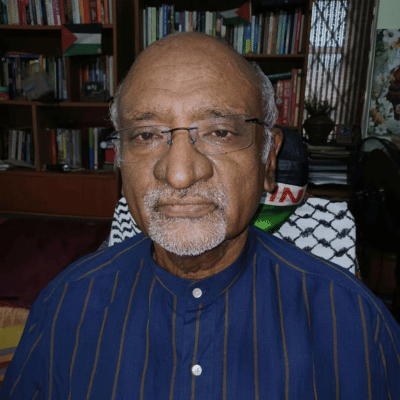
Dr. Ranjan Solomon has worked in social justice movements since he was 19 years of age. After an accumulated period of 58 years working with oppressed and marginalized groups locally, nationally, and internationally, he has now turned a researcher-freelance writer focussed on questions of global and local/national justice. Since the First Intifada in 1987, Ranjan Solomon has stayed in close solidarity with the Palestinian struggle for freedom from Israeli occupation, and the cruel apartheid system. He has initiated solidarity groups in India, Afro-Asia-Pacific alliance, and at the global level. Ranjan Solomon can be contacted at ranjan.solomon@gmail.com
These pieces are being published as they have been received – they have not been edited/fact-checked by ThePrint.