





Thank you dear subscribers, we are overwhelmed with your response.
Your Turn is a unique section from ThePrint featuring points of view from its subscribers. If you are a subscriber, have a point of view, please send it to us. If not, do subscribe here: https://theprint.in/subscribe/
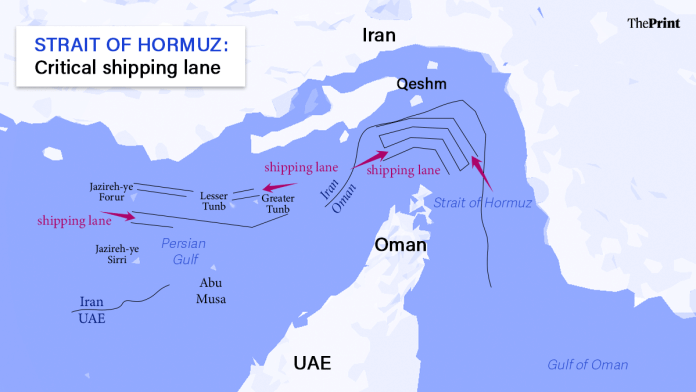
The Strait of Hormuz crisis in 2026 was more than just another case of unrest in the Middle East. It was a moment that showed the basic contradiction at the heart of globalization: strong economic links based on limited geographic vulnerability.
As tensions grew between Iran and a coalition led by the US and Israel, the world was reminded that a strip of water less than 40 kilometers wide could affect the stability of global markets. A long-term blockade isn’t necessary to cause problems in this situation. There was a good chance that it would close, which was enough. Hormuz once again became the link between competition in the region and danger to the whole system.
The structure of a choke point
The Strait of Hormuz is the main waterway for Persian Gulf oil and gas exports. It moves about 20% of the world’s oil use and a lot of liquefied natural gas (LNG) every day.
Saudi Arabia, Iraq, Kuwait, Qatar, and the United Arab Emirates are some of the countries that depend on it for their economies to stay alive. At the same time, countries like India, China, Japan, and South Korea that depend on a lot of imports need a steady supply from the Gulf. Hormuz is important to world politics because of this uneven dependence. Control does not require permanent occupation. People have power because they can cause trouble.
Energy Security and Strategic Independence
The crisis brought up new questions about energy security. In the last ten years, the United States has produced more goods locally, which has made it less vulnerable to direct threats. However, global price swings still affect consumers at home.
The math is harder for Asian powers. India and China still rely significantly on Gulf supplies. Both have strategic petroleum stocks, but a long-term disruption would hurt trade and fiscal accounts.
The crisis showed a paradox: even though Gulf energy has helped Asia’s economy grow, Asia can’t directly affect the strategic rivalry in the Middle East.
This puts people in a situation where they are vulnerable but have no power. Because of this, policymakers are talking more and more about expanding renewable energy, not just as a way to fight climate change, but also as a way to reduce the risk of chokepoints. Solar farms, offshore wind farms, and battery storage all help the environment and the strategy.
The economic ripple effect
Energy shocks don’t usually just happen in oil markets. Prices went up in the fertilizer, petrochemical, shipping, and food supply chains.
Emerging economies are in the most pain right now. Currency depreciation and rising import costs can both make fiscal imbalances worse and cause political instability at home. Central banks have to choose whether to make policy stricter when the economy slows down. The Strait of Hormuz is a macroeconomic pressure point that can change how people think about global growth and inflation.
Strategic signaling and deterrence
The 2026 event changed more than just the economy in the area; it also changed security. Iran proved that it doesn’t need to make the strait illegal to get what it wants. A lot of people were scared just by showing off naval power, missile capabilities, and asymmetric tactics. The US responded by sending more ships to patrol the area and working with partners in the Gulf. Israel’s support for American policies changed the situation in the region. Each move made the stories about deterrence stronger but also made it more likely that someone would make a mistake.
Hormuz is once again the place where competition in the region meets consequences around the world. Marine chokepoints have immediate and shared costs, unlike land battles that happen far away.
The Geographic Limitations of Globalization
The crisis brought attention to a bigger structural problem. Globalization says that trade routes are always changing and infrastructure is always stable. But some of these routes go through small corridors, like the Hormuz, Bab el-Mandeb, and Suez Canal, where instability in one place can affect whole systems.
The issue is that economic integration makes political distance smaller, but it doesn’t get rid of geographic limits. Integration actually makes chokepoints more likely to happen. The system is more likely to break down when the economy is more tightly connected. Hormuz is not just a problem in the region; it is a key part of the world economy.
A key moment in strategy
The crisis of 2026 may have been more of a strategic turning point than just one flare-up when you look back. It sped up talks about using different types of energy, made the case for strategic reserves stronger, and stressed the need for working together on maritime security.
The event showed Gulf producers how important it is to have economies that aren’t just based on oil and gas. It made the case stronger for finding new sources of supply in Asia, which relies heavily on imports, and for speeding up the use of renewable energy. It showed that geopolitical risk was still a part of commodity prices on the global market.
A small stream showed once more how weak the ties between countries are. Hormuz is a good example of how geography, not just trade deals and money moving around, is what makes globalization work. And geography doesn’t make deals. The 2026 crisis wasn’t really about a specific conflict; it was more about the long-standing tension between economic integration and strategic competition. The waterway is still open, but it still has an effect on world stability. In 2026, the Strait of Hormuz did not close. But there was always a chance of closure. The crisis showed that in a society where everything is connected, perception can be just as powerful as action.
About the author:
Anusreeta Dutta is a columnist and climate researcher with experience in political analysis, ESG research, and energy policy.
These pieces are being published as they have been received – they have not been edited/fact-checked by ThePrint.