




Thank you dear subscribers, we are overwhelmed with your response.
Your Turn is a unique section from ThePrint featuring points of view from its subscribers. If you are a subscriber, have a point of view, please send it to us. If not, do subscribe here: https://theprint.in/subscribe/
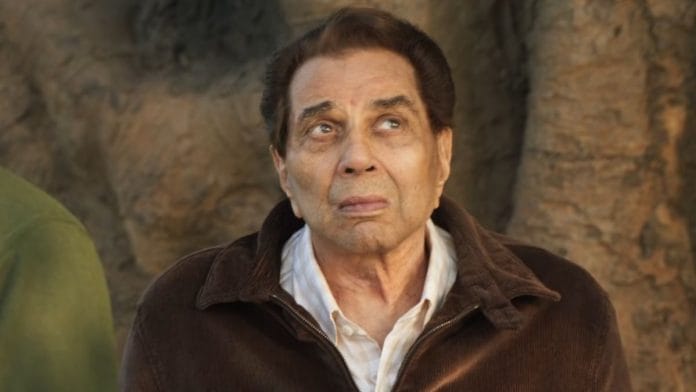
Dharmendra is (I use present tense for the simple reason that the performances of Dharmendra will always be there like Moti Lal, Madhubala, Ashok Kumar, or Dilip Kumar} one of the finest actors of all times. He acted across all genre, even sub-genres. “Shatyakam” is about a Gandhian to a fault or in “Mamta” where he encourages the heroine to stand for her biological mother when she thought she is the daughter of the famous barrister. But as a teenager in early 1970s the genre that fascinated me and my friends was his “revenge”.
Somewhere in the early part of the movie we would watch, mesmerized, Dharmendra tied to a pole with manila rope crossing his chest in an ominous X and either his weeping widowed mother or his small brother or unmarried sister or all of them tied to poles. It used to be a vague warehouse with lot of boxes or tyres and villain’s henchmen lined across with fifty shades of sinister sneer. The villain would walk across is slow menacing gait leering at his sister voicing some bombastic threats. Dharmendra would strain at the rope and utter “Dog, I will drink you blood!” This sounds lame in English but gave goosebumps when he delivered the threat in Hindi with an expression of cruelty, helplessness, and explosive anger. We knew that the game was on and all of us sitting in the dark huge movie hall with two to three thousand audience, relaxed and saw him, brick by brick, decimate the evil empire of the bad man.
Times were simple and innocent. There were hardly any weapons. It was mostly fists fights and occasionally a knife with sudden worrying background score. In the end either police would appear to apprehend the evil man when Dharmendra had beaten him to the skin of his teeth or the powers that be, would trap the villain in a situation where he would die. Remember “Yadon ki Barat” where Shakal is caught between the shifting train tracks and is killed by a speeding train. We clapped as Dharmendra avenged the killing of his parents by Shakal. Or recall when Dharmendra beats Gabbar to pulp for killing his soul mate. Police arrive at the last moment to arrest Gabbar.
Then the 1971 war with Pakistan happened and some ninety thousand POWs arrived in India. The euphorbia lasted a while but our economy tanked, inflation skyrocketed, jobs disappeared and the campuses went up in flames. Some universities declared “Zero” academic sessions while the students and police battled each other within and without the campuses. JP movement and Emergency changed the fabric of the society. An angry young man as the new cult hero emerged. He was more violent, often joined the mafia gangs and would cut open his opponents, literally. The era of Dharmendra’s revenge was over. We had also grown up, got jobs, and raised kids.
It was 1964 and I was ordered to accompany my two teenage brothers to a movie “Haqeeqat”. They were some ten years elder to me. Towards the end Dharmendra kept firing his LMG towards human attacking Chinese to the last bullet and to his last breath, Mohamad Rafi’s soulful song “Ab tumhare hawale watan,” a farewell of a solider to the nation starts in the background. A young boy lets out an anguished high-pitched scream, the camera pans on all the dead Bravehearts. I looked at my brothers. They were weeping, silently without shame. I never ever saw them cry again in life. I looked around the dark cinema hall and found everyone crying and sobbing openly. They were lamenting at one of the most humiliating defeats of a proud nation.
But as I said, Dharmendra, a par excellent performer, lives. At times I see my daughter and her friends watching his movies like “Chupke chupke” on OTT platforms, laughing. He still entertains and moves everyone to tears, laughter and anger.
These pieces are being published as they have been received – they have not been edited/fact-checked by ThePrint.