





Thank you dear subscribers, we are overwhelmed with your response.
Your Turn is a unique section from ThePrint featuring points of view from its subscribers. If you are a subscriber, have a point of view, please send it to us. If not, do subscribe here: https://theprint.in/subscribe/
India and Russia are discreetly investing in a new map of linkages between countries that is much more essential than making trade simpler in the short term. This happens when wars, sanctions, and strategic competition mess up the flow of goods around the world. As a result of their growing interest in new trade routes, especially the International North-South Transport Corridor (INSTC), both countries are thinking more seriously about their economic security in a world that isn’t globalized. The “new route” between India and Russia looks like it’s all about logistics at first glance. It cuts down on shipping costs, transit time, and traffic bottlenecks. In reality, it’s about protecting yourself strategically from Western sanctions, weak points in the marine industry, and a global commercial system that is becoming more and more political.
From sea lanes to important corridors
For a long time, the Suez Canal was the main way for India and Russia to trade. In a stable global order, these pathways worked well, but they are weak in today’s world. The Russia-Ukraine conflict, Red maritime disruptions, and sanctions that make it hard to get insurance and make payments have all shown how dangerous it is to rely too heavily on traditional maritime lanes.
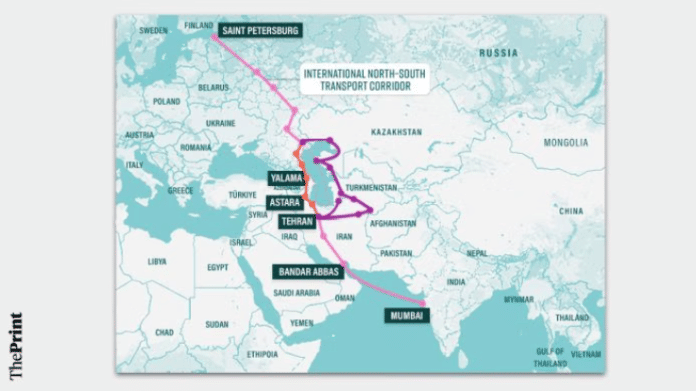
The INSTC suggests a different route: a multimodal corridor that links India to Russia through Iran and the Caspian Sea, using ships, trains, and roads. From Indian ports, cargo goes to Iran’s Chabahar or Bandar Abbas, then north through Iran, across the Caspian Sea to Russia, and finally to Europe and Central Asia. Not only does the corridor cut down on travel time by about 40%, but it also gives you more control. This path goes through countries that are either under sanctions, resistant to sanctions, or working together to fight Western pressure.
What makes this route important to India?
The corridor solves three strategic problems for India at once. First, it makes sure that trade with Russia goes on even when Western sanctions make payments, shipping, and insurance harder. Energy imports, fertilizers, defense supplies, and machinery all need stable logistics and diplomacy.
Second, it makes it easier for people in India to connect with other countries on the continent, which has been hard for New Delhi to do because of its geography and politics. Because Pakistan has limited overland access to Central Asia, Iran has become India’s most important gateway to the west and north.
Third, the path fits with India’s long-term goal of strategic independence. India is not choosing between Western and Eurasian systems. Instead, it is making things more flexible by creating multiple paths that make it less dependent on any one group. This is not an anti-Western message, which is important. It is risk diversification, which even US allies are starting to accept.
Iran: The Middle of the Strategy
Iran is the quiet but important character in our play. Even though there are sanctions, Tehran has become an important logistical center for South Asia, Eurasia, and Russia. The route is possible because India is putting money into the Chabahar port and Iran is improving its roads and railroads. This means transit income, diplomatic power, and economic importance for Iran.
India doesn’t like Iran’s involvement, but it has to happen. New Delhi has carefully described its involvement as based on connectivity rather than alliances. This has allowed it to follow the rules while still keeping long-term strategic access. The corridor thus represents a subtle aspect of modern geopolitics: connectivity frequently moves quicker than consensus.
Payments, insurance, and hard limits
There is some disagreement about the India-Russia link, even though it has a lot of potential.
Payment systems are still hard to deal with. Rupee-rouble trade has been uneven, and settling payments in a third country’s currency makes things even less stable. Insurance for cargo that passes through areas that are under sanctions is still costly and hard to predict. Infrastructure problems, especially with Iran’s rail network, make it hard to scale up.
These limits are important because they show what the corridor really is: it’s not a way to solve global trade problems; it’s a parallel system that is smaller, slower, and safer for politics. And it might be enough.
Conclusion: A Route Signaling a World in Transition
The “new route” between India and Russia is more than just a quicker way to get things from one place to another. This is about changing how power is moved. It shows a future where states don’t work together, they build corridors instead of relying on oceans, and resilience is more important than efficiency. It is not clear if the INSTC will reach its full potential, but it is clear that it is important politically.
In today’s broken world, geography has once again become fate. India and Russia are quietly changing the map.
——————————————————————————————————————
About the author:
Anusreeta Dutta is a columnist and climate researcher with prior experience as a
political researcher and ESG analyst.
These pieces are being published as they have been received – they have not been edited/fact-checked by ThePrint.