




Thank you dear subscribers, we are overwhelmed with your response.
Your Turn is a unique section from ThePrint featuring points of view from its subscribers. If you are a subscriber, have a point of view, please send it to us. If not, do subscribe here: https://theprint.in/subscribe/
No government is perfect, nor is any political leader. This is an axiomatic truth. Even the leaders of the party in power are politicians first and government functionaries afterwards. This is logical and practical because, unless they get elected, how will they bring their party to power? To get elected, it is paramount that they beat their rivals in the political games. The elected opposition leaders and their parties can continue to play politics even after being elected, as they are not directly charged with delivering much to the nation and its citizens. The country only expects them to be a responsible and constructive opposition; unfortunately, the current opposition fails that test. The party in power and its leaders have a more difficult role, since they have to keep ahead in political games without falling back on their deliverables.
When the opposition is weak and frustrated with a defeatist mindset, as is ours in the parliament today, the situation becomes a serious concern for the nation. It is weak because it lacks national-level leadership, notwithstanding Rahul Gandhi. Barring the Congress, other parties are principally regional parties with insignificant national presence and leadership. These parties primarily concentrate on their home turf to ensure a continued hold in their state, lest the BJP wrest that from them as it has done to the Congress at the Centre over the last decade. These regional parties, therefore, do not accept any Congress hegemony in their states.
The Congress leads the opposition in parliament because of its national presence and long history, which in turn gives it more seats by default at the national level, as seen in the last three general elections. This, once again by default, results in Rahul Gandhi becoming the Leader of the Opposition (LOP), but with hardly any credibility or acceptance in the opposition ranks. The situation gets worse because, despite three consecutive national losses, the Congress party and its leadership have still not come to terms with the reality that they are now in opposition. This also explains Rahul’s constant personal barbs against Mr Modi. The whole nation and well-meaning Congressmen know that the party under Rahul Gandhi has no hope for a resurrection. Sooner or later, the Congress party under Rahul Gandhi will register a century of election losses at the state and national level since 2014.
The opposition and the LOP, Mr Gandhi, are barking up the wrong tree if they cannot see the deliveries, achievements, and growth under Mr Modi’s government. In all probability, they do so deliberately because, barring when Mr Narasimhan was the Prime Minister, no other past government comes even close in the last five decades. Even the data, both Indian and from foreign rating agencies, support the Indian growth story. One can always argue that progress could have been better, but that cannot be an excuse for their blindness to what is being achieved in various spheres. It is not for nothing that the nation has given a mandate to the BJP-led NDA and Mr Modi for the third time in a row.
At the national level, the opposition’s ‘opposition for the sake of opposition’ approach is misfiring over time, and yet there is no course correction. It spills over into issues of national importance and security, and the opposition gets branded as anti-national. This is not a good sign for the country or the opposition. After Operation Sindhoor, Rahul had remarked that ‘India had surrendered’. This was used and exploited by Pakistan to further their claims of a make-believe victory and to paint India as the aggressor in international forums. The LOP deliberately ignored the country’s unparalleled successful strikes against key Pakistani targets with unmatched accuracy, which the world was applauding. Will any Indian, much less a Leader of the Opposition, ever make such remarks to downplay his own country’s achievements? Without a doubt, this was a fallout of the perennial opposition mode that the opposition practices today.
In non-BJP-ruled states, opposition parties are busy protecting their home turf to avoid being marginalised. Regrettably, this results in unproductive conflicts with the Centre over trivial issues, often hindering the state’s progress. The issue of the Hindi language in Tamil Nadu, religion-based reservations in the states of Karnataka & Telangana, blatant minority appeasement in West Bengal and Kerala, and opposition to the deportation of illegal migrants in West Bengal and Jammu & Kashmir are prime examples in this regard. Special Intensive Revision (SIR) of voter lists, a much-needed and constitutionally valid exercise, is being opposed in all non-BJP-ruled states with no valid reasons. Instead of assisting the government in this much-needed exercise, they are putting roadblocks in its execution. Such antagonism against the BJP in the state manifests itself at the Centre also in various ways, leading to baseless opposition in the national parliament.
The opposition is seen as an alternative government in waiting. The key deliverables of an effective and constructive opposition in a democracy include ensuring government accountability and transparency, providing checks and balances, offering alternative policies, engaging in robust debates, participating in key parliamentary committees and oversight bodies, highlighting public concerns, and taking key issues to the public to seek their opinions. Does the Indian opposition meet these expectations? It may be prudent to discuss each aspect objectively to arrive at the right answer.
On the accountability front, the opposition has always come a poor second because of a lack of numbers and an unwillingness to discuss the tabled bills and matters in the parliament objectively. This, in turn, results in its inability to provide the necessary checks & balances. When it comes to alternative policies or suggestions for bills in the public interest, the opposition scores a nought. Their chronic opposition to government actions compromises their objectivity. The opposition insists on debates, but not on issues and subjects that the government lists. It demands discussions only on issues, at times farcical, that it hopes will give it political mileage. If the government declines or delays listing matters of its choice, it disrupts the parliamentary proceedings without batting an eyelid. Most bills and matters listed by the government invariably get a short shift and are passed without any substantial discussion. In public forums and rallies, the opposition only exploits issues that help it politically or show the government in a poor light, but fails to outline any vision for the nation.
If this is the state of affairs, it is obvious that the opposition fails the nation and its people on the ‘expectations’ front. And this has been the story for over a decade now. Is the nation poorer for want of an effective opposition? It definitely is since the opposition is an essential part of a democracy. Is there any hope in the country for a constructive opposition in the near future? As things stand today, there appears to be none for many reasons. The BJP’s arrival since the 2014 national elections has stupefied the opposition to no end, and it keeps floundering year after year.
In such a scenario, the moot question is ‘What is required to develop a worthy opposition in the country that can actually be seen as an alternative government in waiting?’ (continued in Part 2).
Part 2
The opposition in the Indian parliament, the I.N.I.D alliance, is a fragile coalition of over thirty political parties with 234 members in the Lok Sabha (LS). About eight of them have no representation in the parliament. The only party with a national footprint is the Congress party, which has 101 members. The next best is TMC from West Bengal with 29, followed by DMK with 22 and Andhra Telegu Desam (TDP) with 16. All others have single-digit seats, and eight have no representation in the parliament. These parties are primarily regional parties with regional interests and no national vision. Their sole focus in parliament is to safeguard their local interests, aimed at retaining their strengths in their states and the challenges posed by the BJP.
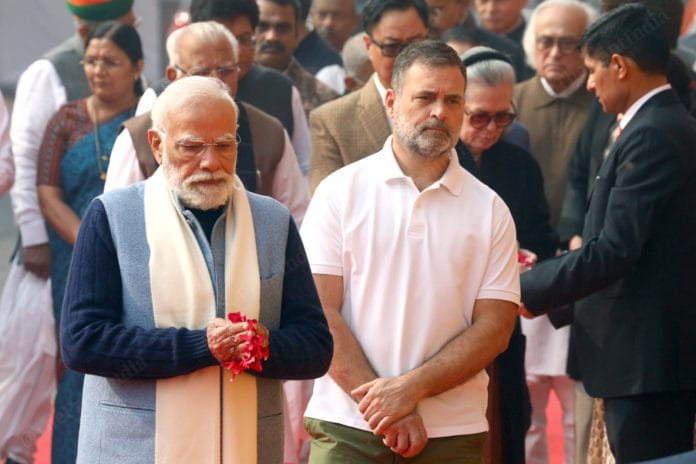
By default, Rahul Gandhi from the Congress is the Leader of Opposition (LOP).
How opposition is helping the BJP to consolidate and making Albert Einstein’s ‘Great spirits have always encountered violent opposition from mediocre minds’ come true.
Being in opposition does not necessarily translate into enmity with those sitting on treasury benches. (Sigmund Freud)
Opposition sounds true to what John F Kennedy said, ‘There will always be dissident voices heard in the land, expressing opposition without alternatives, finding fault but never favour, perceiving gloom on every side, and seeking influence without responsibility.’
Rahul & Co. must understand that discrediting your opponents will not make it easier for you to win. To win, you have to first have a vision supported by an executable plan to achieve that vision. At the national level, it is not about appeasement of a minority or cultivating any particular section of the society, like SC/ST in India. A repeated dose of the status of SC/ST/OBC/Dalit and other similar categories of citizens can only be counterproductive, particularly if the opposition’s track record itself has been below par. It does not sit well with either these sections themselves or the rest of the population.
Playing politics is fine and expected, but being derogatory, disrespectful, and … against a three-time elected Prime Minister with an enviable track record as a three-term CM of one of the more developed states in India will never pay dividends. Personal grudges, grievances, and dislikes have no place here. More so, when one’s own track record has nothing to boast of and is, in fact, dismal to put it bluntly.
Most regional parties are dependent on the Congress for leadership, as they will always have the largest number of seats because of its national presence and a dedicated vote share of 20%. The foremost interests of these parties are regional, including safeguarding their fiefdoms.
To do:
Leadership
These pieces are being published as they have been received – they have not been edited/fact-checked by ThePrint.