





Thank you dear subscribers, we are overwhelmed with your response.
Your Turn is a unique section from ThePrint featuring points of view from its subscribers. If you are a subscriber, have a point of view, please send it to us. If not, do subscribe here: https://theprint.in/subscribe/
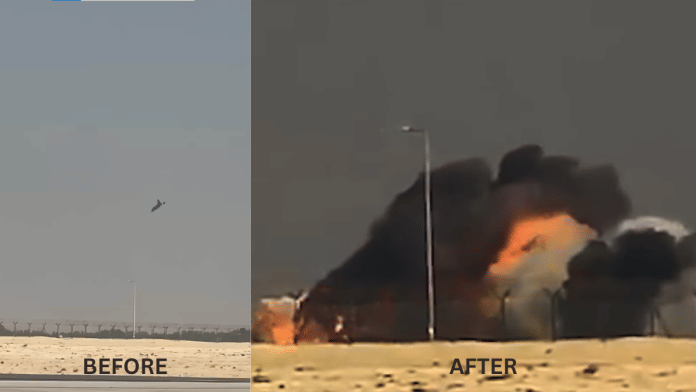
The recent crash of indigenous ‘Tejas’ light combat aircraft (LCA) casts new doubts on aircraft’s quality. The sad demise of the Wing Commander Namansh Syal gripped the nation in sorrow. In a surprising demonstration of solidarity several ex-fighter pilots across different nations came in defense of both the late brave pilot and his aircraft – the pride of make in India – HAL Tejas LCA. However, LCA program remains haunted by the shadows of pitiful production capacity and severe challenges in indigenization of key technologies. Perhaps it’s time to focus on what HAL (Hindustan Aeronautics Limited) can do rather than what the Indian government and the Indian Air Force (IAF) wants them to do. HAL’s jet trainer (HJT-36) aircraft could become a success story that the nation so desperately needs.
The Dubai airshow, 2025 presented a tragic site when the IAF Tejas crash killing the pilot Wing Commander Syal. This tragic view was unfortunately followed by a severely insensitive gesture by the Dubai airshow authorities as they continued with the airshow to cheer the crowd immediately after the crash. The shocking and insensitive attitude of the show’s organizers prompted United States Air Force (USAF) Captain Taylor “Fema” Heister to speak up in solidarity for the late IAF pilot. In a surprising demonstration of camaraderie among fighter pilots across the globe, many ex-fighter jet pilots from UK , USA and aviation expert from France spoke-up in solidarity through their social media platforms. These experienced pilots agreed upon one common point – at Dubai airshow, Tejas’s flight maneuvers were too risky to be performed at such low altitudes. In the future, new guidelines would be necessary to ensure sufficient safety zone available to the pilot by setting minimum altitude requirements.
HAL came into negative light in the aftermath of the crash not because of any flaw in the Tejas aircraft but for their general inability to deliver on time. Tejas aircraft is a very sophisticated machine with innumerable complex components acquired from various nations along with the indigenous components. HAL is inexperienced at making such complex frontline modern fighter with state-of-the-art avionics from ground up. The production gets hampered with additional demands by the government and the IAF to keep the aircraft future-worthy. Under such constraints when the HAL is failing to even win over the IAF, it is no surprise that HAL failed completely in securing any foreign order for Tejas.
One core goal of ‘Make in India’ campaign is to secure foreign orders as that would be the best metric for judging the success of this campaign. Here, I believe that HAL is unnecessarily rushing to prove that they can sell the modern fighter jets to foreign countries. We need to have a long-term view on acquiring foreign orders. HAL has two main products – HJT-36 and HTT-40 – both are trainer aircrafts in which the HJT-36 has jet engine and the HTT-40 has a turboprop (propeller) engine. These aircrafts are smaller, much simpler in design, require fewer foreign components and can be a very cost-effective solutions for smaller air forces in Africa and Asia. The jet trainer HJT-36 whose production will start in 2026, is capable of limited combat role and it can fire guns, rockets and deliver small bombs to the target. It is not unimaginable that in future these smaller fighter-trainers could be deployed as part of anti-drone warfare even by the IAF.
Manufacturing engines have always been the Achilles’ heel for the HAL. Jet engine for the HJT-36 is of the Russian origin (Al-55i engine; UEC Saturn) and the HTT-40’s turboprop engine is purchased from the US (TPE331-12B engine; Honeywell Aerospace). The good news is, with Russia, we have complete technology transfer agreement. Similar agreements could be hoped with the US firm if we secure sufficient orders.
We can take a page or two from the success stories of Indian motorcycle sales in Africa. Indian bikes completely elbowed out their Chinese and Japanese competitors. India enjoys deep cultural ties in African and Asian countries. Indian armed forces are viewed with respect due to our long tradition and commitment to United Nations’ peacekeeping missions in these regions. Many young cadets from these nations come to our defense academies for military training. There is no doubt that if India offers her trainer aircrafts as part of a larger program to modernize training of the recipient country’s air forces, we are sure to secure large orders. These trainer aircrafts will not fulfil the role of frontline fighters even for small third world countries but, these will enhance training and modernization of smaller air forces in Africa and Asia. Such long-term defense engagements will help both the ‘Make in India’ campaign and our geopolitical significance.
These pieces are being published as they have been received – they have not been edited/fact-checked by ThePrint.