





Thank you dear subscribers, we are overwhelmed with your response.
Your Turn is a unique section from ThePrint featuring points of view from its subscribers. If you are a subscriber, have a point of view, please send it to us. If not, do subscribe here: https://theprint.in/subscribe/
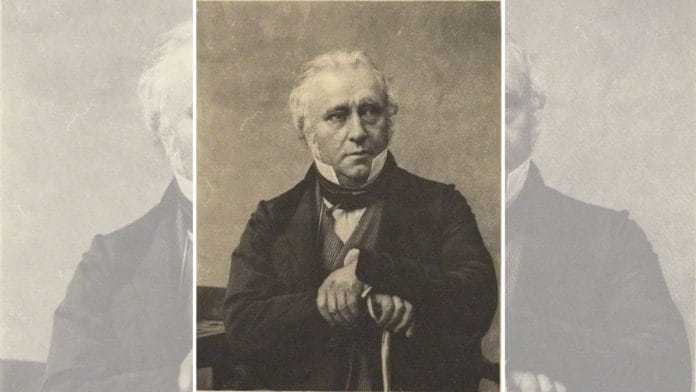
Macaulay was a simple-minded administrator who had a staffing problem. To fill lower-level positions in the (East India) company’s growing Indian administrative set up, even if the Brits could be found, they would not be cost-effective. His believed that Indians were ‘sufficient’ to handle lower positions once they learnt English. The added advantage was higher Brit officials need not learn the local languages. The lower layer of Indians staff would also function as translators to locals (being able to talk both English and the local language).
His comments on Indian language and literature were meant to provide brow-beating arguments to his superiors who might have to deal with influential Caucasian Indophiles.
This was like an engineer’s approach to an immediate problem. He did not devote any time to consider what could be the spin offs of this move.
While the government run schools with compulsory English provided the lower order staff, missionary schools, hill station and city-based schools for the elite started catering to the higher class of Indians. Missionary schools enticed the intelligent with free education if they converted. All this led to great social upheaval. Indians also moved to higher levels in administration. Indian Civil Service officers started heading district administrations.
With proficiency in both English and their mother tongue, Indians started promoting ideas which went against the very existence of colonial rule as they were now fully conversant which struggles and ideas from other parts of the world.
The English language divided the Indian population into two parts- those who wanted colonial rule and those who wanted freedom. By independence, not only Indians but Indian English too started on its own path. Today’s Indian English diverges from British grammar considerably, but Indians are not too bothered by it. It still retains enough of the original grammar so that when Indians move to US, UK or Australia, they can quickly change to the local dialect.
English was to be fully replaced with Hindi by 1965. That date seemed too far away and different parts of the country and large organisations continued their relationship with English in different ways. Hindi speaking areas were gleeful. They simply gave up on English. Being still largely agricultural economies, giving up on English did not matter. Most other states continued with private and missionary English medium education while providing additional English medium sections in government high school. Corporate language remains English all through. The language of the government remained largely English with some leaders paying lip service to Hindi. Army officers spoke to each other in English while they spoke in Hindi to NCOs. In states adjoining Hindi states commerce started being done in Hindi. From south only those who took up jobs in Delhi and Bombay learnt Hindi. English was no longer a language of occupiers but a means to better non-agricultural jobs. Since Hindi speaking states were content with agricultural jobs even those who migrated did so for joining film industry or doing menial jobs. While the central government did little to promote Hindi before 1965, the Hindi states continued to teach their children that Hindi will be the national language and their skills in that language will open doors for them all over the country. Even today social media is full of anger towards south Indians who do not speak to the visiting Hindi people in the ‘National Language of Bharat’
The role of Indian English in creating “People with slave like mindset” started declining with the start of the freedom movement. In the post-independence India, it is a path for better jobs. By 1975 its role got further enhanced with the arrival of information technology. Internet has further enhanced its role in the world.
In this age, to talk of learning English as way to subjugate ourselves to foreign masters does not have any traction. Another amusing thing is that those hold this view would like Hindi to replace Indian English. Hindi was the construct of India’s Muslim rulers who needed a language to communicate with their army as well as the people of Delhi. It was full of Arabic nouns with verbs of Delhi dialects. After advent of Hindi printing press, a serious attempt was made to replace Arabic words with Sanskrit words. However, the spoken language still has far too many Arabic words.
In this context it is worth looking at two other countries of Asia: Singapore with a mixture of Malays, Chinese and Tamilians adopted English as the link language and succeeded. To say that Singaporeans suffer from a slavish mentality would be inconceivable. The Danes in Indonesia never allowed their colony to learn the European language. While Indonesians are okay in their own country, they have no significant presence in world organisations or information technology.
These pieces are being published as they have been received – they have not been edited/fact-checked by ThePrint.