





Your Turn is a unique section from ThePrint featuring points of view from its subscribers. If you are a subscriber, have a point of view, please send it to us. If not, do subscribe here: https://theprint.in/subscribe/
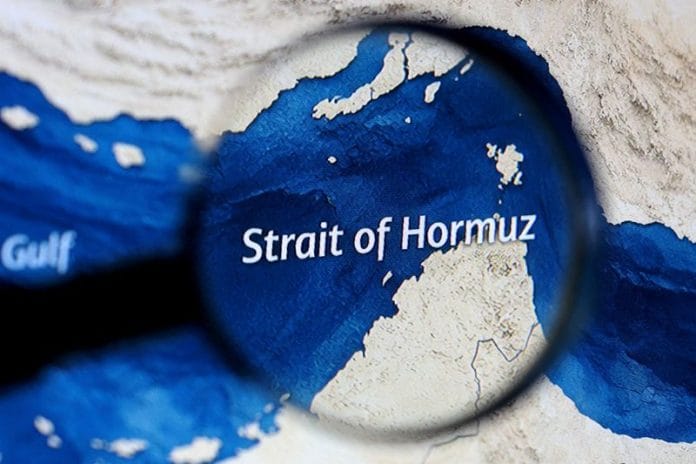
I learned about Thomas Friedman’s idea that “the world is flat” in my AP World History class last year. The theory — that globalization has leveled the playing field and made every corner of the Earth deeply connected — seemed like an abstract concept then. Today, it is playing out in a way that even my textbook couldn’t have predicted, and the proof is a 21-mile-wide strip of water between Iran and Oman called the Strait of Hormuz.
Since late February 2026, following joint military strikes by the United States and Israel on Iran, the Islamic Revolutionary Guard Corps (IRGC) has effectively shut down the strait — one of the most critical maritime chokepoints for global energy trade. The ripple effects have been nothing short of staggering, and they hit close to home for all of us, whether we live in Fort Worth, Tokyo, or Nairobi.
A Small Waterway, A Giant Wound
The narrow waterway through which a fifth of the world’s oil and liquefied natural gas ordinarily passes has emerged as the most potent weapon in Iran’s arsenal. Think about that for a second. One-fifth of the world’s energy supply flows through a stretch of water barely wider than a large American city. Its two unidirectional sea lanes facilitate the transit of around 20 million barrels of oil per day, representing roughly 20% of global seaborne oil trade.
Oil prices surged faster than during any other conflict in recent history, with Brent crude surpassing $100 per barrel for the first time in four years and reaching as high as $126 per barrel at its peak. This crisis has been described as the most acute supply disruption in the history of the global energy market.
The “Flat World” in Action
When we talk about a flat world, we mean that events in one place immediately ripple everywhere else. The Strait of Hormuz crisis is the most dramatic proof of this I have ever seen in my lifetime.
Fuel crunches are hitting Asia and will soon start spreading west. Europe is likely to face surging prices to secure energy cargoes and is at risk of diesel shortages in the coming weeks. Even in the United States, gasoline and diesel prices have jumped, though many in the industry expect America to be one of the last places to be hit, because it is less reliant on Hormuz than buyers in Asia.
And it doesn’t stop at fuel. Petroleum is used to make plastics, which are used in just about everything. The shoes on your feet, the packaging on your lunch, the parts inside your phone — all of it traces back, in some way, to petrochemicals. When the strait closes, the entire supply chain shudders.
Other commodity markets to suffer price increases from the crisis include aluminum, fertilizer, and helium. Fertilizer shortages during planting season are now threatening food supplies in developing nations. That means a conflict in the Persian Gulf could affect what ends up on dinner tables in sub-Saharan Africa or South Asia. If that isn’t a flat world, I don’t know what is.
Diplomacy Goes Global Too
What’s fascinating is that the flatness of the world is showing up in the solutions to this crisis, not just the problems it creates. Iran agreed to allow 20 Pakistani-flagged vessels to transit the Strait of Hormuz, with Pakistan’s foreign minister announcing that two ships would cross daily under the arrangement. Iran also separately permitted ships from China, Russia, India, Iraq, and Pakistan to transit, while Malaysia and Thailand gained access after talks with Iran’s president.
Geopolitics is no longer a game played only by superpowers behind closed doors. Medium-sized nations like Pakistan are now critical mediators in a crisis that affects every country on Earth. That’s globalization in real time.
What This Means for My Generation
I used to think wars and energy crises were things that happened far away and didn’t really affect me. The Strait of Hormuz crisis has shattered that illusion completely.
The International Maritime Organization has warned of 20,000 seafarers stranded in the Strait of Hormuz. These are real people — workers, families — caught in the crossfire of a geopolitical standoff. And the economic shockwaves they’re experiencing will reach my community too, in the form of higher gas prices, pricier groceries, and supply chain delays.
Thomas Friedman was right. The world is flat. And the Strait of Hormuz crisis of 2026 is the starkest reminder yet that in our interconnected world, no one gets to sit on the sidelines.
These pieces are being published as they have been received – they have not been edited/fact-checked by ThePrint.