




Thank you dear subscribers, we are overwhelmed with your response.
Your Turn is a unique section from ThePrint featuring points of view from its subscribers. If you are a subscriber, have a point of view, please send it to us. If not, do subscribe here: https://theprint.in/subscribe/
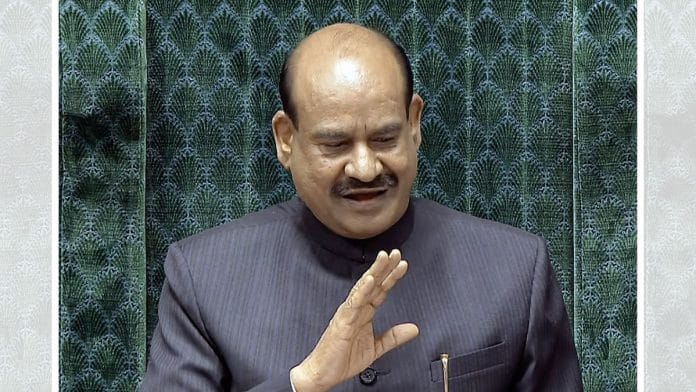
In any parliamentary democracy, the office of the Speaker is sacrosanct. Entrusted with the responsibility of safeguarding the rights of all elected representatives, the Speaker is expected to operate above party politics, ensuring fair debate and impartial governance of the House. Yet, recent events have cast a shadow over Om Birla’s tenure as Speaker of the Lok Sabha, raising legitimate questions about his impartiality and ethical responsibility. Given the mounting evidence of bias and selective conduct, it is now imperative that Om Birla accept moral responsibility and resign — not because the law demands it, but because the very credibility of India’s parliamentary democracy depends on it.
The controversy stems from repeated allegations by opposition MPs that Speaker Birla has consistently favored the ruling party. Reports indicate that opposition members were systematically denied adequate speaking time, while procedural rules were applied inconsistently. MPs have cited instances where disruptions by the ruling party were overlooked, yet even minor dissent from opposition benches was met with harsh warnings or suspensions. Such behavior directly contradicts the constitutional expectation that the Speaker must act as a neutral arbiter. When the individual at the helm of parliamentary proceedings demonstrates partiality, it erodes not only the authority of the office but also the trust of the electorate in the democratic process.
The opposition’s response has been formal and pointed: a no-confidence motion against Om Birla. While the motion does not guarantee removal, it serves as a public declaration that a substantial section of India’s legislature perceives the Speaker as biased. Opposition leaders have argued that Birla’s conduct has compromised parliamentary decorum and weakened minority rights within the House. More importantly, they have insisted that, beyond legalities, there exists a moral imperative for resignation — a standard of ethical responsibility that should guide every high-ranking public officeholder.
Critics may argue that presiding over a House of 545 MPs from multiple parties is inherently challenging, and that occasional criticism is an unavoidable part of the Speaker’s role. Supporters of Om Birla claim that the no-confidence motion is politically motivated, intended to undermine his authority without substantive grounds. Yet such defenses fail to address the deeper issue: perception of fairness is as important as procedural compliance. Even if Birla’s actions were technically permissible, the repeated and documented complaints of bias reflect poorly on the integrity of the Speaker’s office. Public confidence in parliamentary democracy cannot thrive under a cloud of perceived partiality.
Moreover, ethical leadership requires acknowledging mistakes or misjudgments, especially when they impact the functioning of a national institution. By refusing to step aside, Birla risks entrenching a narrative that political loyalty outweighs constitutional duty. The Speaker is not merely a procedural facilitator; he is the custodian of democratic fairness. When the public perceives that the Speaker prioritizes partisan interests over institutional integrity, the repercussions extend far beyond the parliamentary chamber. It sets a dangerous precedent: that high office can be wielded as a tool of political advantage rather than as a guardian of democratic norms.
The moral responsibility of resignation is particularly urgent in light of India’s current political climate. Increasing polarization has already strained the functioning of the Lok Sabha, with legislative debates often devolving into chaos and protest. In such a scenario, leadership that commands trust across party lines is essential. By stepping down, Om Birla could defuse tension, restore faith in parliamentary neutrality, and reaffirm the principle that ethics and public trust supersede personal or party interests. Failure to do so risks further erosion of the very foundations of India’s representative democracy.
It is also important to note that moral responsibility does not imply admission of illegal conduct. Rather, it recognizes that the Speaker’s effectiveness and the credibility of the House depend not only on adherence to procedural rules but also on the perception of fairness and integrity. Ethical leadership, in this context, entails putting the institution above individual reputation or political allegiance. In resigning, Birla would demonstrate a commitment to these higher standards, offering a template for accountability and ethical conduct for future officeholders.
In conclusion, the case against Om Birla is not merely a matter of partisan disagreement; it is a question of ethics, institutional integrity, and democratic principle. By continuing in office amid serious allegations of bias, he risks diminishing the authority of the Speaker’s office and undermining public confidence in parliamentary governance. Accepting moral responsibility and resigning is the only path that honours the ethical and constitutional expectations of his role. In doing so, Om Birla would not only preserve the dignity of his office but also reinforce the values that underpin India’s democracy. Leadership is measured not only by power exercised but also by the courage to act rightly when trust is threatened — in this instance, resignation is the measure of that courage.
These pieces are being published as they have been received – they have not been edited/fact-checked by ThePrint.