




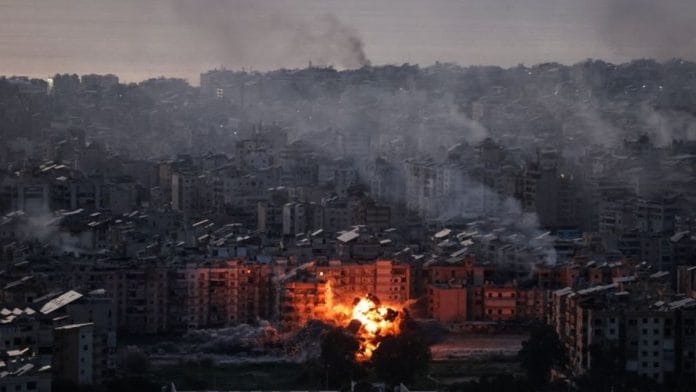

Iran’s recent missile and drone attacks on the United Arab Emirates, Saudi Arabia, Qatar, Bahrain, Kuwait, and Oman have called into question the long-held belief that wars would be fought across the Persian Gulf instead of around it. The Gulf monarchies, which were rich, connected to the rest of the world, and protected by outside powers, saw themselves as stable areas in a region that was always changing.
The End of Politics Based on “Safe Distance”
In the past, Gulf states settled disagreements from a distance. They had military bases, kept strategic alliances, and did proxy politics without actually fighting. Iran’s attacks ruined that model. Tehran’s attacks on countries that host US military bases or make it easier for Western powers to be present show a clear belief that being close means being involved.
The UAE’s airports, oil infrastructure, and logistics networks have come under fire, even though the country claims to be a global business center and not a military power. Attacks on Qatar’s LNG infrastructure have been planned because it is home to one of the largest US military bases in the region. Bahrain, which is home to the US Fifth Fleet, has had problems with its refineries. This isn’t a coincidence. It is calibration.
The UAE is in a unique position in this fight. Unlike Saudi Arabia, which has long been a direct regional enemy of Iran, the UAE has built a reputation for being geopolitically pragmatic, balancing its ties with Iran, the US, and even China. However, this balancing act has not kept it safe. Iran’s attacks on the UAE have symbolic meaning: they challenge the idea that economic interconnectedness provides security; they weaken the UAE’s position as a “safe hub” for global capital; and they show how vulnerable systems can be when they are too centralized. Dubai’s status as a global aviation and trade hub depends on predictability. Missile alarms and drone interceptions hurt not only physical infrastructure but also investor confidence, which is much harder to rebuild.
Oman is probably the best example. Oman has long been seen as a neutral mediator and diplomatic link between Iran and the West, staying out of regional wars. Its ports, Duqm and Salalah, have been neutral places for trade.
Oman has still been hit by drone strikes, though. As geography becomes more important, being neutral is no longer a shield.
Oman is important because it is located on important shipping routes, no matter what its political stance is. In the current conflict logic, importance and weakness are the same thing.
The Infrastructure War and Its Effects on the World
The focus on infrastructure instead of land is what makes this stage of the battle different. This is a war that has been fought.
- Disruption in the supply chain
- Energy bottlenecks
- Economic signaling
The Strait of Hormuz is still very important. Any long-lasting unrest here has effects on the whole world right away:
- Fluctuations in oil prices
- LNG supply problems
- Shipping insurance costs are going up.
The attacks on Qatar’s LNG facilities are very important. Oil gets a lot of attention in the news, but LNG is becoming more and more important for countries that are moving away from coal, like India. Even though there have been many strikes, Gulf governments have mostly avoided directly attacking Iran with military force. This restraint is not a sign of weakness; it is a planned choice.
- Risk that is not equal.
Iran has shown that it can hurt others with cheap weapons like drones and missiles. However, if the Gulf governments keep fighting for a long time, they will lose a lot more.
- Economic Risk.
Tourism (UAE, Oman), financial services (Dubai, Doha), and energy exports from Saudi Arabia and Qatar. These economies are not set up to handle long-term wars.
Conclusion:
Iran’s attacks on the UAE and its neighbors are not just revenge; they also mark the end of a long-standing agreement in the region.
The Gulf is no longer a safe place. It is now a war zone. The effects go beyond West Asia. The energy markets around the world are getting more and more unstable.
It’s harder to stay strategically neutral.
The main battleground is now infrastructure. In this new world, being able to survive will depend more on being strong in terms of your economy, infrastructure, and strategy than on your relationships. In the Gulf today, the question isn’t whether there will be conflict, but how deeply it will affect things that have never been touched before.
These pieces are being published as they have been received – they have not been edited/fact-checked by ThePrint.