





Thank you dear subscribers, we are overwhelmed with your response.
Your Turn is a unique section from ThePrint featuring points of view from its subscribers. If you are a subscriber, have a point of view, please send it to us. If not, do subscribe here: https://theprint.in/subscribe/
Economic headlines can sometimes obscure the full picture. A lower tariff percentage may sound more reassuring than a higher one. However, competitive advantage should not be determined by headline rates alone. We must instead examine the tariff differences among competitors, and at the relative price parity of production costs.
Consider a simple example. If a shirt from a competing country costs $20 on the shelves of a U.S. mall, a similar shirt from India cannot be priced at $23 without losing business. But if every comparable shirt in that mall costs $25, Indian-made shirts can also sell at $25. Consumers compare only the final shelf price, while a manufacturer’s balance sheet accounts for production costs and revenue. Suppose the U.S. imposes a uniform tariff of $5 on every $20 shirt entering the country. The relative position of Indian exporters remains unchanged because no supplier gains an advantage in the final retail price. However, if India negotiates a tariff of $3 while others pay $5, then Indian exporters can land the shirt in the U.S. at a lower cost. Importers can then price it anywhere between $23 and $25, allowing Indian suppliers to increase market share without losing on their profit margins.
This is how tariff differentials become relevant. Tariff differentials between competing exporters may redirect sourcing decisions and tilt market access in favour of one country. In contrast, uniform tariffs preserve the relative order among exporters. This distinction is essential to understand both India’s recent trade negotiations with Washington and the implications of the latest judicial developments in the United States.
Balancing Trade Concessions and Policy Autonomy
Tariffs are applied to export prices, which in turn are dependent on underlying cost functions. If production costs in one country are structurally higher because of differences in labour and raw material costs, then 15% on that higher base can still yield a more expensive final product than 18% on a lower base. Therefore, competitiveness depends on the total cost equation, not on percentages alone, unless the underlying prices are comparable. Hence, an 18% tariff on India could still be more favourable than a 15% tariff on the EU.
Moreover, tariff rates are rarely standalone concessions. They are embedded in broader packages of financial commitments and strategic alignments. Some recent U.S. trade agreements lowering tariffs with countries such as Japan (15%) or South Korea (15%) were accompanied by significant investment pledges into the American economy and commitments to substantially reduce non-tariff barriers in their markets to American goods. A lower tariff secured in exchange for heavy capital obligations and regulatory concessions is not directly comparable to a slightly higher rate achieved without such commitments.
India’s approach in its interim agreement with the United States aimed to preserve sensitive sectors such as agriculture, dairy and fisheries while avoiding large, binding investment commitments. The objective therefore was not merely to secure the lowest headline number, but to balance tariff relief with policy autonomy. India made minimal concessions on agriculture in return for a favourable tariff profile. In that respect, India’s negotiations yielded a balanced and well-calibrated outcome.
From Severe Disadvantage to Narrowed Gap
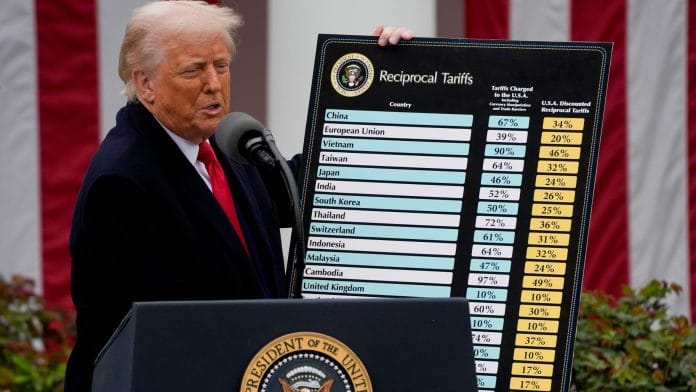
U.S. duties on Indian exports escalated sharply in 2025, reaching a total of 50%. These were among the highest rates applied to major trading partners. The damage was significant because the differential was heavily negative. Several Asian competitors operated with much lower rates. In price sensitive industries such as textiles, leather goods, etc., even a small gap can decisively alter procurement decisions.
Reducing tariffs to roughly 18% on a substantial share of exports dramatically reversed this large differential disadvantage to a small positive advantage. In addition, a significant portion of India’s exports such as generic pharmaceuticals continue to remain duty free or at lower rates. This marked a major repositioning within the competitive hierarchy. Indian industries moved into a relatively advantageous tier, with only a few countries, such as the UK, Japan, and South Korea, truly operating at better tariff.
Rebalance Now Before Signing the Deal.
On 20 February 2026, the Supreme Court of the United States struck down the sweeping tariff regime imposed under emergency powers. In response, President Donald Trump temporarily introduced a uniform baseline 15% tariff under a different law.
This development materially alters the competitive structure under which the interim India–U.S. understanding was negotiated. India calibrated its concessions in exchange for a measurable reduction in tariff disadvantage relative to competing exporters. If U.S. tariffs now move toward uniformity, that relative gain is diminished or erased.
Trade agreements must bring mutual and meaningful gains. An agreement negotiated under one competitive structure cannot remain equally meaningful under another. An appropriate response from India is to seek a rebalancing of the deal. India must secure new tariff concessions that provide a similarly distinct competitive advantage for its exporters.
These pieces are being published as they have been received – they have not been edited/fact-checked by ThePrint.