





Thank you dear subscribers, we are overwhelmed with your response.
Your Turn is a unique section from ThePrint featuring points of view from its subscribers. If you are a subscriber, have a point of view, please send it to us. If not, do subscribe here: https://theprint.in/subscribe/
For decades, Jammu and Kashmir’s trade policy has been almost entirely focused on external access—routes, markets, logistics, and exports. Apples depart the Valley, raw walnut kernels are shipped out, saffron travels as a branded luxury, and horticulture remains the primary source of rural income. However, the critical question is rarely asked: how much value is truly retained inside the region?
Internalizing commerce does not mean leaving markets or protecting the economy. It means changing business so that production, processing, jobs, and ownership are all done in the same place instead of sending raw materials to other countries and paying a lot for finished goods. This line of thinking is most clear and convincing in Jammu and Kashmir when it comes to community-led food processing, especially activities that involve apples, like making jam, extracting pulp, dehydrating food, and packing it.
The Apple Paradox
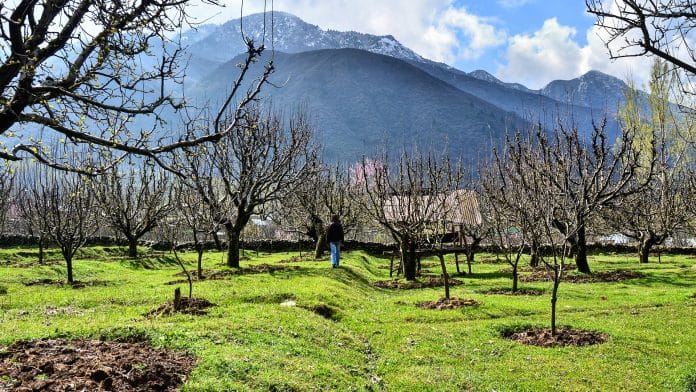
Jammu and Kashmir grows about two million metric tonnes of apples every year, which is about 75% of India’s total apple production. But a lot of apples, especially those that aren’t very good, don’t get a fair price. There are big losses after harvest, not everyone has access to the cold chain, and small orchardists are hit harder by price changes.
At the same time, the market for apple-based goods like jams, concentrates, baby food, drinks, and pastry ingredients is growing quickly in the US. Ironically, many of these needs are met by processing plants located outside the area or by international companies that get raw materials cheaply and make money in other places. The outcome is the same: Jammu and Kashmir sells goods but buys profits. Internalizing trade wants to change this trend.
From fresh fruits and vegetables to businesses in the area
Community-based places to make jam and process food could be a way in. These are not just ideas; they are proven models from Himachal Pradesh, Uttarakhand, and other parts of the Northeast. Three things happen when processing plants are built close to orchards.
First, adding value stays local. Even simple processing steps like grading, pulping, and bottling can greatly boost farmers’ income, especially for fruit that would otherwise go to waste. Second, employment expands beyond agriculture. Food processing units employ local workers, particularly women, who are frequently excluded from formal horticulture revenue despite being essential to orchard work. Jam-making, packaging, quality testing, and branding are labor-intensive operations that are best suited to decentralized, community-based institutions. Third, the risk is spread. Farmers who are co-owners or stakeholders in processing plants are less exposed to price drops and market manipulation by middlemen.
In this way, trade is transformed into a local economic ecosystem rather than a simple exterior transaction.
Why Policy Support is Not Unified
Even though national policy texts keep saying “vocal for local” and “agri-processing,” Jammu and Kashmir has not been able to follow through on these ideas. Subsidies often help businesses that need a lot of capital, which small businesses can’t get. Village-level businesses still have a hard time with licensing, food safety certification, and following the GST rules. The most important thing is that there is no help with branding or access to markets.
To make commerce work better, we need a different policy lens that puts cooperatives, self-help groups, and businesses linked to panchayats ahead of individual private investments. Policymakers shouldn’t just look at how much was exported to see if it was successful. They should also look at how many jobs were created for every tonne processed. How much money stayed in the district?
Public procurement could help speed up this process. Schools, anganwadis, hospitals, and public distribution systems can all get food from local farms, which makes sure that there is always a demand for it. This isn’t protectionism; it’s a planned way to make people want something.
The Importance of Trust and Institutions
Trade internalization is an economic and institutional event. Community businesses, like farmers, processors, and local governments, need to trust each other in order to work. People are right to be skeptical because they have had problems in the past with late payments, middleman exploitation, and regulatory roadblocks. Local institutions, such as cooperatives, producer businesses, and women’s collectives, must be strengthened before scaling can occur. Transparent pricing, shared ownership models, and technical assistance are equally vital as financial incentives.
Universities, agricultural extension services, and local non-governmental organizations (NGOs) can serve as knowledge mediators, assisting with quality control, branding, and compliance rather than leaving communities to traverse these systems on their own.
Beyond Apples: A Replicable Model
While apples are the most obvious example, the logic applies to walnuts, cherries, apricots, saffron-infused items, and even herbal compositions rooted in the region’s biodiversity. Internalizing trade across these sectors can help Jammu and Kashmir transition from a raw-produce economy to a processing-led regional economy.
Such a transformation will not occur overnight. However, without it, the region risks being permanently vulnerable to weather shocks, market volatility, and external disturbances. In contrast, regionally embedded value chains provide resilience. It’s no longer a question of whether Jammu and Kashmir should join national and global markets. That integration is already there. The real question is: under what conditions.
Internalizing trade through community employment, local processing, and shared ownership offers a mechanism for reconciling economic growth with social stability. Businesses that make jam may seem small, but they are part of a bigger change: moving from exporting resources to developing economies and from being dependent to being involved. People must come before markets in trade policy at some point. And in Jammu and Kashmir, the journey must begin at home.
——————————————————————————————————
About the authors:
Anusreeta Dutta is a columnist and climate researcher with experience in political analysis, ESG research, and energy policy.
Zahid Sultan (Kashmir Based Independent Researcher)
These pieces are being published as they have been received – they have not been edited/fact-checked by ThePrint.